Capacity is AI customer service software for mid-market and enterprise contact centres, covering AI agents, agent assist and integrations.

We pulled apart Capacity's vendor documentation, cross-referenced it with whatever user feedback we could surface, and ran into an immediate problem: this tool barely exists on G2 or Capterra. No rating. Almost no review trail. For a platform claiming 20,000 customer organizations and 1.5 million users, that's a strange gap. This Capacity review is built from what we could find, which means their own docs, public case study language, and the handful of third-party mentions floating around. Keep that in mind as you read.
Capacity was founded in 2017, headquartered in St. Louis, and has spent years positioning itself as the one platform that replaces a stack of point solutions in the contact center. Big claim. The 36.3 billion automated interactions figure on their homepage is the kind of number that either means something or gets quietly updated every quarter. We genuinely don't know which.
What is Capacity?
An AI customer support platform aimed at mid-market and enterprise contact centers. The core pitch is consolidation: one place for AI agents, live agent support, outbound campaigns, and automated quality assurance. No separate chatbot vendor. No separate QA tool.
The thing they seem most proud of is what they call the AI Knowledge Orchestration Layer. The idea is you train the AI once, and that knowledge flows across every channel and workflow automatically, voice, chat, SMS, email, web. It's a sensible architectural decision, assuming it works as described. We couldn't verify that from the outside, and that's our honest limitation here.
On the model side, Capacity combines internally hosted and in-house AI components with external models such as GPT-4. Their private model option is based on Llama 3.1. That's a more complicated picture than most vendors present, and honestly, it raises as many questions as it answers about where the actual AI quality comes from on any given interaction.
Capacity Features: Chatbot, Helpdesk & Support Automation Breakdown

The feature list is long. The AI agent handles inbound inquiries across voice and chat. There's an email AI agent too, though that one uses per-response usage pricing, which we'll get to. Helpdesk and ticket automation come in Core. Live chat and a shared inbox land in Pro and above.
The AI Agent Builder lets teams train the bot on their own data through indexing, which is confirmed in the Core plan. That's table stakes now across most serious competitors, but Capacity's "train once, use everywhere" framing suggests they've built it more centrally than most. Intercom, for comparison, requires more per-channel setup work.
Agent Assist is the real-time guidance layer for human agents, confirmed in Pro tier. It includes sentiment analysis and live suggestions during active conversations. The handover from bot to human is part of the same system, not a third-party integration bolted on. That matters. We've seen plenty of platforms where the handover is technically present but operationally janky. Whether Capacity's version holds up in practice, we genuinely can't say.
Outbound campaigns are included at Enterprise. Automated QA is another piece. Both are unusual to find bundled at this level rather than sold separately. Fair.
Capacity Bot Quality: How Well Does It Handle Real Customer Queries?
This is where our research hits a wall. No G2 reviews. No Capterra reviews. No Trustpilot presence. Not normal for a seven-year-old platform with their claimed user numbers.
What we did find: their documentation emphasizes context-aware responses across channels, and the Knowledge Orchestration Layer is supposed to keep answers consistent wherever the conversation happens. That's the theory. The absence of third-party validation makes it impossible for us to say how well the bot actually handles edge cases or ambiguous queries in the wild.
We're skeptical. Not because the claim sounds implausible, but because we can't find anyone outside the company saying it's true. That's a due-diligence gap buyers should fill before signing anything.
Capacity Channel Coverage: Which Platforms Does It Support?
Coverage is genuinely broad. Voice, web chat, SMS, and email are all confirmed, plus web widgets. On the integration side, Salesforce and ServiceNow cover the CRM layer. Microsoft Teams and Slack handle internal comms, and a few others fill out the telephony side, including RingCentral and AWS Connect.
Shopify isn't listed, which means e-commerce teams should look elsewhere. Gorgias is the obvious alternative for that use case. Capacity is clearly built for internal-facing and enterprise contact center work, not consumer retail support.
Multilingual support is not publicly detailed. That's a meaningful gap for any team supporting non-English-speaking customers. English-first is fine for many buyers, but it needs confirming directly with their sales team before you commit. We'd want that in writing.
Is Capacity Easy to Set Up and Manage?
This section is where our research runs thinnest. No user accounts of onboarding. No Reddit threads about implementation. Nothing from community forums, because there isn't one.
What we can infer: the platform's breadth suggests complexity. Voice AI, helpdesk, outbound campaigns, QA automation, and a custom knowledge layer are not things that snap together in a weekend. The developer platform lands in Pro tier and above, which implies real technical setup is expected at that level. Core gets 100GB storage. Pro bumps that to 1TB, and Enterprise goes to 2TB. Those are meaningful infrastructure differences, not cosmetic tier distinctions.
Their homepage mentions AI agents that "continuously improve with each interaction." That kind of self-improving claim is common marketing language, and we've seen it mean everything from actual reinforcement learning to someone manually reviewing flagged tickets every month. We don't know which it is here. Worth asking directly.
No free trial means you're going into a demo-first sales process. Standard for enterprise software, but it means there's no way to poke around the interface before committing to a conversation with a salesperson. Not great.
Capacity Pricing: Is It Worth It for Support Teams?
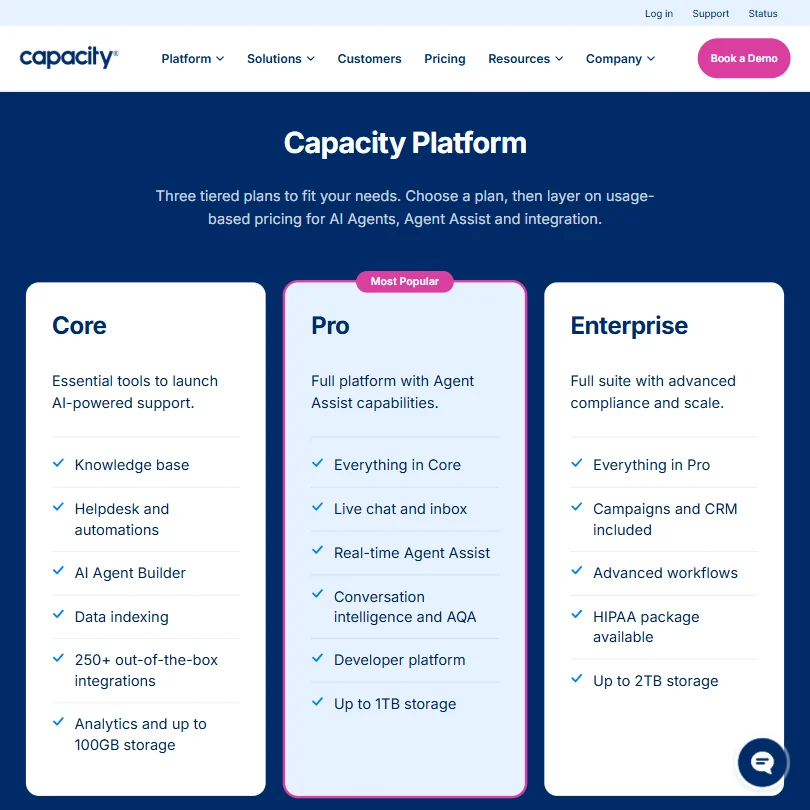
Three tiers: Core, Pro, and Enterprise. No prices publicly listed for any of them. Not even a starting range.
That's a problem. Not unusual at enterprise level, but it means every buyer is flying blind until they're already in a sales conversation. The email AI agent uses per-response pricing on top of whatever the base plan costs. That's an additional variable that could make cost forecasting genuinely difficult for high-volume teams.
Campaigns and CRM are locked to Enterprise. The developer platform starts at Pro. Live chat and the shared inbox, also Pro and above. Buyers who want anything close to the full platform will almost certainly land on Pro at minimum, and quite possibly Enterprise. At undisclosed prices, that's a real commitment to make on faith.
No free plan. No trial. No public refund policy. We don't love that combination. It shifts all the pricing risk to the buyer.
Capacity vs Intercom: Which Customer Service AI Wins?
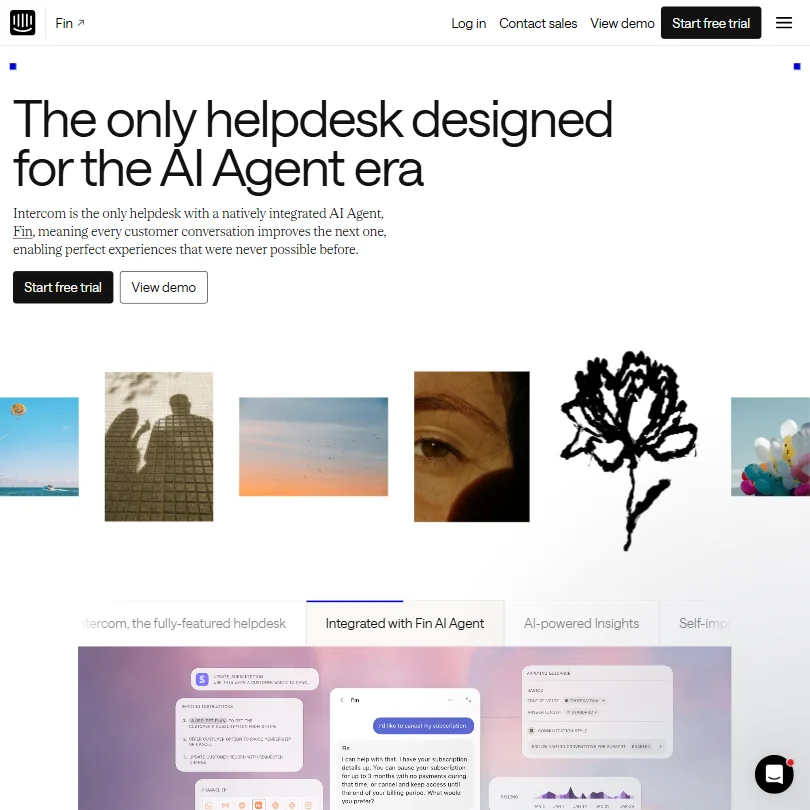
Intercom is the obvious comparison. Both target mid-market and enterprise, both include AI agents and live chat, and both claim to reduce support costs at scale.
Intercom publishes its pricing. Capacity doesn't. That alone changes the evaluation process significantly. Intercom's Fin AI agent is well-documented in the wild, with real user feedback about resolution rates. You can read our breakdown of Fin if you want a direct comparison. Capacity has nothing equivalent publicly available.
Where Capacity theoretically pulls ahead: the breadth. Outbound campaigns, automated QA, voice AI, and a unified knowledge layer in one platform is more than Intercom offers out of the box. Capacity's all-in-one positioning makes the most sense for teams currently paying for separate QA software and campaign tools alongside their support platform. That's a real consolidation argument. Whether the individual modules match best-in-class standalone tools, we can't confirm.
Intercom also has a much larger public review base. That matters during evaluation. Capacity's lack of verifiable user reviews is the most uncomfortable part of recommending it to anyone.
Who Should Use Capacity? (And Who Shouldn't)
Enterprise contact centers managing complex stacks. Teams juggling four or five vendors across voice, email, chat, and QA review are the ones most likely to benefit from consolidation here. That's the real fit.
Small businesses. Not the fit. No free tier, no trial, likely five-figure annual contracts, and a sales-led process. The overhead doesn't make sense below a certain team size.
E-commerce brands on Shopify. Look elsewhere. The integrations aren't there, and Capacity's architecture is built for a different kind of support operation entirely.
Non-English-speaking markets. Get clarity from sales first. The multilingual gap is real, and the documentation doesn't address it.
Capacity Review Verdict
Genuine ambition here. The unified knowledge layer, the bundled QA, the voice-plus-chat-plus-email coverage, it's a meaningful platform for the right buyer. We're not dismissing it.
But the review trail problem is serious. Seven years old, 20,000 claimed customers, and almost nothing on the major review platforms. That gap either means their customers are locked in enterprise contracts with NDAs, or the product hasn't built the kind of loyalty that prompts people to write reviews. We can't tell which. That opacity is the single biggest thing holding Capacity back from a stronger recommendation.
The pricing invisibility compounds it. No trial, no published rates, no refund policy. Buyers who want transparency before they commit will find this frustrating. That's a fair frustration.
What we'd want before recommending it without reservation: published pricing, real user reviews from outside the company, and clarity on multilingual support. Until those gaps close, Capacity is worth evaluating seriously if your needs match, but not worth signing off on without significant due diligence.
Frequently Asked Questions
Does Capacity offer a free trial?
No free trial and no free plan. You'll need to go through their demo process to see the platform. That's a meaningful time investment before you know if the product fits your needs, so come to that conversation with specific requirements written down.
What integrations does Capacity support?
The confirmed list covers Salesforce and ServiceNow on the CRM side, plus Slack and Microsoft Teams for internal comms. RingCentral and a few others fill out the telephony layer. Shopify isn't on the list. API access is available on Pro tier and above for custom connections.
How does Capacity compare to other AI customer service platforms?
The main differentiation is breadth: voice AI, helpdesk, outbound campaigns, QA automation, and a unified knowledge layer in one product. Most competitors require separate tools for at least some of those functions. The catch is that Capacity's individual modules can't be independently benchmarked against best-in-class standalone tools, because there's almost no public user feedback to compare against.