Sudowrite is a tool that's genuinely different from most AI writing products, not because it claims to be, but because it skips the whole marketing-copy use case entirely. Fiction writers and novelists are the target. That's it.
What is Sudowrite?
Founded in 2020 and based in San Francisco, Sudowrite is an AI writing tool built specifically for fiction. Not blog posts. Not ad copy. Novels, screenplays, short stories. The company runs a mix of models underneath, including Claude by Anthropic and OpenAI models, plus their own proprietary Muse model, which they built specifically for creative writing. That last part matters. Most AI writing tools are repurposed business-copy machines with a "creative mode" tacked on. Sudowrite was designed from scratch for narrative work.
Project Folders and the Feedback feature both got their own documentation passes, and the Android app has been updated too. Not major releases, but they suggest a product that's still being actively maintained rather than quietly left to coast.
Sudowrite Features: What You Actually Get
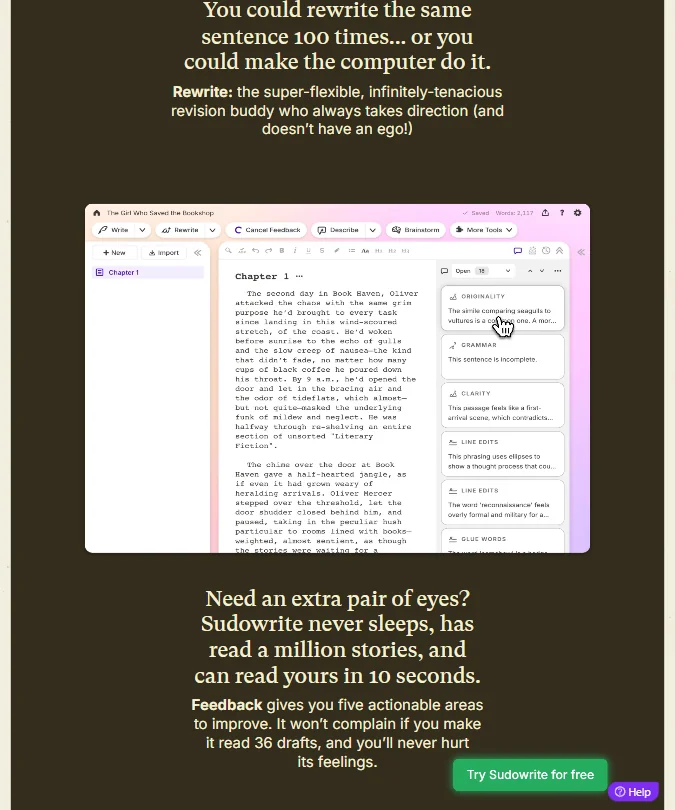
The feature set is narrower than a general-purpose writing tool. Deliberately so. Write generates new scenes or passages. Expand develops a short scene into something longer with attention to pacing. Rewrite lets you revise with directional prompts like "more tension" or "Show Don't Tell." Describe generates sensory detail. Brainstorm surfaces plot ideas and character questions.
Then there's the Story Bible, which is where Sudowrite earns its keep for long-form work. It's a structured worldbuilding and character-consistency layer. You feed it your character details, setting rules, and lore, and the AI is supposed to hold that context while it generates. Screenwriters and novelists working across multiple chapters said in community threads that this was the feature that kept them on the platform.
Canvas is a visual outlining tool. Visualize generates reference art from your character or setting descriptions. Honestly, that surprised us. An image generation feature inside a fiction writing tool is either brilliant or a distraction, and the jury's still out.
There's also a community-built plugin ecosystem with over a thousand entries. Reader simulation, screenplay formatting, character dialogue tools, and a few others. The breadth is real, though quality varies considerably across user-built plugins.
No grammar checker in the traditional sense. No SEO features. No API. Those aren't oversights. They're intentional non-goals.
Sudowrite AI Output Quality: Is It Good Enough?
General-purpose tools like ChatGPT can write fiction, but the output tends toward the generic.
The Muse model seems to handle show-don't-tell better than vanilla GPT outputs. The Feedback tool is documented as a distinct feature rather than an afterthought.
Longer works still require a lot of human correction. The AI can drift out of character consistency even with a Story Bible in place. We don't buy the idea that it solves continuity problems entirely. It helps. It doesn't solve.
Is Sudowrite Easy to Use?
Web-based, with an Android app that's been updated recently. No Chrome extension, though. The in-app editor has focus mode and chapter organization, which helps, but you're still largely locked into their environment.
The learning curve on tools like Story Bible and Canvas is moderate. The plugin ecosystem adds power but also complexity. Knowing which community plugin to trust takes time.
We've seen worse onboarding. But we've also seen better.
Sudowrite Pricing: Is It Worth the Cost?
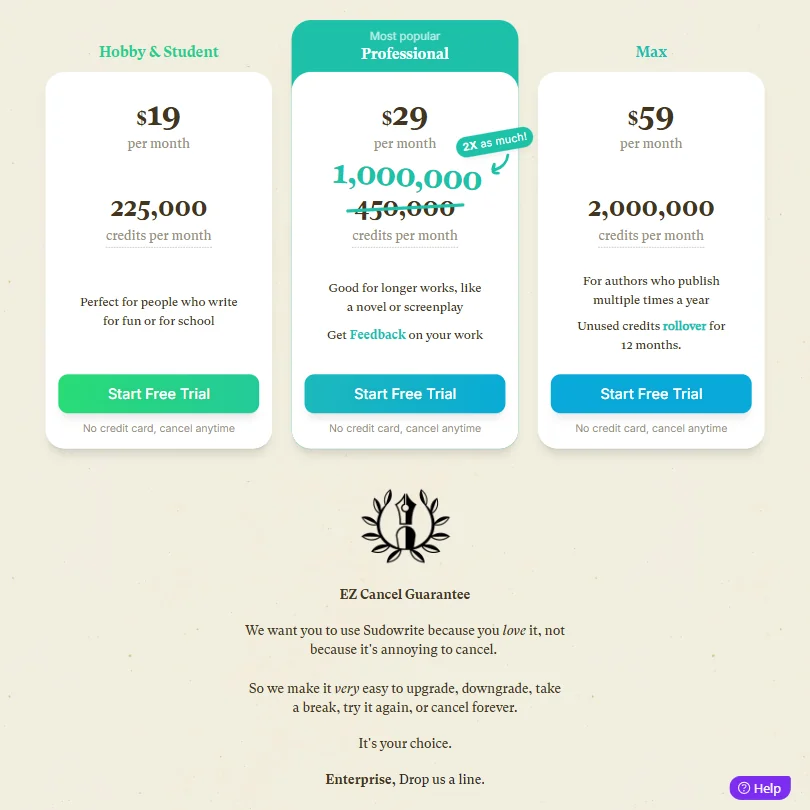
Three tiers. Monthly billing runs $19 for Hobby and Student, $29 for Professional, and $59 for Max. Annual billing drops those to $10, $22, and $44 per month respectively, which is a meaningful difference if you're committing for the year.
The Professional plan is currently showing 1,000,000 credits per month, double what it previously offered, with a "2X as much" callout on the pricing page. The Max plan sits at 2,000,000 credits per month, with unused credits rolling over for up to 12 months. That rollover detail matters for anyone who writes in bursts rather than steadily.
A free trial exists, no credit card required. Fair. The refund policy isn't stated publicly, which is frustrating. Not a dealbreaker, but annoying enough that we flagged it.
The value equation works if fiction writing is your primary use case. It falls apart if you want something that also handles emails or blog posts. You're paying for specialization. Make sure you want that.
Sudowrite vs Jasper: Which Is Better?
Not really a fair fight, because they're solving different problems. Jasper AI is built for marketing teams. Brand voice, ad copy, campaign content at scale. It's good at that. Sudowrite doesn't touch any of it.
Flip it around: Jasper is not built for fiction. Its story features exist, but they're not the core product. Sudowrite's Story Bible, Muse model, and narrative-focused Rewrite feature don't have a real equivalent in Jasper.
So the comparison mostly answers itself. Marketing content, go Jasper. Fiction writing, Sudowrite is the more considered choice, and that's where the product depth actually lives.
Who Should Use Sudowrite? (And Who Shouldn't)
Novelists and screenwriters working on long-form projects. That's the fit. The Story Bible and Canvas tools are built for that workflow, and the community plugin ecosystem assumes you're doing serious creative work.
Hobbyist fiction writers trying to get past writer's block. The Hobby and Student tier at $10 a month billed annually exists for exactly that.
Marketing copywriters, bloggers, anyone who needs SEO content should look elsewhere. This tool won't help and doesn't pretend to. Content teams who want something built for business output will be better served by something like Writer, which is designed around brand voice and team workflows.
Sudowrite Review Verdict
Sudowrite is one of the few AI writing tools we've researched that actually earns its niche. The Muse model, the Story Bible, and the community plugin depth add up to something that general-purpose tools haven't replicated. Not yet.
The weak spots are real. No integrations worth naming and a missing refund policy drag on the overall picture.
But for a novelist who's been copying and pasting into ChatGPT and hoping for narrative consistency, Sudowrite is a meaningfully better tool for that specific job. The price is reasonable for what it does. The trial has no credit card friction. Worth starting there.
Frequently Asked Questions
Does Sudowrite work for genres other than literary fiction?
Yes. The Story Bible and Brainstorm tools handle genre tropes reasonably well. The Muse model isn't tuned to a single genre style.
Can Sudowrite replace a human editor?
No, and you shouldn't expect it to. The Feedback tool is useful for catching structural issues and pacing problems. A human editor who knows your genre is still doing different work than an AI critique pass.
Is there a free version of Sudowrite?
No free tier. The free trial doesn't require a credit card, which lowers the risk of testing it. After the trial, the cheapest paid plan runs $10 a month billed annually, or $19 month-to-month. That's the Hobby and Student tier, and it's the entry point for most casual users.