Our research started, as it usually does, with the vendor docs. Then the third-party forums, the public merchant threads, the competitor comparisons. Manifest AI launched in 2022, positioning itself in a space already crowded with Tidio, Gorgias, Rep AI, and a handful of others all making similar claims. The screenshot on their demo page promises 30X ROI in 30 minutes. We cross-referenced that against what we kept seeing from actual users. The gap is instructive.
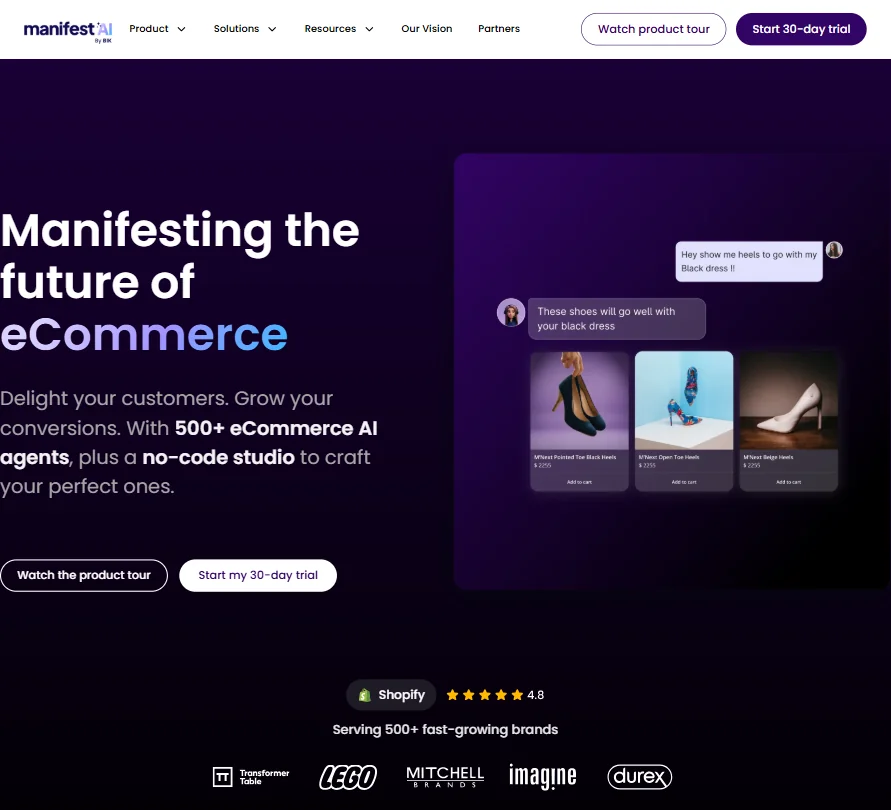
What is Manifest AI?
Not a chatbot. Not a widget. The pitch is a library of pre-built AI agents, 500+ of them, organized across sales, support, and marketing functions. Each one is GPT-based, trained on your brand catalog, and given a name and a role. Jack handles sales. Sarah does support. Jane watches marketing. Brian trains the others. That's the framing from the vendor, verbatim.
It's an unusual product philosophy. Most tools in this category give you one configurable assistant. Manifest AI is selling the idea of a full background team. Honestly, we're not sure yet whether that's a substantive architectural difference or just positioning. The agent personas are real features with distinct scopes, so there's something to it. Whether the division of labor matters in practice is a harder question.
They cite 500+ brands served, their own number, unverified externally. Worth keeping in mind.
Manifest AI Features: Product Listings, Bulk & Marketplace Tools
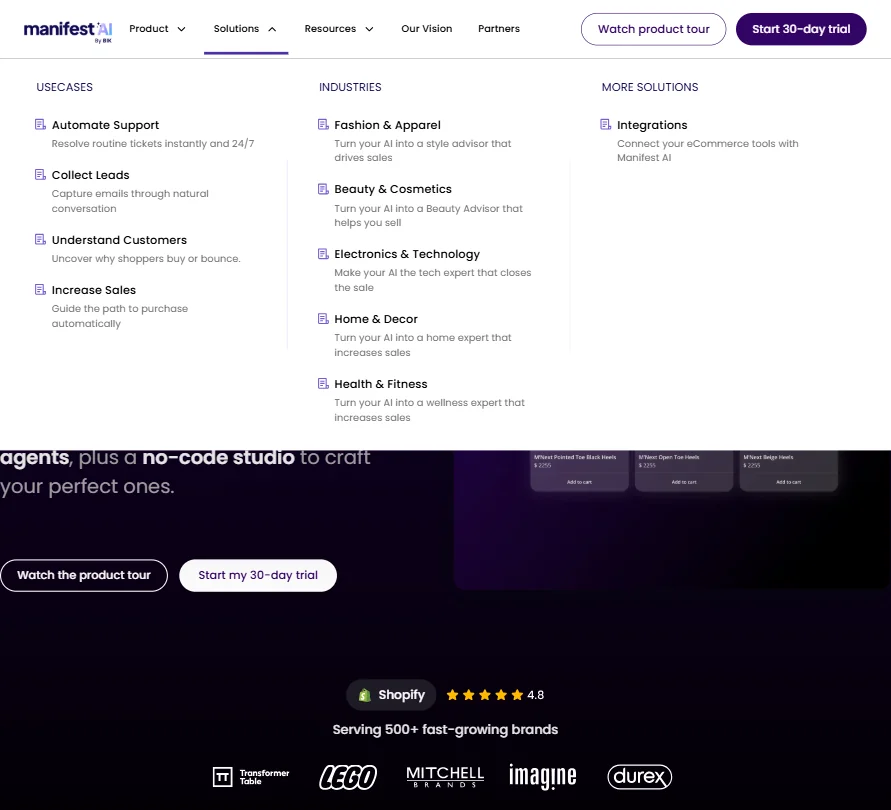
No SEO title optimizer here. No image editor, no batch listing generator. If you arrived expecting something like Hypotenuse AI, which is built explicitly for catalog enrichment and bulk content, you'll leave disappointed. That's a real absence, not a minor gap.
What the platform actually offers is built around conversion. The AI Fit Predictor collects height, weight, and fit preference from shoppers and recommends sizing accordingly. AI Trivia generates product facts to nudge purchase intent. The Customer Reviews agent runs sentiment analysis on existing reviews and surfaces patterns. These are sales tools. Not content tools. The distinction matters a lot depending on what problem you're trying to solve.
Built-in A/B testing is the feature we kept coming back to. You can test agent placements, quiz formats, and PDP widgets without a third-party tool. Fair. Most competitors don't have that baked in at this depth, and we cross-referenced Tidio and Gorgias specifically on this point. Neither does.
Manifest AI AI Writing Quality: Are the Product Descriptions Good?
Wrong framing for this tool. Manifest AI doesn't generate batch product descriptions. The agents respond conversationally in real time, drawing on your catalog data and brand voice as their training source. So the quality question is really about response accuracy and tone consistency, not copywriting output.
From what we kept seeing in merchant-reported threads, quality correlates directly with how clean the input data is. Messy or thin product data going in produces generic, sometimes confused responses coming out. That tracks for any GPT-based system. It's not a knock specific to Manifest AI. But the onboarding documentation isn't detailed enough in public-facing resources for us to say the average merchant will navigate it cleanly.
We're skeptical that a mid-sized Shopify store sets this up without support and gets strong results in week one. The 30-minute ROI framing on the demo page doesn't help calibrate expectations realistically.
Manifest AI Marketplace Support: Shopify, Amazon & Beyond
Shopify is the core. Native integration, order tracking, direct product data sync. That part holds up across everything we read, including merchant-reported experiences. No real complaints there.
Amazon gets a mention in the docs, framed around something resembling an Rufus-style discovery agent. The public documentation on how that actually functions is thin. We wouldn't put weight on Amazon support as a confirmed capability based on what's available to read.
WooCommerce isn't in the docs. Etsy isn't mentioned. This is a Shopify tool. A few peripheral references to Amazon, and that's the full marketplace picture. Don't come expecting broader platform coverage.
Is Manifest AI Easy to Use?
The no-code studio is the headline claim on setup. Build and customize agents without developer involvement. Vendor states seven days to go live, which is a specific number and probably accurate for a clean Shopify store with well-structured catalog data.
More complex setups are where we get skeptical. The help center is described in user threads as basic. Support access appears limited to email and an on-site AI chat. Not great. There is a community called Roaring Ladies of eCommerce, 700+ members, plus vendor-run webinars. We hadn't expected that, and it's a genuine resource, not just a placeholder community page.
No G2 listing exists. No Capterra presence. The total absence of third-party review platforms makes independent due diligence genuinely difficult, and that's not a small issue. It's the main issue. We can't cross-reference ease-of-use ratings, support response times, or onboarding failure rates the way we can with Tidio or Gorgias.
Manifest AI Pricing: Is It Worth It for E-Commerce Sellers?
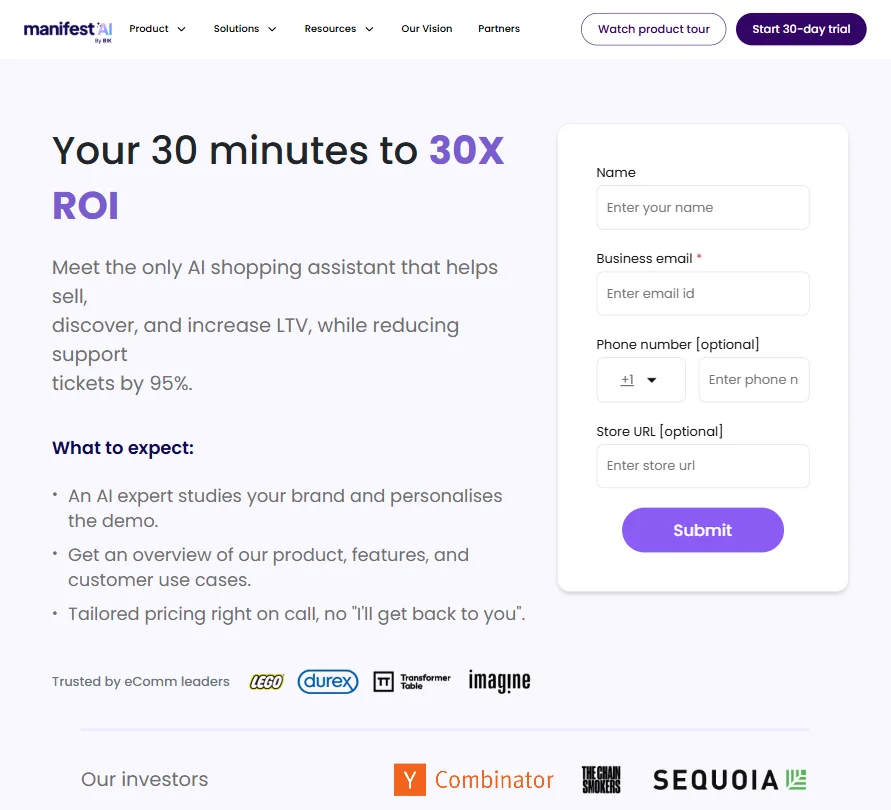
Nothing is public. No tiers, no starting price, no per-agent or per-conversation figures. The demo page, visible in their current web presence, collects your name, business email, store URL, and phone number before anything gets discussed. Pricing comes on the call. Enterprise is custom, presumably.
In our database of 28 reviewed tools in this category, seven offer a permanent free plan. Manifest AI offers a 30-day trial and then a sales conversation with no public anchor. We've seen opaque pricing in SaaS before. Not often this complete, though.
Tidio publishes tiered pricing starting around $29 per month. Gorgias uses a transparent support-ticket-based billing model that merchants can calculate before signing up. Manifest AI offers neither. That's our concern, stated plainly.
Manifest AI vs Tidio: Which E-Commerce AI Tool Is Better?
Tidio has a published pricing page, a free plan, a G2 presence with hundreds of reviews, and it covers Shopify alongside other platforms. It's the more auditable option by a significant margin.
Manifest AI goes deeper on conversion-specific tooling. The AI Fit Predictor, the agent persona structure, the built-in A/B testing capability, these aren't features Tidio matches at the same depth. Manifest AI is also more narrowly focused on driving add-to-cart behavior rather than managing support ticket volume, which is where Tidio's AI features concentrate.
Shopify merchants who want to evaluate options with real pricing data before committing. Tidio wins by default in that situation. Merchants already past the evaluation stage, running at scale, and prioritizing conversion rate lift over helpdesk efficiency. That's where Manifest AI's feature set starts making sense. Two different buying situations entirely.
Who Should Use Manifest AI? (And Who Shouldn't)
Scaling Shopify brands where a 2% improvement in add-to-cart rate justifies a meaningful monthly spend. The fit predictor, the quiz formats, the PDP agent layer. It's designed for that context specifically.
Early-stage stores. Not yet. The pricing opacity alone makes budgeting nearly impossible, and the documentation isn't detailed enough to support a merchant still building out their catalog. Same answer for anyone not on Shopify.
Merchants whose primary need is bulk product content generation rather than conversational sales tooling. Look at Hypotenuse AI instead. It's a more direct fit for that workflow.
Manifest AI Review Verdict
A few things here are genuinely distinctive. The agent library structure, the A/B testing integration, and the fit prediction feature aren't standard offerings in this category. We cross-referenced all three against Tidio, Gorgias, and Rep AI specifically. None of them match all three.
The problems are also real. Pricing opacity this complete is unusual even for early-stage SaaS. The documentation is thin. Third-party review coverage is nonexistent. The demo page collects four fields of contact information before a merchant can learn what anything costs. That's a lot of friction for a tool still establishing credibility.
It sits below the category median in our current database. Not dramatically, but below. Pricing transparency alone could shift that assessment. Until that changes, evaluate it on the trial, not on the homepage promise of 30X ROI in 30 minutes.
Frequently Asked Questions
Does Manifest AI work with Shopify?
Yes. Shopify is the primary and best-documented platform. Product data sync and order tracking are both included in the native integration. Other platforms are largely absent from the public docs, and we wouldn't assume support for them without confirming directly with the vendor.
Is there a free plan for Manifest AI?
No permanent free plan exists based on everything we found. A 30-day trial is available. After that, pricing comes through a sales conversation with no public numbers to set expectations against. For merchants trying to budget before committing, that's a real friction point with no clean workaround currently.
How does Manifest AI compare to Gorgias for Shopify support?
Different tools with some functional overlap. Gorgias is built around support ticket management, with transparent billing based on ticket volume. It also integrates directly with Manifest AI according to the vendor docs, so they're not always competing. Manifest AI handles conversational sales, product discovery, and conversion optimization on top of basic support functions. Helpdesk workflow as the primary need. Gorgias is the cleaner answer. Conversion optimization as the primary goal. Manifest AI is the more relevant tool.