Fast Simon is an AI ecommerce tool for Shopify, BigCommerce, Magento and WooCommerce stores, covering search, merchandising and personalisation.
What is Fast Simon?
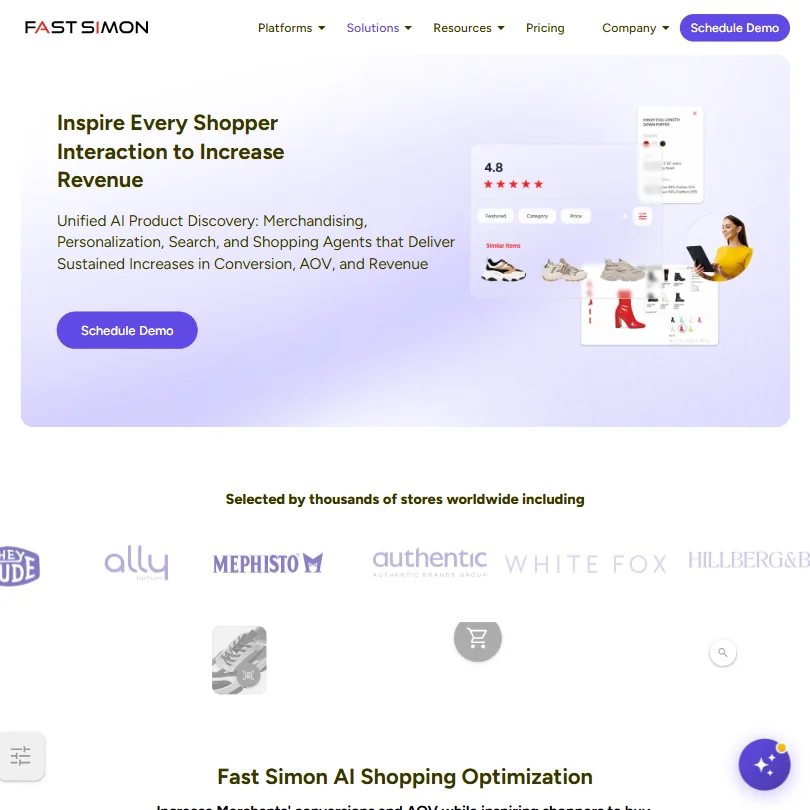
Fast Simon is an AI-powered product discovery platform built for e-commerce stores. The core offer covers site search, collection merchandising, and on-site personalization. They've been at this since 2016, headquartered in Palo Alto, and the platform has grown well past its original search-only roots. What they're selling now is closer to a full discovery stack. AI Shopping Agents handle conversational commerce, the kind where a shopper types something like "show me a blue jacket under $100" and gets a filtered, ranked result without landing on a dead-end search page. Visual Discovery covers Shop Similar and Shop The Look functionality. Then there's the merchandising layer: collection sorting, product ranking, promotional tiles, all of it adjustable with rules or automated by their proprietary AI model. That's a lot of surface area for one platform. Honestly, that's both the appeal and the risk with Fast Simon.Fast Simon Features: Product Listings, Bulk & Merchandising Tools

Fast Simon AI Writing Quality: Are the Product Descriptions Good?
The writing angle here is narrower than you might expect. Fast Simon isn't trying to be a product description writer. That's not the pitch. What they do offer is AI-generated promotional tile content and attribute enrichment from visual inputs. The Hyper Tagging system reads product images and adds structured attributes. That's useful for search relevance, but it's not the same as generating polished product copy. Product data enrichment is where the AI writing actually shows up, and in our research it seems to perform well enough for catalog-scale work. Users in Shopify community threads mention it being useful for normalizing inconsistent product data across large SKU counts. We're skeptical that the output replaces a copywriter. It doesn't seem designed to. For structured attribute data at scale, it sounds solid. If product description generation is your primary need, Hypotenuse AI is built specifically for that problem and covers bulk catalog enrichment more explicitly.Fast Simon Marketplace Support: Shopify, Amazon & Beyond
Fast Simon runs on Shopify natively, including Shopify POS. It also has native integrations for BigCommerce, Magento, WooCommerce, and Wix. There's headless support via an npm package, and mobile SDKs exist for iOS and Android. Amazon isn't supported. Not listed anywhere in the docs. This is an on-site tool. If your business runs primarily through marketplace channels, Fast Simon doesn't solve that problem. The Shopify integration is the strongest. It's a native app with POS support, which suggests some real depth. Reviews from Shopify store owners are the most positive segment of the feedback we found, and the Tapcart and Klaviyo integrations add useful reach for mobile-first or email-heavy brands. That said, there's no Zapier connection. No Amazon. No Etsy. The integration list is wide but only within the e-commerce platform layer. Fair. They're not trying to be everything.Is Fast Simon Easy to Use?
Here's where the research gets murkier. Fast Simon markets a no-code setup, and for basic Shopify installs that appears to be true. The app installs, syncs your catalog, and search starts working. That part is reportedly smooth. The complexity surfaces when you go deeper. Merchandising rules, personalization audiences, and A/B testing campaigns all require configuration. In Shopify forum threads from 2023 and 2024, we kept seeing a similar pattern: merchants who installed for search and found everything else overwhelming to set up without guidance. The eCommerce Wiki and success stories library exist, but the help documentation looks light for a platform this complex. No live chat is confirmed. Support comes through a contact form. That's fine at enterprise tier where you presumably have an account manager, but for smaller shops it's a real gap. We've seen worse. Not by much, though.Fast Simon Pricing: Is It Worth It for E-Commerce Sellers?

Fast Simon vs Algolia: Which E-Commerce AI Tool Is Better?
Algolia is the most direct comparison, and it's the one Fast Simon is clearly fighting for. The difference worth knowing: Algolia is infrastructure. It's an API-first search engine that developers configure and customize. Fast Simon is more of a finished product, designed for merchandising teams who don't want to write code. For a technical team that wants control, Algolia wins on flexibility. For a merchandising team that wants to run campaigns and adjust rankings without touching code, Fast Simon's no-code merchandising layer is a real advantage. Bloomreach and Constructor.io are also in this space, both at higher complexity and typically higher price. Searchspring is a closer competitor on the mid-market side. Nosto covers personalization but doesn't do search. If you're earlier in the journey and still figuring out whether your Shopify store needs dedicated search infrastructure at all, Luigi's Box is a lighter-weight alternative worth considering before committing to a platform at Fast Simon's scale.Who Should Use Fast Simon? (And Who Shouldn't)
Mid-market e-commerce brands on Shopify or BigCommerce with a real catalog problem. That's the fit. Stores with thousands of SKUs where search relevance and collection organization are actively hurting conversion. Teams that have a merchandiser or e-commerce manager who will actually use the tooling. Small shops on tight budgets. Not the fit. The pricing model and the support structure both assume you're spending real money and have someone to run the platform. Anyone whose primary sales channel is Amazon or a third-party marketplace. Pass. Fast Simon doesn't reach there. Headless commerce teams building on custom stacks are a reasonable fit too, given the composable commerce SDK. But they'll need developer resources to get full value out of it.Fast Simon Review Verdict
Fast Simon is a well-built platform for a specific problem. AI-powered on-site discovery across a large catalog, with merchandising control that doesn't require a developer every time you want to change a collection sort. That's genuinely useful. The blind spots are real, though. Pricing transparency is the biggest problem for anyone doing preliminary research. No public numbers makes evaluation harder than it needs to be. The support structure leans heavily on documentation that isn't quite deep enough for the platform's complexity. And the absence from G2 and Capterra means there's no independent review dataset to sanity-check the vendor's own claims. What we kept seeing in community threads is that Fast Simon works well when it's set up well. The drop-off happens when smaller teams hit configuration friction and find the support response too slow. That's a product-market fit issue more than a feature issue. The visual discovery and conversational shopping agent features are newer additions, and they look interesting. We'd want more user reports before endorsing them strongly. Right now they feel like a preview of where the product is heading. Solid platform. Go in with a demo call ready and specific questions about pricing and onboarding support.Frequently Asked Questions
Does Fast Simon work with Shopify?
Yes, and it's their strongest integration by a distance. The native Shopify app includes catalog sync and Shopify POS support. Most of the positive user feedback we found comes from Shopify merchants specifically.
Is there a free plan or trial for Fast Simon?
No permanent free plan exists. There's a 14-day free trial, but after that you're on a paid tier. Pricing isn't public, so you'll need to talk to sales before you know what you're actually committing to.
How does Fast Simon compare to Algolia for e-commerce search?
Algolia gives developers more control and is better suited to technical teams building custom search implementations. Fast Simon is designed for merchandising and e-commerce teams who want to manage search and collections without writing code. They're solving similar problems but for different types of users. Your team's technical capacity is the deciding factor.