The homepage pitches an all-in-one content platform. The pricing page is clean. What we kept seeing when we cross-referenced vendor docs against the wider review landscape was something more complicated than either the marketing or the skepticism fully captures.

SEOBoost comes from the Semper Plugins team, the people behind AIOSEO. That lineage matters more than it might seem. This isn't a venture-backed content tool burning cash on positioning. It's a deliberate build from a team that already has a real footprint in WordPress SEO. That shapes what the product is, and just as much, what it's decided not to be.
What is SEOBoost?
A web-based content optimization platform. It covers the workflow from initial research through to content auditing, inside one product.
The core loop is straightforward. You start with a target keyword, SEOBoost generates a topic report using NLP and competitor analysis, and you build a content brief from that report. Then you write or paste content into their editor, which scores it in real time. The audit feature comes in after publishing, flagging what's decayed or drifted. That's the complete cycle, and it actually holds together as a sequence.
They position it for freelance writers, content teams, agencies, and bloggers. We'd say the fit shakes out narrower than that marketing copy implies. More on that below.
SEOBoost Features: SEO & Content Tools Breakdown

Wide feature set for the price. Topic reports pull from the top 30 competing pages for a given keyword, surfacing gaps and NLP-ready terms. The content brief generator structures that research into something usable. The editor scores as you type, and the audit tool revisits existing content later.
Honestly, that's a coherent product. Most tools at this price give you one or two of those functions, not the full chain.
The gaps are harder to ignore. Rank tracking isn't listed anywhere in the documentation. Backlink analysis isn't there. The public docs are quiet on API access and third-party integrations. The tool lives mostly in its own world, which is either fine or a dealbreaker depending on how your stack is built.
The topic clusters feature is worth flagging specifically. It's explicit in the feature list and, for a content team building topical authority, that matters. Whether the clustering logic is genuinely useful or just relabeled keyword grouping is something we couldn't verify from documentation alone. Fair question.
SEOBoost Keyword Research: How Deep Does It Go?
Not very deep, and that's by design. Phrase analysis, word frequency, LSI keyword recommendations. It's built for content-level optimization, not for the kind of broad keyword discovery work you'd run in Ahrefs or a dedicated rank tracker.
SEOBoost doesn't really try to hide that. The keyword work here is narrowly focused on the piece you're writing, not on mapping an entire site's opportunity landscape. We're not skeptical of what it does. We're skeptical of the framing when vendors call that "keyword research" in a way that implies competition with full-stack SEO tooling. It doesn't compete there. It's useful for a different, smaller job.
That tracks, actually. Scoping the tool correctly matters more than overselling it.
SEOBoost Content Creation: AI Writing Quality Tested
We haven't run the editor ourselves. What we pieced together from documentation: the tool generates briefs with AI, scores content with NLP, and makes optimization suggestions inline. It doesn't appear to be pitching itself as a long-form AI writer the way Scalenut does. That's probably the right call.
The brief generation is where SEOBoost puts its weight, and based on the documentation, it's doing real competitor analysis to populate those briefs rather than padding them with generic H2 suggestions.
We found no independent third-party write-ups testing the AI output quality in any specific way. No G2 entries exist yet. Capterra has nothing. Trustpilot is blank. That's a significant gap in the review record. We can tell you what the features are supposed to do. We can't tell you how well they actually do it, because the user reports that would confirm or deny that simply aren't there yet.
Is SEOBoost Easy to Use?
The workflow is logical. Research, brief, write, audit. A sequence most content people will recognize immediately.
Where it gets messier is integration context. One thing worth correcting from what we initially had: SEOBoost does have a confirmed WordPress integration. The AIOSEO Writing Assistant surfaces SEOBoost recommendations directly inside the WordPress editor, which is a meaningful connection we'd undercounted. We found no evidence of a standalone Chrome extension, though. No confirmed Google Docs pathway either.
Fair. The WordPress angle matters for a lot of the buyers this tool is targeting. It's not nothing. But teams running content operations outside WordPress are still mostly working inside SEOBoost's web interface and moving content manually, and that friction adds up at scale.
SEOBoost Pricing: Is It Worth It vs Free Alternatives?
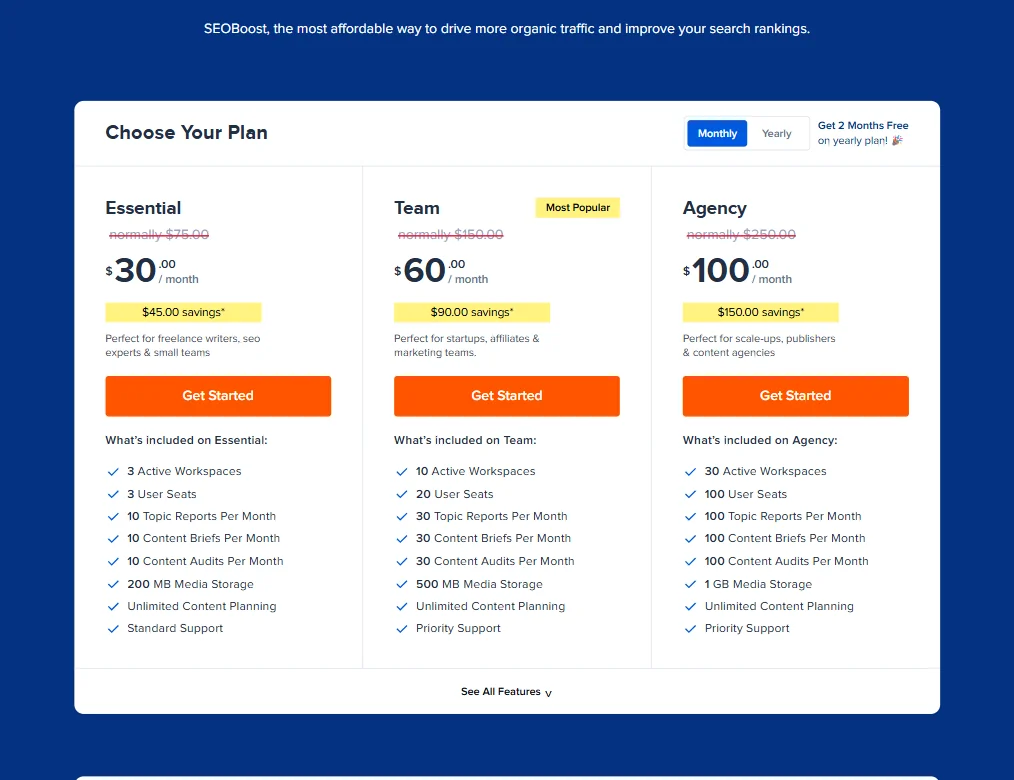
Three tiers. Essential runs $30 per month billed monthly (normally $75), or $22.50 per month billed annually. Team is $60 per month, $47.50 annually. Agency is $100 per month, $80.83 annually. There's a 14-day free trial and a 14-day money-back guarantee. No free tier.
On the entry end, the annual price is genuinely competitive. Surfer SEO's Discovery plan currently starts at $49 per month billed annually, so the gap is smaller than it used to be. Surfer's Standard plan runs $99 per month annually. Clearscope starts at $129 per month for Essentials. SEOBoost is cheaper than Clearscope at every tier, and cheaper than Surfer's Standard, and less than half the price of Surfer's entry plan on annual billing.
The Agency plan at $80.83 per month annually is where we'd push back. The integration surface is still thin outside WordPress. No API. No confirmed Google Search Console connection. For agencies running client work at real scale, that missing infrastructure is a problem that a lower price doesn't solve by itself. We've seen worse pricing structures. But this one's asking agency buyers to build workflows around a tool that doesn't talk to much else.
SEOBoost vs Surfer SEO: Head-to-Head Comparison
Surfer has a substantially longer review trail. More independent testing, more documented edge cases, and a clearer integration story that now officially includes Google Docs and WordPress. On the pricing gap, though, the picture has shifted. Surfer's entry plan at $49 annually is roughly 2.2 times SEOBoost's $22.50 annual Essential rate, not the four-times figure that circulates in older comparisons. Surfer's Standard at $99 is closer to 4.4 times, but Standard isn't the entry plan.
SEOBoost wins on price at the entry level. Surfer wins on verified track record. That's the honest split. If your budget is tight and your workflow is relatively simple, SEOBoost makes a defensible argument. If you need third-party confirmation that the NLP scoring actually holds up under real conditions, Surfer has years of public evidence. SEOBoost doesn't, yet.
That "yet" matters. The AIOSEO team has genuine shipping credibility. We'd expect the review record to fill in over the next year or two. Right now, you're buying on price and potential rather than a documented track record. Reasonable bet at $22.50 monthly. Less reasonable at $80.83.
Who Should Use SEOBoost? (And Who Shouldn't)
Freelance writers producing SEO content for clients. Core fit. The price is right, the workflow is complete enough, and the scale requirements are low enough that the thinner integration story doesn't bite hard.
Small content teams on limited budgets who need something more structured than a spreadsheet plus a free keyword tool. That works too, especially if WordPress is in the stack.
Agencies expecting a full production environment with broad third-party connectivity. Not yet. The integration gaps outside WordPress are real, and the absent review record makes it harder to stake client deliverables on tooling you can't verify through external sources.
Enterprise teams should keep walking for now. No API, no rank tracking, no backlink data, and no confirmed GSC integration makes this a non-starter at that level, regardless of what the Agency plan costs.
SEOBoost Review Verdict
Competently built. The price is honest. The brief-to-editor-to-audit loop is exactly what a content-focused team needs and rarely finds bundled this cheaply. The WordPress integration through AIOSEO is a real asset that the tool's marketing undersells.
The near-empty review record is the thing we kept coming back to. Not a dealbreaker at the Essential level. Meaningful friction for anyone trying to justify the Team or Agency tiers where the cost-versus-uncertainty math gets harder.
The missing integration story outside WordPress is what holds it back from a stronger recommendation at the upper tiers. Add GSC. Give agencies a confirmed pathway for the tools they're already running. The bones are solid. The surrounding infrastructure needs time.
Worth a trial at Essential. Approach Team or Agency with calibrated expectations until the integration picture fills in and the review record catches up.
How SEOBoost compares
SEOBoost scores 2.9 out of 10 among the content optimisers we rate. These three do the same job and are the closest to it, compared on what each vendor publishes.
MarketMuse
MarketMuse shows keyword volume and difficulty in its Keywords tool; SEOBoost's Topic Reports give keyword frequency from the top 30 pages but no search volume or difficulty figures at all. MarketMuse also has a free plan with 10 queries a month; SEOBoost has no free tier, though its Essential plan is $30 a month with a 14 day trial. SEOBoost works inside WordPress through the AIOSEO plugin; MarketMuse has no WordPress publishing, only a copy button to paste content into your CMS.
Pick MarketMuse if you want a free plan and real keyword volume data.
Pick SEOBoost if you already publish through WordPress and want a low price.
Clearscope
Clearscope writes 20 draft articles a month; SEOBoost has no AI writer at all, only optimization suggestions and content briefs, 10 a month on its Essential plan. Clearscope is also far pricier, $129 a month against SEOBoost's $30. Clearscope gives unlimited seats on every plan and a real Google Docs add-on; SEOBoost's Essential plan includes 3 seats and has no Google Docs integration.
Pick Clearscope if you need an AI writer and unlimited team seats.
Pick SEOBoost if budget matters and you already write inside WordPress.
Frase
Frase's Starter plan includes a technical site audit, backlink analysis and an API with 5,000 requests a month; SEOBoost has none of the three. SEOBoost is cheaper though, $30 a month against Frase's $49. Frase's AI Agent also drafts 10 full articles a month; SEOBoost has no AI writer, offering only content briefs and optimization suggestions. SEOBoost publishes to WordPress through the AIOSEO plugin, while Frase auto-publishes directly on every plan.
Pick Frase if you need a technical audit, backlinks or full article drafts.
Pick SEOBoost if budget is tight and you already use AIOSEO on WordPress.
Frequently Asked Questions
Does SEOBoost have a free plan?
No free plan. There's a 14-day free trial on all paid tiers, and a 14-day money-back guarantee if you've already paid. That's a reasonable window to pressure-test whether the brief generation and content scoring actually fit your production process before committing to an annual rate.
Does SEOBoost integrate with WordPress or Google Docs?
WordPress, yes. The AIOSEO Writing Assistant brings SEOBoost recommendations directly into the WordPress editor, which is a confirmed integration. Google Docs isn't publicly documented as a supported pathway. No standalone Chrome extension appears to exist. Teams outside the WordPress ecosystem should plan on working primarily inside SEOBoost's web interface and moving content from there.
How does SEOBoost compare to other on-page SEO optimization tools?
It sits in the same general category as Surfer SEO and Frase, priced below both at the entry level on annual billing. The feature set is comparable on paper. What it can't yet offer is years of user feedback confirming that the NLP scoring and competitor analysis hold up under real workloads. At the annual Essential rate, that uncertainty is a trade-off many buyers can live with. At the Agency tier, it becomes a harder sell until the external review record exists to back it up.