What is RetentionX?
Customer intelligence for Shopify brands. That's the short version.

RetentionX positions itself around a real problem: most DTC stores have plenty of data and still can't tell which customers are worth spending money on. The platform is trying to close that gap, not by adding another dashboard, but by connecting customer data to actual marketing action.
The scope here is wider than most tools attempt. Customer analytics and segmentation form the base. Identity and session tracking sit on top of that. Automations run off the customer data the platform collects. And merchandising tools, which feel like the newest addition, tie product decisions back to buyer behavior. Founded in 2018 and based in New York, RetentionX claims around 1,500 brands on the platform. Not a massive number. But real.
RetentionX Features: Product Listings, Bulk & Marketplace Tools
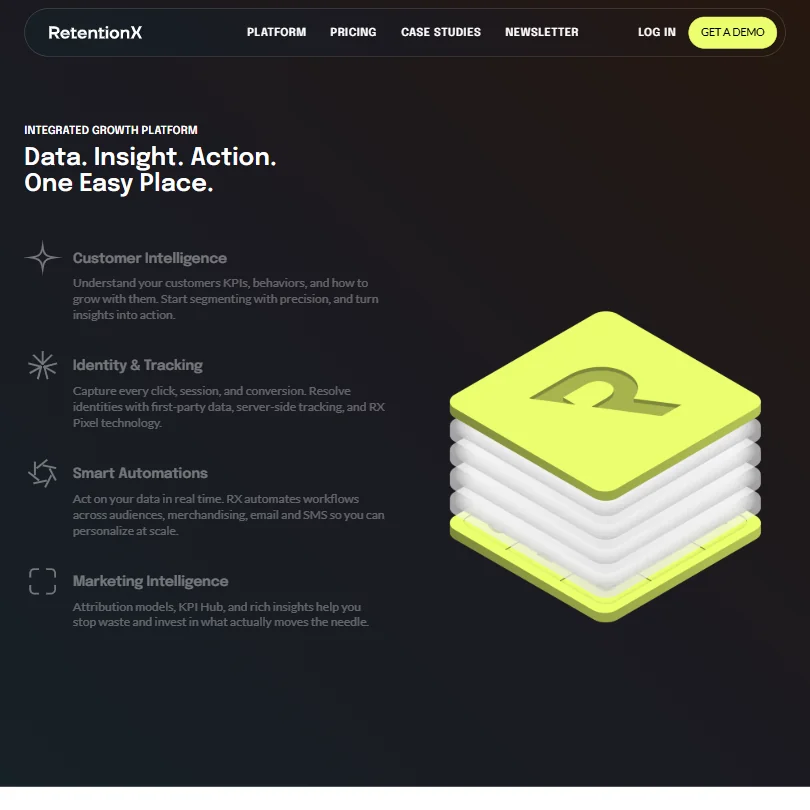
Over 100 analytics tools and reports is the claim on the vendor side. What that actually means in practice: RFM analysis covering recency, frequency, and monetary scoring, cohort tracking, LTV projections cut by segment, and follow-up purchase tracking that shows what a customer buys second, not just first. That last piece matters more than vendors usually admit.
The identity tracking layer is genuinely interesting. RetentionX builds a live profile per customer, pulling session data, device behavior, attribution events, and purchase history into a single timeline. The homepage demo shows a browse session stitching into a cart add, an email attribution event, a purchase, and eventually a review submission. Useful signal. Whether it works that cleanly in production is a different question.
Automations run off the intelligence layer. Churn risk gets forecast, and workflows build around it. A lapsing customer routed into a replenishment campaign before they actually go dark. That's the pitch. We're skeptical of that at face value without independent user confirmation, but the architecture makes sense on paper.
Merchandising automation feels like the newest piece here. Smart rules connecting product decisions to buyer data. We've seen much larger platforms attempt this badly.
What RetentionX doesn't do is worth stating plainly. No ad copy generation. No SEO or listing tools. No competitor monitoring. If content generation is the goal, this isn't the product.
RetentionX AI Writing Quality: Are the Product Descriptions Good?
Not applicable. Genuinely.
RetentionX doesn't generate copy. No product descriptions, no bulk content output, nothing on that side. The AI sits entirely on the analytics and prediction layer: forecasting churn, modeling LTV, flagging customers who are ready to buy again versus ones who've already mentally moved on.
If product description generation is the priority, Hypotenuse AI is a better fit. Different category entirely.
For what RetentionX actually does with AI, which is predictive customer modeling, the approach is proprietary. No third-party model gets named in the documentation. That's not unusual for a platform at this level, but it does make independent verification harder than we'd like. We cross-referenced the docs and didn't find specifics on the underlying architecture. Fair.
RetentionX Marketplace Support: Shopify, Amazon & Beyond
Shopify. Mostly just Shopify.
The integration is deep, covering multi-store setups, first-party data consolidation, and connections to email and SMS platforms for automation delivery. Ad network connections get mentioned in vendor materials, though detail thins out fast.
Amazon isn't publicly confirmed. WooCommerce isn't either. This is a Shopify-native product built around Shopify data. That's not a weakness exactly, it's just a hard boundary brands need to know about before they invest time in a sales call.
We also couldn't find any confirmed Zapier integration or open API documentation in our research. That limits DIY flexibility compared to something like Klaviyo, which has documented integrations across most standard DTC stacks. Not a dealbreaker for every brand. But worth knowing up front.
Is RetentionX Easy to Use?
Hard to call without direct access. Honestly.
The homepage is organized. The feature documentation is coherent. That's already a better baseline than a lot of tools in this space manage. But the breadth of the platform is where complexity lives. Over 100 analytics tools is a selling point and a caution at the same time. Brands without a dedicated analyst or a data-fluent marketer may end up with a lot of reports they don't know how to act on.
The demo-first sales model suggests RetentionX knows the onboarding conversation matters. No self-serve trial appears to be publicly available. That's not automatically a red flag. Brands expecting to spin up and evaluate solo won't find that option here, and planning for a sales conversation upfront will save time.
Support includes a help center and email. Chat support appears in demo materials but isn't clearly confirmed at every tier. No community forum that we could find. Lean, by most standards.
RetentionX Pricing: Is It Worth It for E-Commerce Sellers?
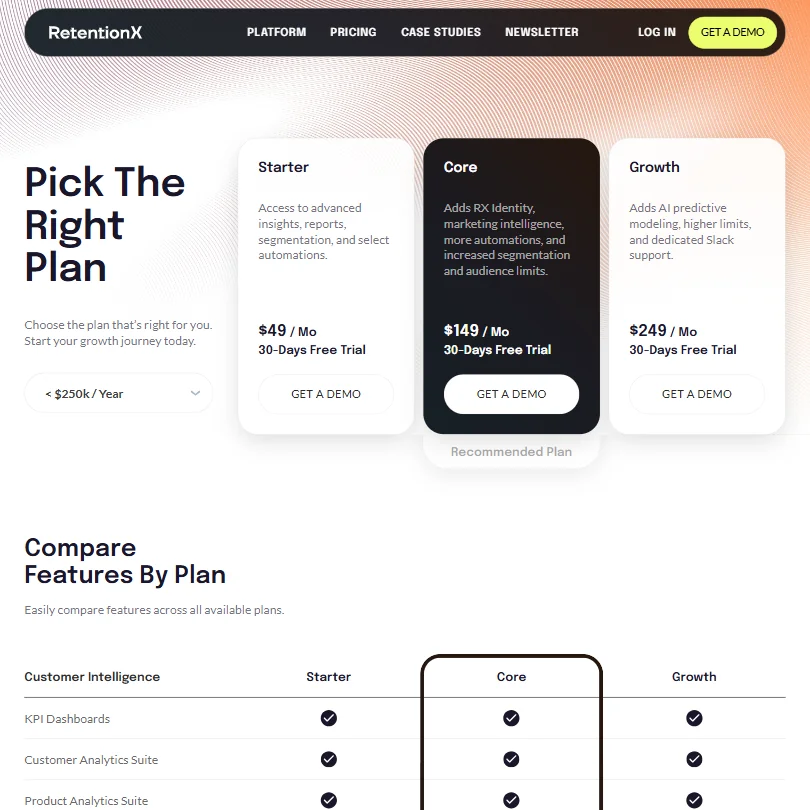
Three tiers are visible from the pricing page. Starter at $49 per month, Core at $149 per month, and Growth at $249 per month, each with a 30-day free trial offer and a demo call as the conversion path. The page shows a revenue filter, set at under $250k per year in the screenshot, which suggests pricing scales with brand size beyond those base figures.
Worth noting what each tier actually includes. Starter covers advanced insights, reports, segmentation, and select automations. Core, which the vendor marks as the recommended plan, adds RX Identity, marketing intelligence, more automations, and increased segmentation and audience limits. Growth layers AI predictive modeling, higher limits, and dedicated Slack support on top of that.
Pricing varies widely across this category. Entry-level analytics products can start below $100 per month, while advanced attribution and enterprise platforms may cost hundreds or thousands depending on revenue, traffic, features, and contract scope. RetentionX at $49 to $249 per month sits toward the accessible end of that range at the base level, though what happens to those numbers as revenue scales isn't publicly detailed.
The 30-day free trial is a meaningful detail. We hadn't seen that confirmed elsewhere in the vendor documentation, and it changes the calculus for brands that want to evaluate before committing.
RetentionX vs Klaviyo: Which E-Commerce AI Tool Is Better?
These two overlap in a specific, limited way. Both sit in a Shopify brand's marketing stack. Both touch customer data and email automation. That's about where similarity ends.
Klaviyo is an email and SMS platform that has added customer data features over time. Transparent pricing, broad integrations, and name recognition that makes internal approvals easier. Most DTC brands have already used it or are using it now.
RetentionX isn't trying to replace Klaviyo. It's trying to make Klaviyo smarter by feeding better segmentation into it. The RFM analysis, cohort data, and churn predictions are meant to power existing channels, not substitute for them. The two tools can coexist in the same stack.
Where RetentionX has a real edge is depth of customer intelligence, specifically the identity tracking and LTV modeling that Klaviyo doesn't go as deep on. Where Klaviyo wins is pricing clarity and the integration breadth that comes from being the default choice in most DTC tech stacks.
Triple Whale and Northbeam show up in similar purchasing conversations. Both do attribution analytics for DTC brands. RetentionX's identity tracking overlaps with what those tools offer, though RetentionX leans toward retention and LTV rather than ad attribution specifically. Different emphasis.
Who Should Use RetentionX? (And Who Shouldn't)
DTC brands on Shopify with real order volume. Specifically brands that have moved past basic acquisition and are trying to extract more value from existing customers.
The platform rewards whoever uses it. An analyst, a data-fluent marketer, someone who actually builds segments and acts on the churn forecasts. Without that person, the 100-plus reports become background noise.
Early-stage stores. The complexity and the demo-gated access signal that RetentionX isn't optimized for the low end of the market, and the tool's depth will be wasted at low order volumes.
Brands that need product content generation or listing optimization should look elsewhere. Not this product's category.
RetentionX Review Verdict
A serious analytics and retention platform. Not a content tool. A customer intelligence layer built for Shopify brands that have already figured out acquisition and are now trying to get more from the customers they have.
The analytics depth looks genuine based on documentation. The identity tracking layer is the most differentiated piece in the stack. The churn forecasting, if it performs as described, justifies a real budget at any of the three tiers.
The 30-day trial is a meaningful entry point that makes evaluation more accessible than the demo-only framing suggested. Pricing opacity beyond the base figures is still a real issue for brands trying to model costs as they scale, since the revenue-based scaling isn't detailed publicly.
We couldn't surface significant review volume on G2 or Capterra to cross-reference vendor claims against reported experience. That's not RetentionX's doing, but it means our analysis leans heavier on documentation than on aggregated user feedback. That gap matters.
For a Shopify-native DTC brand serious about LTV, with the internal resources to act on data, this is worth the conversation. For everyone else, the gaps add up.
Frequently Asked Questions
Does RetentionX have a free plan or free trial?
No free plan. A 30-day free trial appears attached to each published pricing tier, though the path to access still runs through a demo call rather than self-serve signup. That's standard for platforms at this complexity level, but it does mean evaluation requires a sales conversation first.
Is RetentionX only for Shopify stores?
Based on everything we could find, yes. The platform is built around Shopify integration and the documentation stays almost entirely within that ecosystem. WooCommerce and other platforms aren't publicly confirmed. Ask the sales team directly before investing time in an evaluation if you're running anything else.
How does RetentionX differ from a standard email marketing tool?
It isn't one. RetentionX is closer to a customer data and analytics layer that feeds your existing email or SMS platform with smarter segments and predictions. It sits behind the send button rather than being the button itself. Most brands use it alongside something like Klaviyo, not as a replacement for it.