Vendor docs, G2 write-ups, Capterra listings, and a fair amount of Reddit friction. That's what this is built from. Not a press kit. RankIQ launched in 2021 out of The Woodlands, Texas, and made a deliberate call to ignore agencies and chase bloggers instead. That decision shapes everything about the product, including where it falls short.

The signal is mostly positive. But there are specifics worth knowing before you hand over any money.
What is RankIQ?
A web-based SEO and content tool with a narrow scope, by design. The product sits at the intersection of hand-curated keyword research and on-page content optimization, and it doesn't wander far from that. No backlink data. No technical crawling. No Chrome extension to speak of.
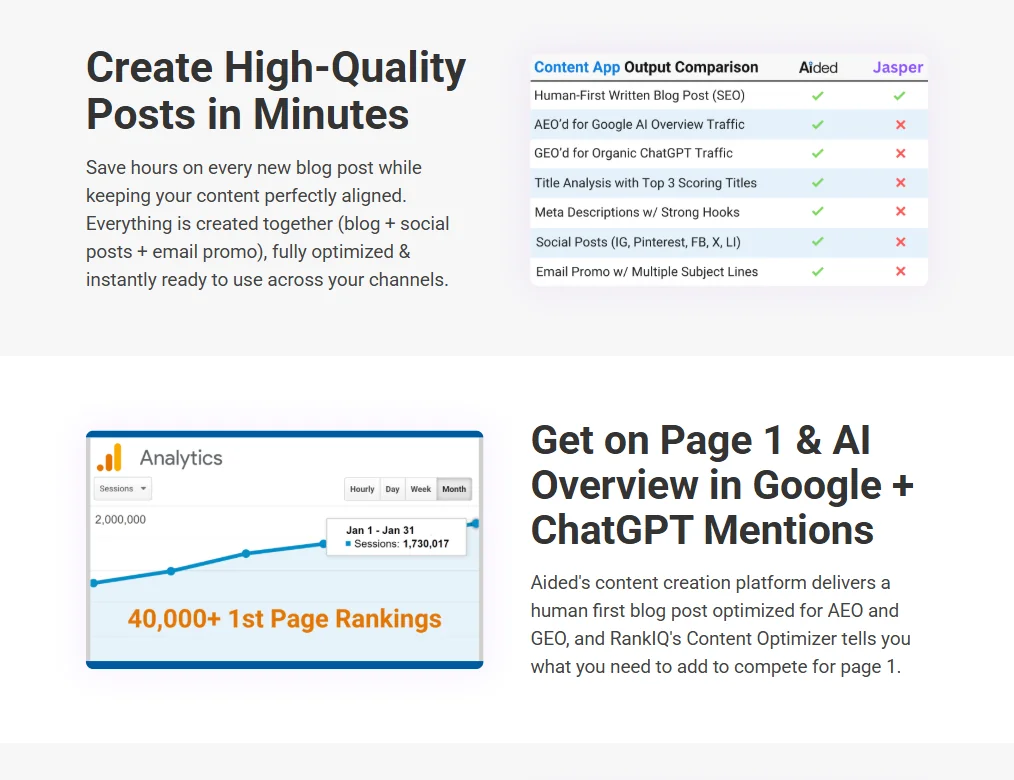
What's actually in the box: a keyword library sorted by blog niche, a Content Optimizer that grades your drafts against top-ranking pages, and an AI writing layer called Aided. The Aided bundle pulls in Claude, Gemini, and ChatGPT under one login, and adds social post generation for Instagram, Pinterest, and a few others.
Honestly, the focus is refreshing. Most SEO tools try to cover everything and end up being genuinely useful for nobody. RankIQ made a bet on bloggers and has largely kept it.
RankIQ Features: SEO & Content Tools Breakdown
The Content Optimizer is the product. You feed it a keyword, it pulls apart what the top-ranking pages cover, then tells you what your draft is missing and assigns a grade. Simple loop. Effective one, according to most of what we read on G2.
Food bloggers and personal finance writers kept coming up in reviews specifically praising the optimizer. Not the AI writer. The optimizer. That tracks with how RankIQ positions the thing.
Title analysis is baked in too. The tool flags weak title structures and suggests alternatives based on search performance patterns. Small feature. Generates a surprisingly consistent mention volume in reviews, which tells you something.
The Aided bundle adds long-form AI writing, described in vendor docs as producing "human-first blog posts optimized for AEO and GEO." We're skeptical of that framing. But Capterra reviewers noted the output was usable without heavy editing, which is a higher bar than most AI writing tools actually clear, so maybe don't dismiss it outright.
What's absent: no confirmed rank tracking integration, no backlink layer, no Google Search Console connection, and no API. For a solo blogger running a tight operation, those gaps may be fine. For anyone expecting one tool to cover a full stack, they're not.
RankIQ Keyword Research: How Deep Does It Go?
This is the genuine differentiator. Surfer SEO and Clearscope let you research any keyword you want. RankIQ gives you a pre-filtered library it says is low-competition with real traffic potential, organized by niche.
The appeal is obvious. Skip the research rabbit hole, go straight to writing. For solo bloggers without much SEO background, that's a real shortcut worth paying for.
The concern, which surfaced in Reddit threads from 2024 and 2025, is staleness. Pre-curated libraries go stale. A niche that was genuinely low-competition in 2022 may be flooded with AI-generated content now. We cross-referenced this against G2 feedback and found no strong consensus either way, but the question is legitimate. RankIQ's documentation doesn't clearly address how frequently those libraries get updated. That omission is notable.
No publicly stated keyword clustering capability either, which limits how far the tool takes you toward building a topical map.
RankIQ Content Creation: AI Writing Quality Tested
We haven't run the AI writer. Full stop. What we know comes from Capterra and G2 review patterns, and those patterns are fairly consistent: the Aided bundle output works for bloggers, and it doesn't work particularly well for content teams running high-volume technical writing.
The 1-click AI apps produce blog posts and social content. Two things actually matter here. Whether the content is usable without major rewrites is one. The other is whether the optimizer grade reflects real ranking probability, not just content completeness. Reviewers seem satisfied with the first point. The second is harder to verify from the outside.
One thing we kept seeing in G2 reviews: bloggers reporting ranking improvements after using the Content Optimizer. Correlation, not proof. But it showed up enough times across enough independent accounts to register as a real pattern, not planted feedback.
Is RankIQ Easy to Use?
By consistent account, yes. The interface draws steady praise for being straightforward. No buried settings, no steep learning curve. The core workflow is: pick a keyword, run the optimizer, write to the brief.
The flip side of that simplicity is that power users hit a ceiling fast. No Chrome extension, no Zapier connection, and no API access are real workflow costs if your content operation involves multiple tools passing data between each other. RankIQ sits in a silo. That's fine if you want a silo. Not fine if you don't.
On support, the picture is more complete than some early reviews suggested. Capterra's current listing identifies email, help desk, FAQs, a knowledge base, phone support, and chat options. G2 reviewers also flagged responsive support and community chat access. The "email only" characterization we've seen elsewhere doesn't hold up against that data. Fair.
RankIQ Pricing: Is It Worth It vs Free Alternatives?
The pricing structure takes a moment to parse. RankIQ doesn't list prices publicly, so confirmed figures come from vendor communications and review site disclosures. What our research turned up: the standalone RankIQ plan runs higher than the bundle, and the RankIQ + Aided bundle, which adds the AI writing layer and multi-model access to Claude, Gemini, and ChatGPT, comes in at $59 a month. The bundle costs less than the standalone. That inversion isn't a typo, it's just a strange way to build a pricing page.
No free plan. No free trial. The refund policy isn't publicly stated, which makes the first purchase feel heavier than it should. Surfer SEO at least lets you explore the product before committing real money.
For a solo blogger, $59 a month covering keyword research plus an AI writer is reasonable. Compared to something like NEURONwriter, which offers more integration flexibility at a lower entry point, RankIQ's value depends almost entirely on whether you're actually going to use the Aided bundle or just want the optimizer.
No enterprise tier. No team pricing visible anywhere. This is not a tool built for groups.
RankIQ vs Surfer SEO: Head-to-Head Comparison
Surfer SEO is the obvious comparison. The core philosophical difference: Surfer lets you research any keyword you choose, build content outlines, and pull in performance data. RankIQ narrows the front end down to a pre-selected library and gives you a faster path from keyword to optimized draft.
Surfer is more powerful. RankIQ is more opinionated. For someone who finds keyword research genuinely paralyzing, the curated library removes a real friction point. For someone who already knows exactly what they're targeting, Surfer or Clearscope give you more control where it counts.
RankIQ has no backlink layer and no technical SEO capability, which Surfer at least gestures toward through integrations. If either of those matter to your workflow, that gap is the deciding factor, not the price difference.
Who Should Use RankIQ? (And Who Shouldn't)
Hobby bloggers and content-focused independent publishers. Especially those in niches like food, finance, or lifestyle, where the keyword library has real depth. The tool was built for them.
SEO agencies. Wrong tool, missing integrations, no client reporting infrastructure.
Content teams at growing companies should look elsewhere. The silo problem is real, and collaboration features simply don't exist here in any meaningful form.
RankIQ Review Verdict
The Content Optimizer earns its reputation. The keyword library is a genuine shortcut for bloggers who don't want to spend hours lost in research tools. The satisfaction pattern across G2 and Capterra isn't manufactured noise, it's consistent enough across enough reviews to be real.
The weaknesses are structural, not cosmetic. No integrations worth speaking of. No refund policy in plain sight. No trial period to test the thing before committing. The pricing inversion between standalone and bundle plans is genuinely confusing and makes it unclear what the base product is actually supposed to cost.
Bloggers who want to stop overthinking keyword research and start writing optimized content faster. That's who this earns its price for. Anyone who needs their SEO tool to communicate with the rest of their stack, it doesn't.
Frequently Asked Questions
Does RankIQ have a free trial?
No. As of our research, neither a free plan nor a free trial exists. The lowest confirmed entry point is the RankIQ + Aided bundle at $59 a month. That's a real commitment to make without testing first, so factor that in before signing up.
What's the difference between RankIQ and the Aided bundle?
RankIQ is the core keyword research and content optimization product. Aided is a separate AI writing platform bundled with it, adding access to Claude, Gemini, and ChatGPT, plus social content creation. The bundle runs lower than the standalone plan. That structure is confusing on its face, and we'd recommend confirming the current terms directly with the team before purchasing, since pricing isn't publicly listed anywhere we could find.
Is RankIQ good for SEO beginners?
Probably the best-fit audience, actually. The pre-curated library removes most of the technical guesswork from keyword research, and the Content Optimizer grades your work as you go. Beginners who'd otherwise spend weeks inside Ahrefs or Semrush learning the basics can get to actual writing faster here. The tradeoff is that the tool won't scale with you once you want more control over the research side of your operation.