SAASINSPECTOR
PodGen.io logo

PodGen.io Review

Individuals, content creators, businesses, and large teams converting web and document content into podcasts

Visit PodGen.ioFrom $9.99/week

Research-based review. We analyzed vendor documentation, customer reviews on G2, Capterra, and Reddit, and live pricing — not hands-on testing yet. We update as our team puts tools through real workflows.

The verdict

PodGen.io is an AI podcast generation tool that converts content sources like YouTube URLs, PDFs, and blog posts into two-host audio conversations. It targets individual creators and small teams looking to repurpose content into audio format without manual production. While audio quality is a relative strength, the lack of API access, batch processing, and third-party reviews undermine confidence for professional or team-scale use.

Pros

  • Supports a wide variety of input types including YouTube URLs, PDFs, blog posts, and typed prompts, making it flexible for content repurposing.
  • Claims a library of over 1,000 voice options, giving users significant variety when selecting podcast voices.
  • The text-based editor allows users to edit audio by editing the transcript, which is a practical and intuitive workflow.
  • Voice cloning is advertised as instant, reducing setup time for users who want personalized audio output.
  • Audio quality is noted as a relative strength, with Product Hunt users commenting positively on the naturalness of conversations.
  • AI enhancement feature is included to improve existing audio quality.
  • Generates a two-host AI conversation format automatically, simulating a natural podcast dynamic without manual scripting.

Cons

  • No presence on major third-party review platforms like G2, Capterra, or Trustpilot, making independent verification of quality claims difficult.
  • No music generation capability, which limits the production value of the final audio output.
  • No noise removal feature listed in the documentation, a significant gap for a content production tool.
  • No API access available, preventing teams from integrating PodGen.io into automated content pipelines.
  • Batch processing is absent, making the tool impractical for high-volume podcast production workflows.
  • No mobile app is listed, restricting usage to desktop environments.
  • The claimed 1,000+ voice library raises skepticism about how many are truly distinct, high-quality voices versus variations on a base model.
From $9.99/weekFree plan NoFree trial Yes

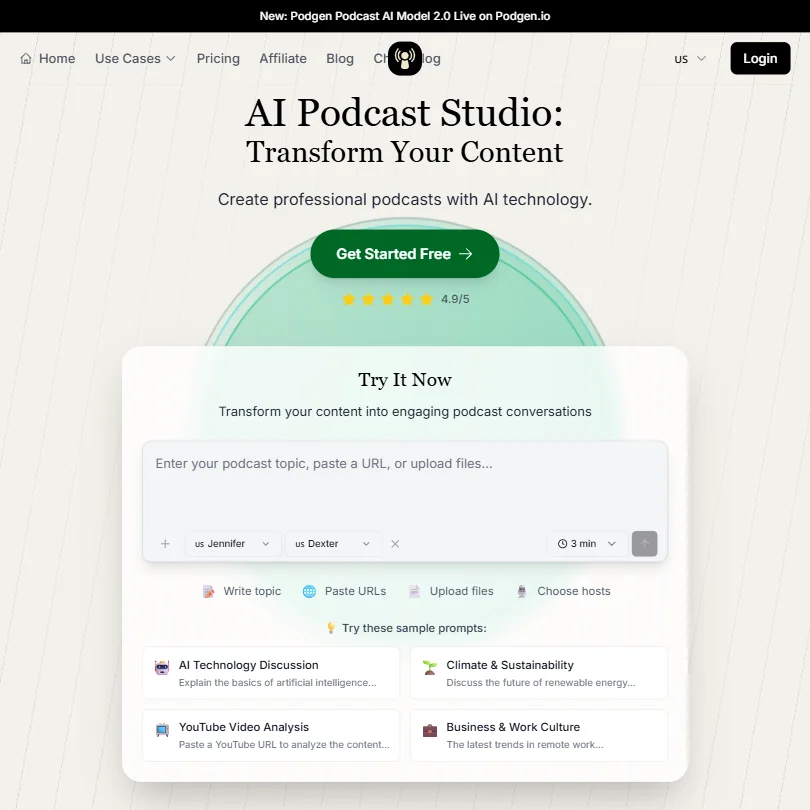
PodGen.io homepage screenshot
PodGen.io — Homepage

Our research on PodGen.io started with the vendor's own documentation, moved through Product Hunt comments, and stopped there, because the public review trail is genuinely thin. No G2 page. No Capterra listing. No Trustpilot presence worth citing. For a product claiming 25,000 active users, that absence is data, not an oversight.

What is PodGen.io?

The premise is simple. Drop in a piece of content, get a podcast back. YouTube URL, PDF, blog post, typed script. The platform converts the source into a two-host AI conversation, pulls from a library of over 1,000 voices, and exports audio.

Founding date isn't listed anywhere public. HQ, unknown. The model running the conversion is called Podgen Podcast AI Model 2.0, described as proprietary. What that means under the hood, they don't say.

Honestly, the concept isn't new. Wondercraft has been doing content-to-audio conversion for a while. What PodGen.io leans on harder is the range of input types and the voice library size. Whether that's enough separation is a real question, not a rhetorical one.

PodGen.io Features: Voice, Music & Audio Capabilities

The input flexibility is genuinely broad. YouTube, PDF, pasted URL, direct script. That's more variety than most tools in this category bother to support.

The text-based editor lets you edit audio by editing the transcript, which is a legitimately useful approach. Voice cloning is listed as instant. AI enhancement for improving existing audio is also listed, though documentation on what that means in practice is vague.

What's missing is notable. No music generation. No noise removal in any docs we found. Batch processing and API access are both absent. For teams trying to build this into a content pipeline, the missing API is a real ceiling, not a minor gap.

The 1,000-plus voice count is a large number. We're skeptical of how many are genuinely distinct versus variations on a smaller set of base models. That figure gets thrown around freely across AI voice products and rarely survives scrutiny.

PodGen.io Audio Quality: How Natural Does It Sound?

This is where PodGen.io holds up better than its other weak spots might suggest. Early Product Hunt comments praised the natural-sounding voices and ease of turning source material into polished audio. The two-host conversation format does make output more listenable than single-voice narration.

That said, AI-generated podcast conversations still hit a ceiling, and anyone who's spent time with these outputs knows exactly where it is. Transitions feel constructed. Pacing is predictable in a way real conversation isn't. Good enough for a repurposed blog post or internal training content. Not going to pass as a genuine interview.

A user on Product Hunt reported a 39-minute podcast failing repeatedly after 20 to 30 minutes of processing. Worth keeping in mind if you're planning to feed long-form sources into the tool.

PodGen.io Voice Cloning & Customization: How Deep Does It Go?

Voice cloning is listed as a feature. The word the vendor uses is "instant." The documentation doesn't go further, and we didn't find user reports detailed enough to independently verify clone quality.

The 50-plus professional voices with emotional expression are a distinct offering from the broader 1,000-plus library. That matters. Emotional expression is technically harder, and the fact that only 50 voices carry that label suggests the majority are more basic reads. Not a criticism exactly, just an honest read of what the numbers imply.

Customization beyond voice selection is murky. No mention of pitch controls, pacing adjustments, or style tuning in any documentation we reviewed. Not great.

Is PodGen.io Easy to Use?

The core workflow is three steps. Pick a source, choose hosts, generate. Product Hunt commenters noted fast onboarding. No credit card required at signup. Free credits to start.

The text-based editor is a real ease-of-use win. Editing a transcript is faster than editing a waveform, and for non-technical users it removes most of the friction. Real-time team collaboration is built directly into the platform, which is a more serious inclusion than you'd expect at this stage of the product.

Web-only, though. No mobile app. For a content creation tool in 2025, some users will feel that.

PodGen.io Pricing: Is It Worth It for Creators & Businesses?

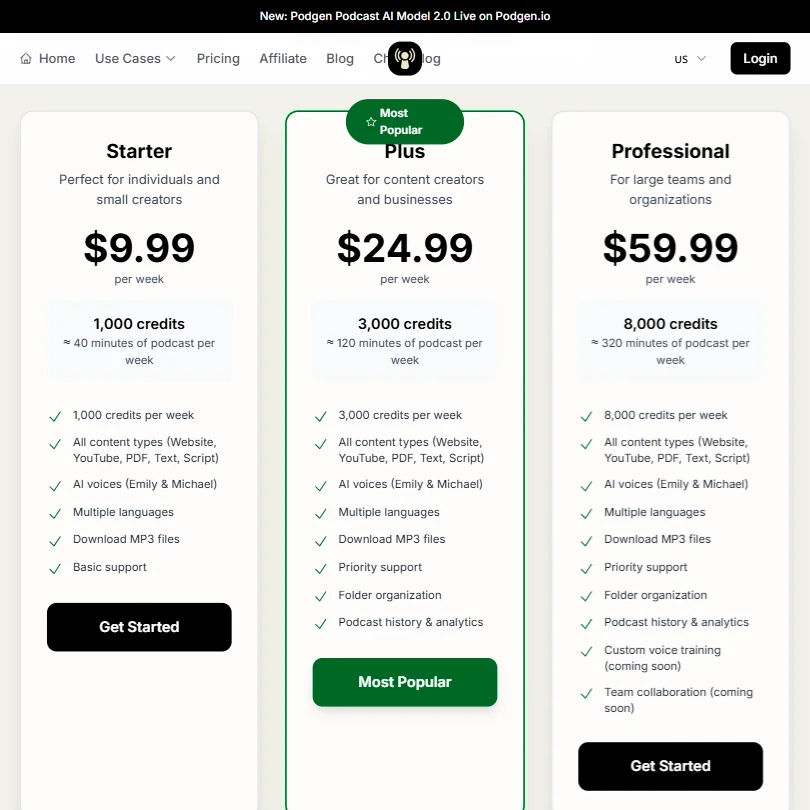
PodGen.io pricing screenshot
PodGen.io — Pricing

The pricing here is more concrete than we initially expected. Three tiers are publicly visible. Starter runs $9.99 per week and includes 1,000 credits, roughly 40 minutes of podcast output. Plus is $24.99 per week for 3,000 credits, approximately 120 minutes. Professional is $59.99 per week for 8,000 credits, around 320 minutes.

The free entry point is real. The platform launched with 100 free credits, explicitly disclosed as covering roughly four minutes of audio. A user on the Product Hunt launch post stated they had already purchased 2,000 credits, so the billing model was visible from the start, not buried.

The weekly billing cadence is worth examining before you commit. Most tools in this category bill monthly. Weekly cycles add up differently, and the math changes depending on how consistently you use it. At Plus tier, $24.99 per week is just under $1,300 annually. That's not a casual spend for a content creator.

The Starter plan gets you 1,000 credits per week with all content types supported and both AI voices, Emily and Michael, included. The Plus plan adds priority support, folder organization, and podcast history with analytics. Professional adds team collaboration and custom voice training, both listed as coming soon. Fair.

For comparison, Murf AI publishes plan details starting at $29 per month. Monthly billing, visible upfront. Different category overlap, but the transparency contrast is real.

PodGen.io vs Wondercraft: Which AI Audio Tool Wins?

Wondercraft is the closest direct competitor. Both convert content into AI-hosted audio. Wondercraft has a more established review presence and integrates more cleanly into production workflows.

PodGen.io counters with broader input flexibility and YouTube import as a core, central feature. Wondercraft doesn't make that as prominent. The collaboration features also lean toward PodGen.io, assuming they work as described.

Wondercraft has the track record. That matters when you're building a repeatable content workflow around a tool and need to know the thing won't break on you.

Who Should Use PodGen.io? (And Who Shouldn't)

Solo content creators with a backlog of existing material. That's the fit. Someone with a blog archive or a YouTube channel who wants audio versions without hiring a producer.

Marketing teams with real production requirements. Look elsewhere. The missing API and the weekly billing structure make it hard to justify at team scale.

Developers wanting to build on top of the platform. Not an option, at least not publicly.

PodGen.io Review Verdict

The content-to-podcast conversion works. Input flexibility from YouTube to PDF to raw URL is one of the broader offerings in this category. The editor is accessible. The free entry point is real and honestly disclosed.

The gaps are real too. Weekly billing at these price points is an unusual structure that warrants scrutiny. The API absence blocks automation entirely. The public review footprint is thin enough that we're cross-referencing a short list of sources, not a deep pool of user experience.

For casual creators, the free credits are worth trying before forming an opinion. For anything more structured, we'd want the collaboration and voice training features to ship before committing to Professional tier. And if voice cloning quality is the primary concern rather than the podcast conversation format, ElevenLabs has a more mature cloning product and a longer public track record in that specific lane.

Frequently Asked Questions

Does PodGen.io offer a free plan?

Free credits are available at signup with no credit card required. The platform launched with 100 free credits, covering roughly four minutes of audio. Plan to test within that window before assuming the output quality generalizes to longer sessions.

Can PodGen.io convert YouTube videos into podcasts?

YouTube import is a listed core feature and one of the more distinctive inputs the tool supports. Paste a URL, the platform pulls the content and converts it into an AI-hosted conversation. Product Hunt commenters said this worked well. A separate user reported processing failures on a 39-minute source, so longer videos appear to carry more risk.

How does PodGen.io compare to tools like ElevenLabs for voice quality?

They're solving different problems. PodGen.io is built around converting content into a multi-host podcast format. ElevenLabs is a voice generation engine first, with a more developed cloning infrastructure and a wider range of output use cases. If broadcast-quality single-voice narration or serious cloning is what you need, PodGen.io isn't the right comparison to be making.

PodGen.io is featured in

Alternatives to PodGen.io

See all PodGen.io alternatives →

Other AI Audio Tool options we've reviewed.

User reviews

Review PodGen.io

Your rating

Reviews are moderated and appear once approved.