Pagepilot is an AI ecommerce tool that turns a product URL from AliExpress, Amazon or Etsy into a branded Shopify product page.

What is Pagepilot?
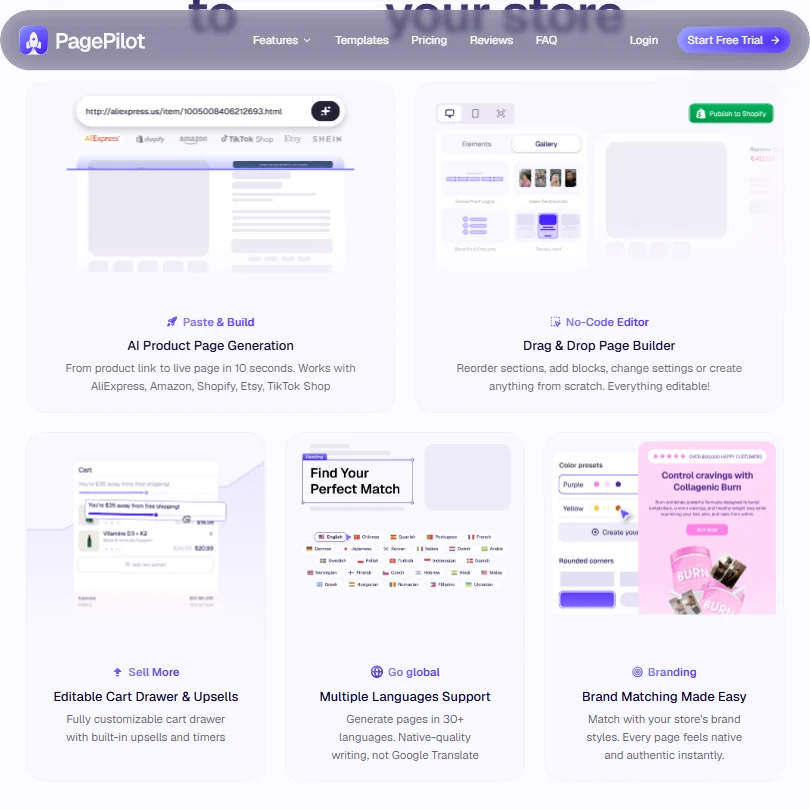
Aimed squarely at Shopify merchants who move fast and don't want to hire a designer. That's the whole pitch. Paste a product URL from AliExpress, Amazon, or Etsy, pick a template, and the AI generates the page, including copy and product images, then you publish directly to Shopify. Their own numbers claim over 400,000 merchants have tried it, which is a specific enough figure that we're inclined to take it at face value. What separates it from something like GemPages is the AI content layer. GemPages is a capable builder, but you're still doing the writing. Pagepilot tries to close that gap by generating copy and visuals from the source URL itself. Whether it closes it well enough to publish without editing is a different question. Honestly, the concept is right for this audience.Pagepilot Features: Product Listings, Bulk & Marketplace Tools
Pagepilot AI Writing Quality: Are the Product Descriptions Good?
Most uncertain section. Pagepilot isn't on G2 or Capterra in any meaningful volume, so we can't pull star distributions or reviewer patterns the usual way. What we found on Reddit and Product Hunt leans positive, but not uniformly. The template quality gets consistent praise, and the initial AI output is described as a usable starting point. The word "branded" comes up repeatedly across threads, which suggests the styling lands more reliably than the copy does. A few discussions mention editing descriptions before publishing rather than running them as-is. We're skeptical of any AI page tool that claims zero editing is needed. The honest use case here is a strong first draft. Not a finished product.Pagepilot Marketplace Support: Shopify, Amazon & Beyond
Imports work from AliExpress, Amazon, Etsy, and Shein, plus native Shopify products. That covers most active dropshipping workflows. Publishing, though, goes only to Shopify. No WooCommerce. No other native destination. That focus is defensible, but it's a hard stop for anyone not already on Shopify. Worth confirming before you start a trial. The Shopify integration is the anchor around which everything else is built. The imports, the image generation, the page builder itself, all of it exists to feed one publish target. We've watched tools try to support every platform at once and end up doing none of them well. Pagepilot didn't do that. That tracks.Is Pagepilot Easy to Use?
Based on what we read across vendor docs and user threads, yes. The drag-and-drop editor draws consistent praise. The URL-to-page workflow is fast enough that the "60 seconds" figure in their own materials doesn't seem implausible for simple products. Support runs 24/7 live chat plus Discord and email access. That's a meaningful amount of support infrastructure for a tool starting at $39 a month. The help center gets described as basic. Not a dealbreaker at this price, but if you hit edge cases, you'll be leaning on live chat rather than finding answers on your own. The onboarding story is one of the cleaner ones in this category. No credit card required to start the trial. No stated time limit on the trial either. For merchants already skeptical of subscription commitments, that's a lower-friction entry than most competitors offer.Pagepilot Pricing: Is It Worth It for E-Commerce Sellers?

Pagepilot vs GemPages: Which E-Commerce AI Tool Is Better?
GemPages is the more established builder. Deeper template libraries, more documented conversion features, a larger review footprint. But it doesn't generate product descriptions or ad creatives natively. You're using it as a design tool, not a content tool. Pagepilot inverts that priority. The AI content generation is the product, and the page builder exists to give that content somewhere to live. High-volume dropshippers who need a fast visual and written asset pipeline will find Pagepilot the better fit. Merchants building a brand where design precision matters more than turnaround time will find GemPages has the edge. Different jobs. Neither is wrong.Who Should Use Pagepilot? (And Who Shouldn't)
Dropshippers running volume. Clearest fit. Testing 20 products a month and needing pages that look credible fast, that's the use case Pagepilot is built around. Established brands with strong design systems should look elsewhere. The AI templates are impressive for speed, but you'll hit limits when your brand standards conflict with what the generator produces. Anyone not on Shopify should stop here entirely. No path forward for them. Merchants whose main need is bulk catalog content rather than page design might also look at Hypotenuse AI, which covers that ground more deeply and without the Shopify dependency.Pagepilot Review Verdict
Pagepilot does what it says. The URL-to-Shopify-page pipeline is genuinely fast, and bundling AI image generation with every plan at $39 is a pricing move that's hard to dismiss when you compare it against what competitors charge for the same capability as an add-on. The writing quality needs a human pass before publishing, but that's true of every AI content tool in this category without exception. The gaps are real. The refund policy is conditional enough to read carefully before committing annually. WooCommerce support doesn't exist. Documentation on several features is thinner than we'd like. And the review footprint is slim enough that we're working with less user data than we'd normally want before publishing a take. Not a pass, not a problem. A tool that works for a specific kind of seller, priced reasonably for what it delivers.Frequently Asked Questions
Does Pagepilot work with WooCommerce or other platforms?
No. Publishing is Shopify-only. You can import product URLs from Amazon, AliExpress, Etsy, and Shein, but the only native publish destination is Shopify. If your store runs on WooCommerce or anything else, Pagepilot isn't the tool.
Is there a free plan or just a free trial?
Free trial only, no permanent free tier. The trial carries no stated time limit and doesn't require a credit card upfront, which is a lower commitment than most tools ask for. To publish pages to your store, you'll need a paid plan starting at $39 a month.
Does Pagepilot include AI image generation on the base plan?
Yes, and that's one of the more notable things about the pricing structure. AI product images, including photoshoot-style shots and ad creatives, are included on every plan, not locked behind the top tier. For a $39 monthly subscription, that's a meaningful amount of functionality that would normally require a separate tool or a higher-tier upgrade with most competitors.