Replo is an AI agent and page builder for Shopify, sold as two separate products under one pricing page: an agent that builds and edits pages from a prompt, and a Theme Builder for landing and theme pages. What decides whether it suits you is which of those you need, since each is metered differently even though the headline prices match.
What is Replo?
Replo is built by a small team based in San Francisco. It is a page and site builder for Shopify, and it has no listing in the Shopify App Store; a store connects to it through Replo's own native Shopify integration instead.
What you can build with Replo

The Theme Builder plan table lists an intuitive drag-and-drop editor for landing and theme pages. Replo Agent is a chat interface that can build and edit pages and sections from a prompt, using live Shopify data to keep them accurate. For code-level changes, Replo supports a Git-based workflow that connects to Cursor, Claude Code or another coding client, so edits can be made locally and then committed and pushed after each turn.
Pages publish back to a merchant's own Shopify store. Checkout stays on Shopify; Replo does not provide its own checkout, though it reviews checkout paths for friction as part of building a page. Built-in A/B testing is metered by session volume, with 5,000 A/B test sessions a month on the Theme Builder's Starter plan. Replo syncs products already in a merchant's Shopify catalogue rather than sourcing or importing new ones to sell. Its integrations page is a directory of official integrations Replo built itself, not a marketplace of third-party add-ons.
Integrations and setup
Replo runs in the browser, with no mobile or desktop app. Its documentation includes a dedicated API reference and an SDK reference for custom development. Named integrations include Figma, Klaviyo, Meta, TikTok, Google Ads, Attentive, Customer.io, Shopify, Recharge, Loop Returns, Smile.io, Google Analytics 4, Slack, Notion, Triple Whale and PostHog, among others.
Replo pricing: what each plan gives
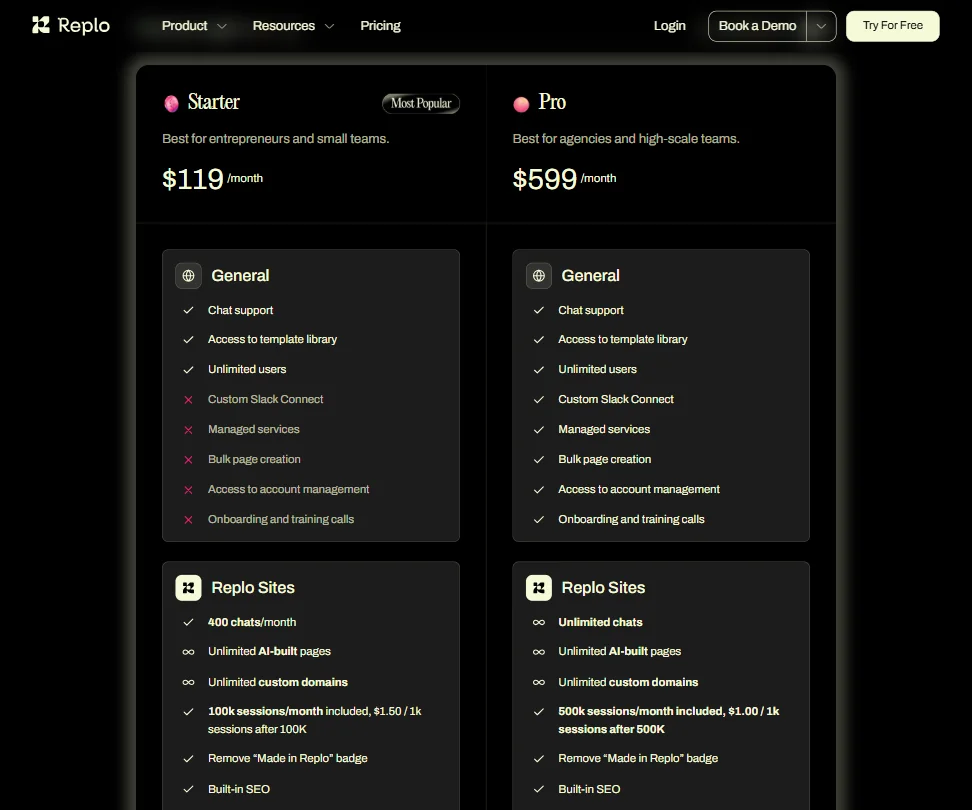
Starter costs $119 a month, or $99 a month billed annually. Pro costs $599 a month, or $499 a month billed annually. Replo sells the agent and the Theme Builder as two separate products at those same headline prices, but each meters something different: the agent by monthly AI-agent credits plus an included visitor-session allowance, the Theme Builder by published Shopify items and A/B test sessions.
Starter, the cheapest paid tier, gives 10,000 agent credits a month, 100,000 included visitor sessions, and custom domains. Pricing grows with visitor sessions past that allowance, with volume session pricing discounted 33 percent on Pro.
The free plan does not expire, but has no custom domains and no included visitor-session allowance, with basic email support only. There is no minimum contract term; plans run monthly or annually by billing choice.
Privacy and security
Support on Starter is basic email only. Pro adds priority chat, a dedicated Slack channel and a dedicated account manager, plus 1:1 onboarding and training that is not included on Starter.
Who Replo suits
Replo suits Shopify merchants who want an AI agent to build and edit pages from a prompt, or developers who want direct code access to a site through Git and their own coding client. It also suits teams who want built-in A/B testing tied to session volume rather than a fixed page cap.
It suits less well anyone building outside Shopify, since Replo works with Shopify only, or anyone on the free plan who needs a custom domain or an included visitor-session allowance, since neither is part of that tier.
How Replo compares
Replo scores 6.0 out of 10 among the AI store and page builders we rate. These three do the same job and are the closest to it, compared on what each vendor publishes.
GemPages
Replo starts at $119 a month and scales with visitor sessions; GemPages is flat at $29 a month with a free plan, making it the far cheaper entry point. GemPages also ships 200 templates. Replo counters with a public API and a longer integrations list at 25 against GemPages' 11, plus more support channels. Both build pages on Shopify without their own checkout.
Pick GemPages if you want templates ready to go and a free plan to start on.
Pick Replo if you need a public API and more integrations and can absorb session pricing.
Pagepilot
Replo starts at $119 a month with pricing that scales by visitor sessions and includes a public API and 25 integrations. Pagepilot is flat at $39 a month, publishes only 8 templates, and adds a dropshipping product finder that Replo does not have, plus support for more than one Shopify store on one account. Replo also gives you code access through a Git-based workflow.
Pick Pagepilot if you want built-in dropshipping product sourcing at a flat lower price.
Pick Replo if you need a public API, more integrations and Git-based code control.
Runner AI
Replo is a $119-a-month page builder for an existing Shopify store, priced by visitor sessions, with a public API and Git-based code access. Runner AI is a full store builder from $25 a month plus a declining per-sale fee from 3.5% down to 1%, with its own checkout from the Plus plan and no code editor for merchants. Replo has no dropshipping or product-sourcing feature; Runner AI sources products on every tier.
Pick Runner AI if you want a complete store with checkout and built-in product sourcing.
Pick Replo if you want direct code control and a public API for pages on your existing store.
Frequently Asked Questions
How much does Replo cost?
Starter costs $119 a month ($99 a month billed annually) and Pro costs $599 a month ($499 a month billed annually). A free plan is also available, though without a custom domain or included visitor sessions.
Which store platforms does Replo work with?
Replo works with Shopify only, connecting through its own native Shopify integration rather than a Shopify App Store listing.
Are Replo Agent and the Theme Builder the same product?
No. They are sold as two separate products at the same $119 and $599 starting prices, but Replo Agent meters monthly AI-agent credits and visitor sessions, while the Theme Builder meters published Shopify items and A/B test sessions.
Does Replo offer an API for custom development?
Yes. Replo's documentation includes a dedicated API reference and an SDK reference for building custom integrations.