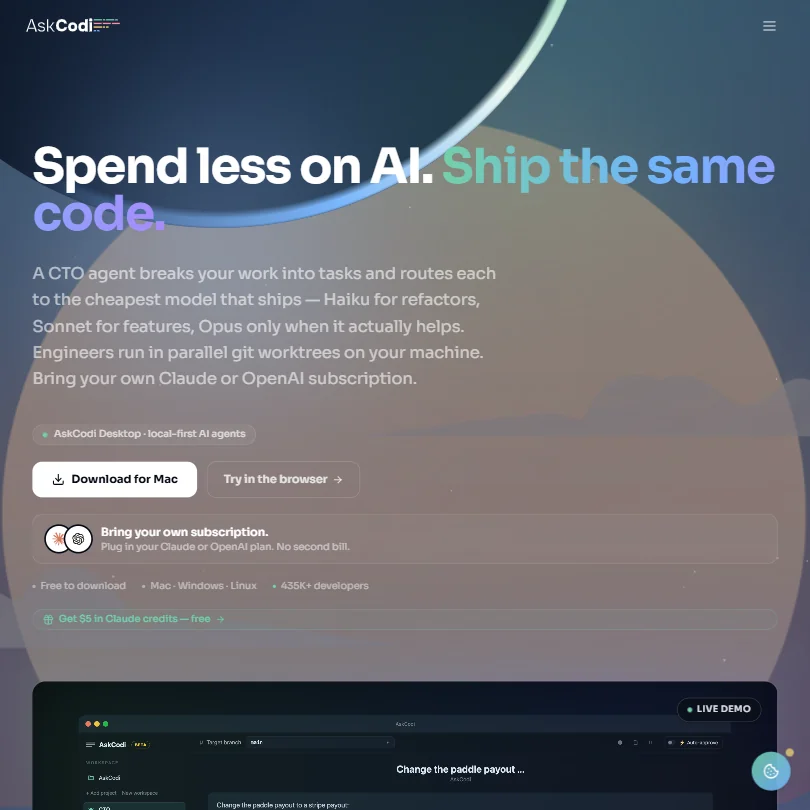
Our research on AskCodi started with the homepage and the site's documentation pages. Founded in 2021, AskCodi has spent a few years building something that doesn't slot cleanly into the usual AI coding assistant category. That's either a genuine differentiator or a positioning problem, and we weren't sure which until we got deeper into the docs.
What is AskCodi?
Not a code completer. Not a chat interface you bounce syntax questions off. The actual pitch is closer to: describe a feature, and a coordinated swarm of specialist AI agents splits the work, runs it across isolated git branches in parallel, reviews each other's output, and hands you a diff to approve or reject.
The CTO agent sits at the top of that stack, reading your brief and routing subtasks to agents focused on tests, security, and refactoring respectively. It also tries to pick the cheapest suitable model per task. Haiku for lighter refactors. Sonnet or Opus when complexity demands it. We haven't seen many tools make cost optimization a structural part of the architecture this explicitly, and we cross-referenced several competitor docs to confirm that.
They also support bring-your-own-subscription. Connect your Claude or OpenAI account and AskCodi runs on top of it. Developers already paying for Claude Pro or a GPT-4 API key don't pay twice. That's a real differentiator, not marketing language.
AskCodi Features: Code Generation, Review & Developer Workflow
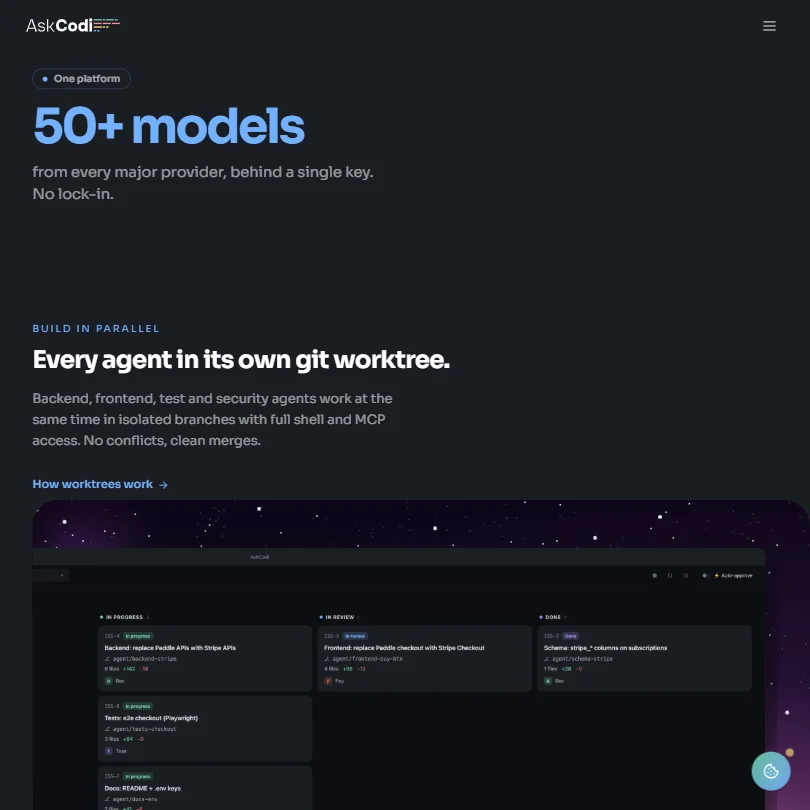
The core loop: you describe what you want built, the CTO agent splits it into chunks, specialist agents pick up those chunks in separate git worktrees, and another agent reviews each output before anything touches your main branch. You see the diff. You decide.
Outside that orchestration layer, AskCodi ships what you'd expect from any AI coding assistant. Code completion and documentation generation. Unit test creation and cross-language translation. Codi Chat handles conversational coding. Codi Workbooks look closer to a notebook environment for experimentation.
Honestly, the orchestration is where the interesting stuff lives. The rest is table stakes in 2024.
They also run an MCP layer, Model Context Protocol, which lets agents issue shell commands and call external tools. Full CLI access. Most competitors keep agents sandboxed. AskCodi's can actually run things, which is not common at this price tier.
AskCodi Code Quality: How Accurate and Reliable Is It?
G2 sits high, somewhere north of 4.8, across roughly 100 reviews. High number, modest volume.
The idea of agents reviewing each other's output before a merge is sound architecture. Whether it actually reduces bugs in practice depends on which models the CTO agent selects and how cleanly the original brief was written. We didn't find many specific failure cases documented in AskCodi's public docs. That could mean it works well. It could also mean the user base is still small enough that edge cases haven't surfaced loudly yet.
We're cautiously optimistic. The architecture makes sense. The track record is thin.
AskCodi IDE & Workflow Integration: Where Does It Work?
VS Code gets the extension. The desktop app covers Mac, Windows, and Linux. AskCodi supports JetBrains IDEs through Continue.dev; a separate first-party AskCodi JetBrains plugin is not clearly listed, and teams relying on IntelliJ or WebStorm should verify that before committing to a plan.
Git integration is baked into the agent architecture, not bolted on afterward. Parallel git worktrees mean agents are working in genuinely isolated branches. Cleaner than tools that generate code and drop it into your working directory.
The OpenAI-compatible API means you can script workflows or plug AskCodi into CI pipelines. Most users won't touch it on day one. Worth knowing it exists.
Is AskCodi Easy to Set Up and Use?
The documentation is functional. Not exceptional. AskCodi Desktop itself is free to use, with no card required; you only pay when you use models through your own provider account or optional AskCodi API credit. That's a real free tier, not a 14-day trial with a countdown.
BYOS setup adds steps. Connecting your Claude or OpenAI subscription is genuinely useful once it's running, but it's not a five-minute onboarding for someone new to API keys. Fair warning.
The multi-agent code generation workflow also rewards clear technical briefs. Vague input produces vague output. That's true everywhere, but it matters more here because a bad brief at the top cascades across several agents running in parallel. The blast radius of a poorly scoped request is larger than in a single-agent tool.
Community support lives in Discord. That's lean. We've seen worse, but we've also seen better at this price point.
AskCodi Pricing: Is It Worth It for Solo Devs and Teams?

Four tiers. AskCodi Desktop is free to use; you pay only for model usage through your own provider account or optional AskCodi-managed API credit. The free plan includes custom agents and an OpenAI-compatible API, which is a genuine offering.
Whether that math works depends entirely on how heavily you're using the orchestration layer. Solo developer running occasional tasks, Starter is probably enough.
Cancel or change plans anytime is what the site says, which is standard SaaS language. It doesn't tell you what happens to the current billing period if you upgrade mid-cycle. Worth asking before you commit to Pro.
No enterprise tier is listed publicly. That's a gap. Augment Code has more explicit enterprise-level controls if that's the requirement.
AskCodi vs GitHub Copilot: Which AI Coding Tool Is Better?
Different tools, different jobs. GitHub Copilot lives in your editor and helps you write the next line. AskCodi is trying to write the next feature. Not a subtle distinction.
Copilot wins on IDE integration depth and sheer ubiquity. Cheaper at the individual tier too. Inline suggestions as you type, Copilot is the better fit. Not close.
AskCodi wins when you want orchestrated multi-agent code generation where the tool handles a full task end-to-end and brings back a reviewed diff. That's a different use case. Not inherently better, just different.
Cursor is the closer comparison. Cursor's agent mode handles complex, multi-file codebases and its IDE integration is deeper. More established user base. AskCodi's edge over Cursor is the local-first privacy posture and the BYOS model. Cursor runs its own model infrastructure. AskCodi lets you supply your own. For developers already paying Anthropic or OpenAI, that matters.
Who Should Use AskCodi? (And Who Shouldn't)
Solo developers already paying for Claude or OpenAI access. Clearest fit. BYOS means no double-paying for model access, and the agent architecture lets one person punch above their weight on feature development.
Privacy-focused developers. Code runs locally, according to their docs. The local-first desktop app is the actual architecture, not a tagline. If your codebase can't touch external servers, that's meaningful.
Who shouldn't? Teams depending on JetBrains should verify IDE support carefully before signing up. Developers who want fast inline autocomplete should look at Copilot or Codeium instead. AskCodi is slower by design. Agents do more work, and more work takes time.
Beginners might also struggle with the brief-writing requirement. That's not a knock on AskCodi specifically. It's a fit issue.
AskCodi Review Verdict
Doing something genuinely different. The local-first multi-agent orchestration concept kept pulling us back during research, because most tools in this space are still racing to improve autocomplete quality. AskCodi is betting that the real value is in running a coordinated AI engineering team on your machine.
Whether that bet pays off at scale depends on execution. The G2 reviews are positive, but the gap between "400,000 users" as a headline number and roughly 100 public reviews is worth noticing. The jump to Pro is a commitment.
The BYOS support for Claude and OpenAI is the practical win that separates AskCodi from most of the field. If you're already paying for model access elsewhere, not paying again is real money. That alone is worth considering seriously.
We'd want to see tighter documentation, a clearer enterprise path, and more public evidence of the multi-agent review loop catching real bugs before calling this a definitive recommendation. Right now it's a smart architecture that needs more miles on it. Not great at the edges. Interesting at the core.
Frequently Asked Questions
Does AskCodi work with your own Claude or OpenAI subscription?
Yes, and it's one of the more practical reasons to try it. The bring-your-own-subscription model lets you connect existing Claude or OpenAI API access. You're not paying AskCodi for model usage on top of what you're already paying Anthropic or OpenAI. That compounds into real savings for developers running heavy workloads.
Is AskCodi's code kept private?
The local-first architecture means code runs on your machine and, according to their published docs, doesn't leave it. That's a meaningful claim for developers on proprietary codebases. We'd still recommend reading their privacy policy directly before connecting a sensitive repo. "Local-first" can mean different things depending on what telemetry a tool collects in the background.
How does AskCodi compare to Cursor for agentic coding?
Cursor has more polish and a larger established user base. Its agent mode handles complex multi-file tasks and the IDE integration is deeper and better documented. AskCodi's edge is the local-first privacy posture and the BYOS option. Already paying for Claude Pro and want to keep code off external infrastructure, AskCodi makes the stronger case. Want the more proven agentic workflow with fewer setup variables, Cursor is the safer bet today.