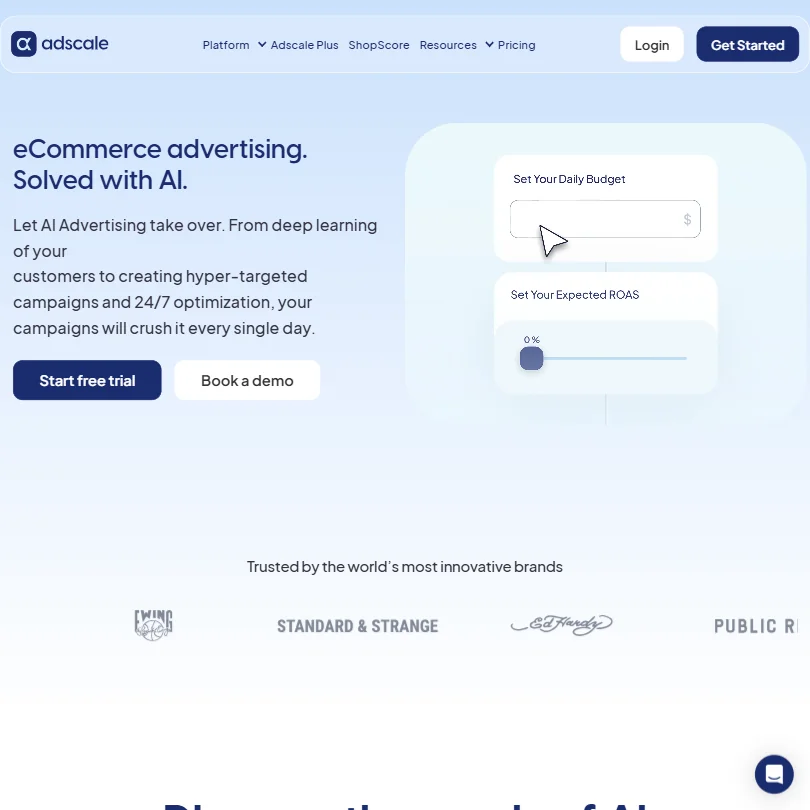
We pulled vendor documentation, worked through the available Shopify app listing details, and cross-referenced what users were saying across Reddit threads and third-party forums. No hands-on testing. That comes separately. But what we kept seeing across multiple sources gave us enough to form a real picture of what AdScale is, who it's for, and where it falls short.
AdScale launched out of Tel Aviv in 2017 and has connected with over 1,000 stores since. The pitch is AI-powered ad management across Google and Meta. Build campaigns, allocate budgets, optimize bids, generate creative. All automated. That's a crowded space, and AdScale knows it, which is why they lean hard on their proprietary Audience Signal Graph and a three-layer AI model that combines structured learning, unstructured learning, and reinforcement learning into one engine.
Whether that triple-layer framing is genuinely differentiated or just good marketing copy is the real question.
What is AdScale?
The platform is built for ecommerce businesses and uses first-party store data to manage advertising across Google and Meta. Connect your store, let it read your product catalog, and it builds campaigns, then keeps optimizing them around the clock. The 24/7 intraday budget reallocation is one of their more concrete claims. Not "we optimize daily." Intraday. Budget moves happen in real time as performance data shifts.
Two main audiences show up consistently in AdScale's positioning: direct-to-consumer brands running their own Shopify or WooCommerce stores, and marketing agencies managing multiple ad accounts. There's a self-service tier and a fully managed option they call AdScale Plus. They also have a product called ShopScore, which appears to analyze store health, though documentation on it is sparse relative to the core ad platform.
Honestly, the product surface is broader than you'd expect for a company this size. That's not always a good sign.
AdScale Features: Product Listings, Bulk & Marketplace Tools

Campaign creation is where AdScale does most of its work. Feed it your store data and it maps products to campaign types across Google Search, Performance Max, and Display, plus Meta placements. It's not manual campaign building. The AI constructs targeting logic, copy, and creative, then launches.
Automated campaign creation at scale is the feature most users point to when explaining why they signed up. The live store-to-ads sync also stands out. When a product goes out of stock, AdScale catches that and pulls it from active campaigns automatically. We read several accounts from Shopify merchants who said this alone saved them real money in wasted spend.
Budget Groups are another concrete feature. You set a goal and a total budget. The AI distributes spend across channels and campaigns based on performance signals. Two things here: you don't need to babysit individual campaign budgets, and the system theoretically chases ROAS without manual bid rules. Whether it does that well is a different question, which we'll get to.
A/B testing exists in the creative layer. The AI models different creative variants and predicts winners before significant budget burns on losers. Fair. That's useful if it works as described.
AdScale AI Writing Quality: Are the Product Descriptions Good?
They call it Magic AI copy. It generates ad copy for Google and Meta placements, pulling from your product catalog and store data. The AI tailors copy to platform norms, so Google Search ad copy looks different from a Meta carousel headline. In theory.
We couldn't find detailed user feedback specifically on copy quality. Most reviews focused on campaign performance and budget optimization rather than whether the generated headlines were any good. That tells us users are probably treating copy output as a starting point, not a finished product.
Ecommerce teams needing bulk product content generation across a full catalog should know AdScale isn't built for that job. A platform like Hypotenuse AI goes much deeper on PIM enrichment and image work. AdScale's copy features support its ad campaigns. They're not a standalone content tool.
Not a knock on AdScale. Just a different job.
AdScale Marketplace Support: Shopify, Amazon & Beyond
Shopify and WooCommerce are the two native store integrations. That's it for commerce platforms. No Amazon. No Etsy. The ad-side coverage is stronger: Google's full suite and Facebook plus Instagram on the Meta side.
Amazon sellers: AdScale isn't relevant here. The platform is built for businesses using their own storefront, not marketplace listings. Sellozo is worth a look for that specific use case.
The absence of Amazon support will disqualify AdScale for a meaningful chunk of ecommerce operators. That's a scope decision, not a flaw exactly. But it's better to know upfront than after you've connected your store.
API access isn't publicly documented. Zapier isn't mentioned anywhere we could find. For agencies wanting to build custom workflows, that's a real limitation.
Is AdScale Easy to Use?
This is where the research gets murkier. AdScale's onboarding materials describe a guided five-step setup. Connect your store, let the AI analyze your data, set your budget and goals, then let it run.
Some users who are new to PPC report a learning curve, although others find the setup and dashboard straightforward. What we kept seeing was a pattern: people who came in expecting a pure set-it-and-forget-it experience got frustrated. Users with existing Google Ads or Meta experience found the automation genuinely useful because they understood what was being abstracted away. That tracks. The platform is automating sophisticated campaign logic, and if you don't know what's happening underneath, you're flying blind.
Support may include account-manager assistance, while chat support is also available through the dashboard. The dedicated account manager model is specifically tied to the managed service tier, not universal. Onboarding quality, as a result, probably varies depending on which manager you get.
AdScale provides a public help center and video guides, but no separate community forum was found. The help center covers ads, segments, technical issues, Google and Meta integrations, and includes AdScale Academy video content. That's a real resource. The missing piece is a community layer where users can share what's actually working.
AdScale Pricing: Is It Worth It for E-Commerce Sellers?
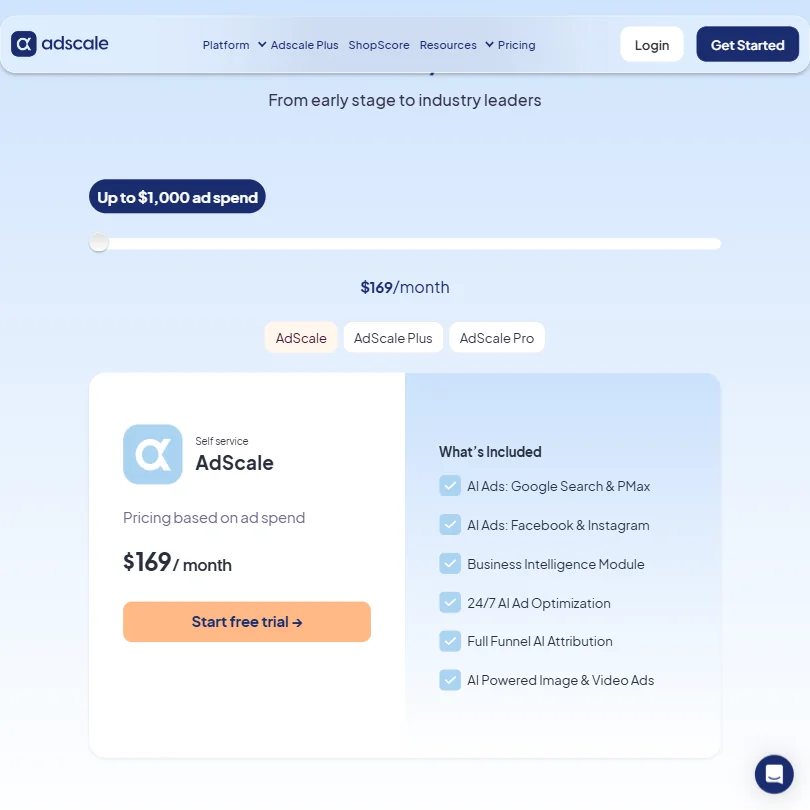
Pricing is tiered. The Starters Only plan runs $490 per year for stores processing up to 25 orders per month. Basic is $169 per month for up to $1,000 in monthly ad spend. Growth is $249 per month for up to $2,000 in monthly ad spend. Higher self-service tiers cover spend up to $10,000 per month, though exact prices for those aren't fully published. AdScale Plus, the managed service for businesses spending more than $10,000 per month, is custom-quoted.
AdScale offers a 14-day free trial on its standard plans. The Shopify listing shows a separate 30-day trial for the Starters Only plan. That's a real answer, and it's better than the vague "start free trial" button experience that many competing tools give you. No free tier exists beyond those trials.
At $169 per month against a $1,000 ad spend cap, the tool costs roughly 17% of your total ad budget at the base tier. For larger spenders, the percentage drops as you move up. Standard for this category. But for a small store testing paid ads for the first time, that ratio is hard to justify.
Refund policy isn't stated publicly. That matters. SMS and email credits are available for an additional charge, though complete credit pricing isn't displayed. Worth asking about before you sign.
Madgicx sits in a similar price range. Revealbot starts lower. We're skeptical that pricing alone closes the argument. The value case for AdScale rests on whether the AI optimization actually outperforms what you'd get from a cheaper tool or a hands-on media buyer.
AdScale vs Madgicx: Which E-Commerce AI Tool Is Better?
Madgicx is the obvious comparison. Both run AI-powered ad automation across Google and Meta for ecommerce brands. Both claim automatic budget optimization.
Where they diverge: Madgicx puts more emphasis on creative analytics and audience insights as features you can explore and act on yourself. AdScale wraps everything into a more opinionated, unified campaign management flow. If you want to dig into data and build your own optimization logic, Madgicx gives you more surface area. If you want the AI to handle it with less manual input, AdScale's approach is more closed-loop.
Madgicx has more public review data, which is a real transparency gap for AdScale. It's listed on G2 and Capterra with enough reviews to identify patterns. AdScale isn't listed on either platform as of our research. That absence doesn't mean the product is bad. It does mean you're making a higher-trust purchase decision without the social proof that would normally support it.
Smartly.io competes in an adjacent lane but skews enterprise and gets expensive fast. Perpetua is Amazon-focused, which puts it in different territory from AdScale entirely.
Who Should Use AdScale? (And Who Shouldn't)
Shopify or WooCommerce stores spending several thousand dollars a month on Google and Meta. That's the fit. The AI optimization needs meaningful spend data to generate useful signals. A store running $200 a month in ads won't generate enough.
Marketing agencies managing multiple ecommerce clients are the other clear use case. The AdScale Pro tier is built for that workload, and the Budget Groups feature specifically addresses multi-account management.
Small stores on tight margins. That's where AdScale stops making sense. The starting price consumes too much of a limited ad budget to justify.
Amazon-first sellers. Already covered, but worth repeating.
Brands needing deep creative production, not just AI-generated ad copy, should look elsewhere. AdScale's creative features support its campaign work. They're not a replacement for a dedicated creative workflow.
AdScale Review Verdict
AdScale does a lot in one place. Campaign building, budget optimization, creative generation, store sync, intraday reallocation. The Audience Signal Graph and the three-layer AI model are interesting differentiators on paper. Whether they produce better ROAS than a competing tool or a hands-on media buyer is harder to verify without substantial public review data to anchor the claim.
The lack of presence on G2 and Capterra is the single thing we'd push hardest on. For a company founded in 2017 with over 1,000 connected stores, that's a choice, not an oversight. It limits our ability to recommend with confidence.
Pricing is reasonable at scale. It's harder to swallow at the entry tier. The 14-day trial is a real, stated commitment, which is better than we expected. The missing refund policy and incomplete higher-tier pricing are transparency gaps that matter before you sign.
What we'd tell someone seriously considering AdScale: run it against Madgicx with a defined test window and compare performance on your actual account. Ask about cancellation terms before clicking through. Don't buy the three-layer AI story. Buy the results.
Frequently Asked Questions
Does AdScale work with Shopify?
Yes. Shopify is one of AdScale's primary native integrations. The platform syncs directly with your store to pull product data, track inventory, and update active campaigns when products go out of stock. WooCommerce is also supported.
Is there a free trial for AdScale?
AdScale offers a 14-day free trial on its standard Basic and Growth plans. The Shopify listing shows a 30-day trial for the Starters Only plan. No permanent free tier exists.
How does AdScale compare to Madgicx?
Both tools automate Google and Meta ad campaigns for ecommerce brands and sit in a similar price range. Madgicx offers more surface area for creative analytics and manual exploration. AdScale takes a more opinionated approach where the AI handles more of the decision-making. Madgicx also has public reviews on G2 and Capterra, which makes it easier to verify user satisfaction at scale. AdScale doesn't, and that's worth factoring into your decision.