What is Salesloft?
Founded in 2011, out of Atlanta. That's long enough to have survived at least two full waves of sales tech consolidation, and Salesloft came through both with a bigger product than when it entered. What started as a sales engagement platform has grown into something the company now calls a Revenue Orchestration Platform. Whether that label reflects genuine product evolution or just rebranding for the AI era is a fair question. We think it's mostly earned, with some caveats.
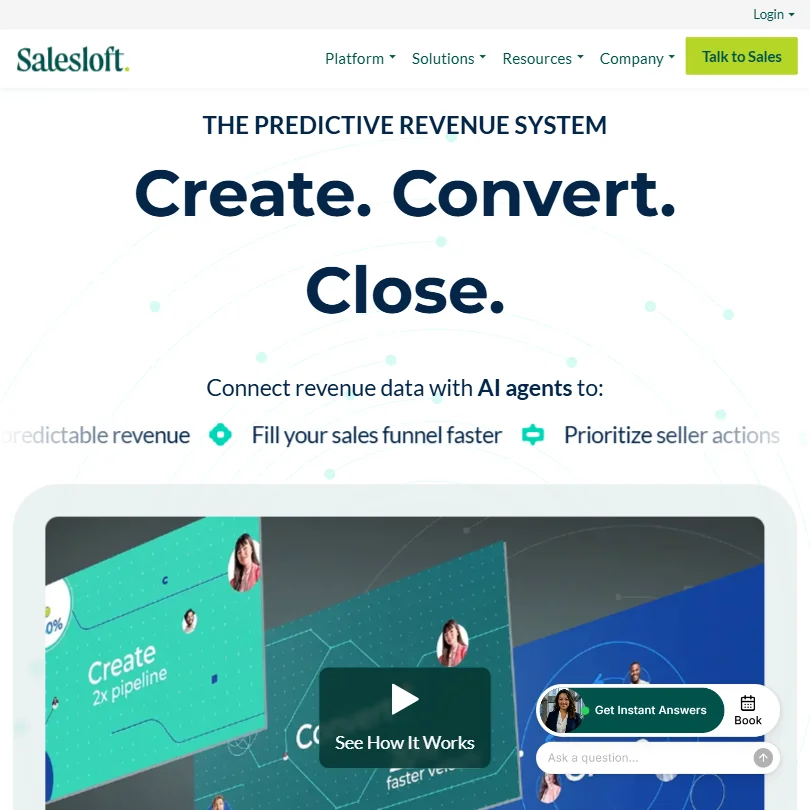
The modules are real and distinct. Cadence handles multi-step outreach sequences. Rhythm sits above it and prioritizes what sellers should do next based on buyer signals. Deals manages pipeline and flags risk. Forecast does what it sounds like. Conversation Intelligence records and analyzes calls. Chat Agents handle inbound website visitors. That's first touch through renewal, and the claim holds up structurally better than most vendors who make it.
Over 4,000 customers use it. The core audience is B2B revenue teams: sales leaders, account executives, SDRs, and revenue operations people who need one place for all of it. The AI model is proprietary. Salesloft doesn't disclose specifics about the underlying architecture, which is increasingly unusual in this market but not disqualifying. Most of the AI claims live inside what they call their Predictive Revenue System, which connects the modules together into something they position as a unified intelligence layer.
Salesloft Features: Workflows, AI Agents & Automation Capabilities
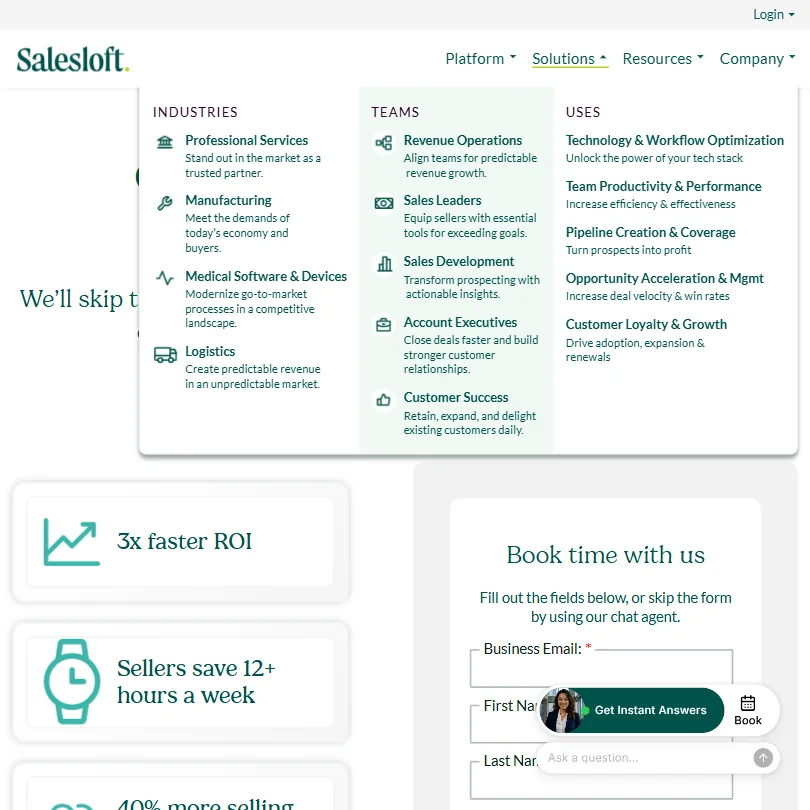
The Cadence workflow builder is the historical core and still the thing most teams adopt first. Visual, multi-step, the kind of sequence builder that sales ops teams know how to move through without hand-holding. Trigger types include scheduled runs, CRM events, email replies, call outcomes, and webhooks. That's meaningful coverage. Most competitors in this category hit three or four. Salesloft covers all of those and a few others.
Rhythm is the newer, more interesting layer. It aggregates buyer signals from across the platform and tells sellers what to act on next, not in a vague task-queue way, but in a prioritized, signal-weighted way. G2 reviewers in sales leadership roles call this out specifically as a reason for renewal. That tracks with what we saw across community threads.
The Deals module surfaces deal risk alerts and visibility into where opportunities are stalling. Useful on its own. More useful because it feeds directly into Forecast, which gives revenue leaders actual data to work with instead of spreadsheets and instinct. We cross-referenced vendor documentation with user reports, and the consensus is that Forecast genuinely replaces something messier for most teams that adopt it.
Conversation Intelligence handles call recording and analysis. Coaching tools sit inside it. Team performance dashboards and Focus Zones for individual sellers are both part of the package. On integrations, Salesforce and Microsoft Dynamics are the anchors, LinkedIn Sales Navigator is a real connector rather than a surface-level one, and Slack and Google Workspace are both supported, along with a marketplace that reaches 500-plus total connections.
The Enterprise Data Platform sits underneath all of this and unifies revenue data across the system. Without it, the AI agents are working with incomplete inputs. That infrastructure investment is part of the reason pricing lands where it does.
Salesloft Automation Power: How Complex Can Your Workflows Get?
The trigger set is mature for a sales context: scheduled runs, buyer signals, CRM events, email replies, call outcomes, webhooks. Conditional logic lives inside Rhythm, where it factors signal strength and deal risk into action prioritization. That's not a visual if/then branch builder, which some technical users will miss. But for revenue workflows specifically, it may be more practically useful than raw branching logic.
Honestly, the automation here is purpose-built and it shows. Salesloft isn't trying to be Make. It's not a general-purpose connector across arbitrary systems. The automation is opinionated, designed specifically for revenue workflows, and doesn't pretend otherwise. Enterprise revenue operations people. That's the fit. If you need cross-department automation stitching together HR, finance, and sales into one flow, this is the wrong tool.
Custom code support isn't documented publicly. That's a real gap for technical users who want to inject their own logic. API and webhook support covers some of that ground indirectly, but it's not native custom code execution and shouldn't be described as equivalent.
Execution logs exist. Activity tracking across cadences is well-documented. Error handling in the Deals module is thoughtful in a specific way: deal risk alerts fire when opportunities go quiet or signals turn negative, surfacing problems in a way that prompts action rather than just logging them. That's a design choice worth noting.
Salesloft AI Agent Capabilities: What Can It Actually Do Autonomously?
"AI agents" is currently the most oversold phrase in B2B software. We went into this section skeptical. Salesloft's claims are more grounded than most, but not perfectly transparent.
The AI agents span email drafting, conversation analysis, inbound chat for website visitors, forecasting support, and prioritized seller actions through Rhythm. Email agents draft outreach. Conversation agents pull objections, themes, and next steps from recorded calls. Chat agents handle website visitors and try to convert them into pipeline. That's a real suite, not a single feature dressed up with "agent" terminology.
The human-in-the-loop design is deliberate. Sellers review and approve AI-recommended actions before they execute. We're not sure that's a limitation, actually. Given how often AI-drafted outreach reads like exactly that, a human checkpoint is probably the right architecture for most teams. The agents surface recommendations. Sellers act on them.
Ask how much of the "agent" behavior represents true autonomous execution versus smart prompting and surfaced recommendations. Vendor documentation leans into the "agents" framing as a positioning term without always being specific about what runs without human input. Not unique to Salesloft. Common across the category. But push on specifics before signing a contract that's partly justified by AI autonomy claims.
The Conversation Intelligence piece stands out within the AI agent platform framing. Near-real-time call analysis that feeds back into coaching and pipeline visibility is genuinely useful, and G2 reviewers mention it repeatedly enough that we take it seriously.
Is Salesloft Easy to Set Up Without Code?
No. Not for full deployment.
The Cadence builder is visual and a trained sales ops person can build sequences without engineering support. Fair. But connecting Deals, Forecast, Conversation Intelligence, and Rhythm into a working whole involves real configuration work. CRM integration, particularly with Salesforce, generates a recurring thread of complaints on G2. Field mapping, sync issues, and admin overhead come up consistently enough that we don't treat them as edge cases.
Salesloft offers Professional Services support, Customer Education materials, Office Hours, and a Champions Hub community for peer support. That infrastructure exists because setup is non-trivial. We'd call that honest rather than reassuring.
Reddit threads from 2024 surface a specific pattern: teams expecting to be operational in a few weeks ended up closer to a few months before the workflows they actually wanted were running. That timeline gap has direct cost implications and should factor into any implementation budget conversation.
G2 data does favor Salesloft on onboarding compared to its closest competitor. Salesloft scores 8.6 versus Outreach's 7.7 for Ease of Setup, and 8.8 versus 8.3 for Ease of Use. So relative to Outreach, the experience is meaningfully better. In absolute terms, it's still a complex platform. Those two things are both true.
Mobile apps on iOS and Android exist, along with a Chrome extension. Functional for day-to-day selling once configuration is done. Getting there is the hard part.
Salesloft pricing: what each plan gives
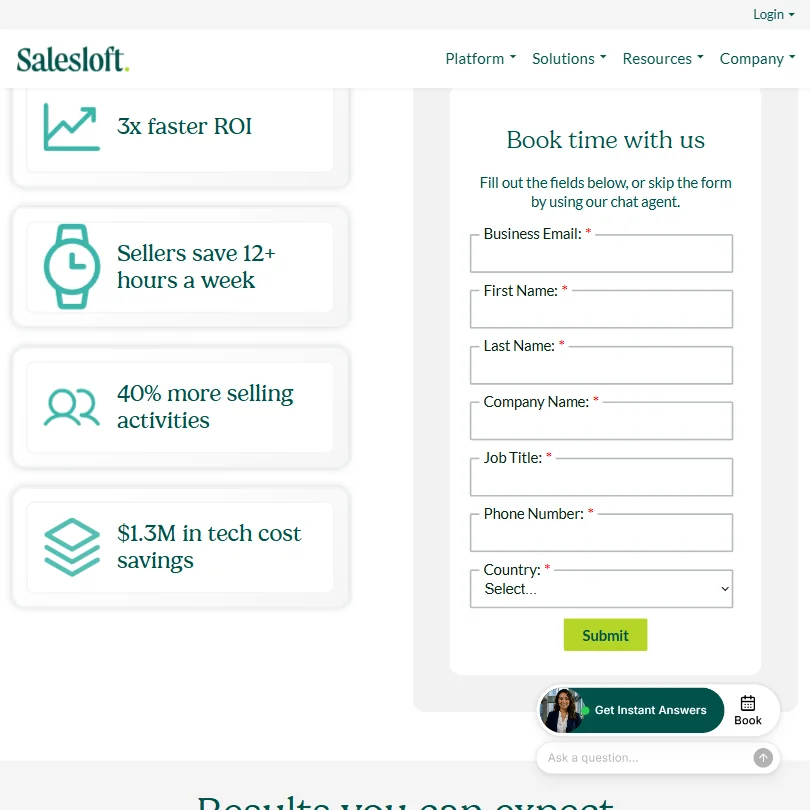
Nothing on the public pricing page tells you what you'll actually pay. Custom enterprise pricing, contact sales, no published tiers. We dug through what's publicly available and found exactly what we expected. This is a deliberate choice, not an oversight.
We're not fans of that approach. Community forum data suggests the numbers are enterprise-range, meaning thousands per seat per year rather than hundreds. Comparing that to Zapier is only useful as a framing exercise. Zapier is a connector. Salesloft is a full revenue platform. Different products, different budget conversations entirely.
No free plan exists, and no free trial is publicly offered. That's a real access gap for teams trying to evaluate before committing. You're trusting the demo to tell you enough, which is a significant ask given the implementation complexity described above.
The 3.3x ROI over three years figure, and the claims of sellers saving 12-plus hours a week and 40% more selling activities, come from Salesloft's own marketing, so treat them with caution. The pattern in G2 reviews from teams that stayed past the first renewal does suggest genuine value at scale. The problem is there's no low-cost way to test that before you're already committed.
Salesloft vs Outreach: Which Automation Platform Wins?
This comparison surfaces constantly in sales communities, and for good reason. Outreach and Salesloft have been trading the top spot in enterprise sales engagement rankings for years. They're close.
On usability, G2's current data favors Salesloft. The 8.8 versus 8.3 Ease of Use gap and the 8.6 versus 7.7 Ease of Setup gap are meaningful, not marginal. The G2 review summary explicitly notes Salesloft provides a more intuitive onboarding experience. The older narrative that Outreach generally wins on UI doesn't hold up against current data.
On forecasting, neither platform clearly leads. Outreach scores higher on Predictive Forecasting, Salesloft scores higher on Live Forecasting. G2's current forecasting scores are mixed, with neither platform clearly leading across all forecasting measures. Anyone telling you one obviously wins on forecasting is working from outdated comparisons.
Against HubSpot Sales Hub, the answer is clearer. HubSpot wins on price and accessibility. Salesloft wins on depth for enterprise revenue teams with real operational complexity. Apollo.io and ZoomInfo SalesOS used to compete mainly on data and prospecting. That's no longer accurate. Apollo now offers sequences, multichannel engagement, a dialer, conversation intelligence, and deal management. ZoomInfo describes itself in 2026 as an all-in-one AI GTM platform with intelligence, orchestration, and engagement layers. Gong remains the standalone conversation intelligence comparison, for teams that want that capability without the broader platform commitment.
The decision between Salesloft and Outreach usually comes down to CRM team preference and which UI sellers will actually open. We've seen teams pick Salesloft for Cadence and stay for Rhythm. We've seen others go to Outreach and not look back. Neither is obviously wrong at enterprise scale.
What Salesloft has that most competitors haven't matched is a genuinely unified data layer feeding all modules from one source. That architectural choice matters at 200-plus person sales orgs. Less so at 20.
Who Should Use Salesloft? (And Who Shouldn't)
Enterprise B2B sales teams with dedicated sales ops, a CRM administrator, and a budget that can absorb enterprise SaaS costs. That's the fit.
Revenue operations leaders who need pipeline creation, deal management, and forecasting in one platform will find real value here. The unified data approach earns its keep at that scale.
SDR teams at mid-market companies. Worth evaluating, but be honest about which modules you'll actually use. If you're buying the full platform and only running Cadence, you're paying for a lot you won't touch. That's a planning failure, not a product failure, but it happens often enough to be worth saying directly.
Small sales teams and early-stage startups should look elsewhere. Setup overhead alone is a problem. Pricing is a bigger one. There are workflow automation options built for leaner contexts that will deliver more value per dollar at that stage.
Solo sellers and small agencies. Not the right tool.
Salesloft Review Verdict
Seventeen consecutive quarters as an Enterprise Sales Engagement Leader on G2. That didn't happen by accident, and we don't treat sustained recognition as marketing noise. The platform breadth is real. The AI workflow builder in Cadence combined with Rhythm's signal-based prioritization is more thoughtful than what most competitors have shipped. Conversation Intelligence works. Forecast gets used, which is more than you can say for most forecasting modules in any category.
The access problem is real and shouldn't be minimized. No trial, no public pricing, setup complexity that can stretch to months. You're making a significant commitment before proving any value internally. That gap between promise and operational reality is where scrutiny should focus before signing.
The pricing opacity is the single thing we'd change. Not the price itself. The opacity. Teams deserve to understand what tier structure exists before sitting through three demo calls to find out they can't afford it anyway.
At enterprise scale, with proper sales ops support and a real CRM foundation underneath it, this platform delivers. The path to getting there is longer and more expensive than the marketing materials suggest. Go in knowing that.
Frequently Asked Questions
Does Salesloft offer a free trial?
Not publicly. No free trial is advertised on the Salesloft website, and no free plan exists. Evaluation means going through their sales process and requesting a demo. That's an intentional friction point, and knowing it upfront saves time before the first outreach.
What's the difference between Cadence and Rhythm in Salesloft?
Cadence is the sequence builder, where multi-step outreach workflows are designed with emails, calls, and tasks in defined order. Rhythm sits above it and uses buyer signals to tell sellers which of those actions to prioritize on any given day. Cadence is the plan. Rhythm is the daily prioritized list that adjusts based on what buyers are actually doing.
How does Salesloft compare to Outreach for enterprise teams?
Closer than the conventional wisdom suggests, but Salesloft holds a measurable advantage on usability and setup based on current G2 data. Rhythm and the unified data layer give Salesloft an edge in signal-based prioritization. On forecasting specifically, neither platform clearly leads across all measures. Both are legitimate enterprise choices. Run both through a demo before committing to either.