Prediko is an AI inventory management and demand planning app built for Shopify stores, covering forecasting, purchase orders and FIFO-based cost of goods reporting. What decides whether it suits you is whether inventory operations, rather than marketing or customer analytics, are the problem you need solved, since Prediko does not offer attribution or lifetime value tracking.
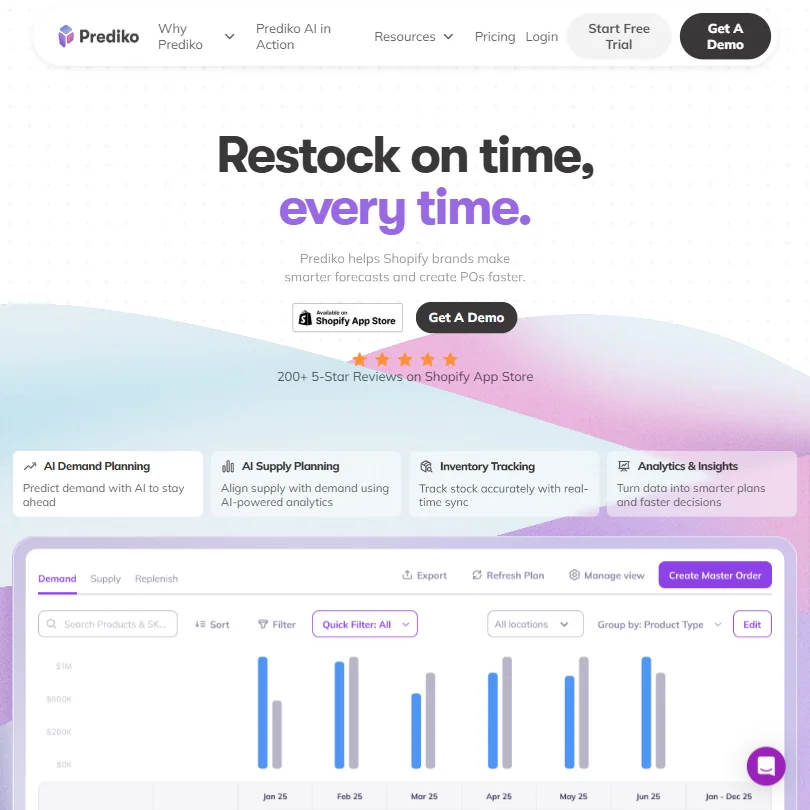
What is Prediko?
Prediko is built by Prediko Ltd, founded in 2022 and based in Paris, France. It works with Shopify, including Basic, Advanced and Plus stores, POS and B2B, and also covers Amazon and Etsy sales channels. It has a listing on the Shopify App Store and is a Shopify certified tech partner.
What Prediko measures
Prediko's core purpose is inventory: AI-assisted demand planning helps a store reach its revenue target, and AI supply planning generates a twelve-month purchase order calendar with buying alerts. Purchase order management and low-stock alerts run alongside a customizable analytics dashboard.
Profit and margin reporting comes from FIFO-based cost of goods sold with landed cost, which also flags estimated revenue lost per stockout and surfaces deadstock and overstock automatically.
Prediko does not track competitors' prices, does not offer benchmarking against other stores, and has no customer lifetime value, cohort or attribution features; it is built around inventory and demand rather than marketing analytics.
Integrations and setup
Prediko connects to more than 100 warehouse management systems and 3PL providers, including ShipBob, ShipHero, Extensiv, Dear Systems, Mintsoft and Packiyo, plus Xero and Quickbooks for accounting, and ChatGPT MCP and Claude MCP for AI assistants. Full API access is included on every paid tier.
A personalized onboarding session is included from the base plan, and support runs through chat, a dedicated customer success manager, and a private Slack channel. The interface is available in English, German, Spanish, French, Hebrew, Japanese, Russian, Swedish, Chinese and Portuguese.
Prediko pricing: what each plan gives
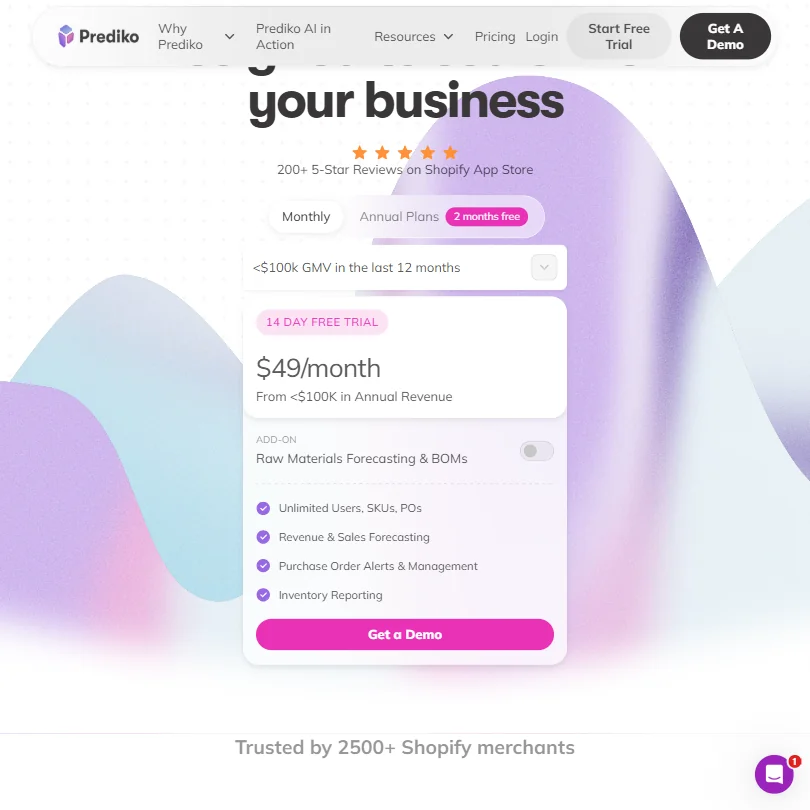
Starter costs $49 a month ($42 a month billed annually) for stores with up to $100,000 in trailing revenue, and includes all features, onboarding and support. Scale-up costs $119 a month for stores up to $500,000 in revenue. Growth costs $199 a month ($169 a month billed annually) for stores up to $2,000,000 in revenue. Enterprise, for stores above $2,000,000 in revenue, is free to install, but its subscription price is not published.
Price rises with a store's own trailing twelve-month revenue as it moves into each revenue band. There is a 14-day free trial, no setup fee, and no minimum contract term; billing runs monthly, with quarterly or annual discounts available.
Privacy and security
Prediko processes personal data under the GDPR and the UK GDPR.
Who Prediko suits
Prediko suits a Shopify merchant whose main problem is inventory: demand forecasting, a twelve-month purchase order calendar, and FIFO-based cost of goods reporting with landed cost, connected to a warehouse management or 3PL system.
It suits less well a merchant looking for customer lifetime value, cohort analysis or marketing attribution, since Prediko does not offer any of those, or a store above $2,000,000 in trailing revenue, since Enterprise pricing is not published.
Screenshots
How Prediko compares
Prediko scores 6.3 out of 10 among the e-commerce analytics tools we rate. These three do the same job and are the closest to it, compared on what each vendor publishes.
RetentionX
Prediko is built for demand forecasting and stock planning, with profit tracking based on cost of goods; RetentionX is built for attribution, with its own pixel and lifetime value by cohort, but does not plan stock or track profit. Prediko starts at $49 a month and scales with revenue with a 14 day trial; RetentionX also starts at $49 but with a 30 day trial instead. Both include custom, build your own dashboards, though only Prediko has a public API.
Pick RetentionX if you need channel attribution and your own tracking pixel.
Pick Prediko if you need demand forecasting, stock planning and a public API.
Lebesgue
Prediko forecasts demand and plans stock and purchase orders; Lebesgue attributes orders to channels and tracks lifetime value by cohort with its own pixel, jobs Prediko does not do. Prediko starts at $49 a month and scales with revenue, with a 14 day free trial; Lebesgue's cheapest plan is $79 a month flat, with a free plan instead of a trial. Both track profit after costs and forecast demand.
Pick Lebesgue if you need attribution, your own pixel and a free plan.
Pick Prediko if you want revenue based pricing and a public API.
Triple Whale
Prediko is built for demand forecasting and stock planning; Triple Whale is built for attribution and profit tracking across channels, with its own pixel and lifetime value by cohort. Prediko starts at $49 a month and scales with revenue, with a 14 day free trial; Triple Whale's cheapest plan is $219 a month flat, with a free plan instead. Both include a public API and custom, build your own dashboards.
Pick Triple Whale if you need channel attribution, a tracking pixel and benchmarks.
Pick Prediko if you want inventory planning and revenue based pricing.
Frequently Asked Questions
How much does Prediko cost?
Starter costs $49 a month ($42 billed annually) for stores up to $100,000 in revenue, Scale-up costs $119 a month, and Growth costs $199 a month ($169 billed annually) for stores up to $2,000,000 in revenue. Price rises with a store's own trailing revenue, and Enterprise pricing above $2,000,000 is not published. There is a 14-day free trial.
Which store platforms does Prediko work with?
Prediko is built for Shopify, including Basic, Advanced and Plus stores, POS and B2B, and also covers Amazon and Etsy sales channels.
Does Prediko forecast inventory needs?
Yes. AI demand planning and AI supply planning generate a twelve-month purchase order calendar, with purchase order management and buying alerts.
Does Prediko track customer lifetime value?
No. Prediko has no customer lifetime value, cohort or attribution features; its analytics are built around inventory, stockouts and FIFO-based cost of goods sold.