What is Octane AI?
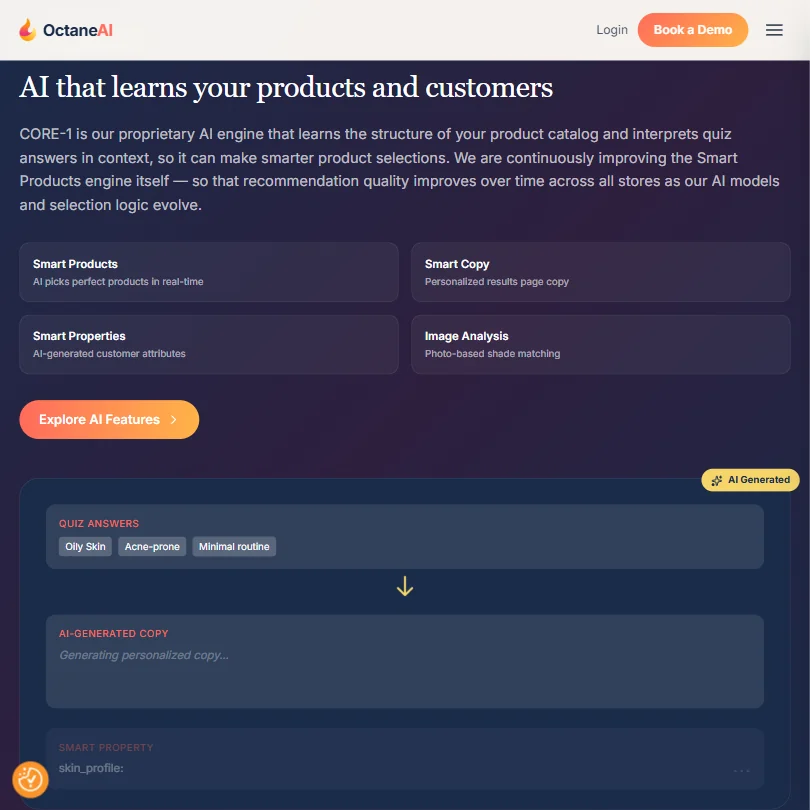
Shopify-native, full stop, from day one in 2016. Octane AI is a product quiz platform, and the whole system is built around one loop: shopper answers questions, catalog returns a recommendation, merchant captures data. The AI layer running underneath that is called CORE-1, a proprietary model the vendor says learns your product catalog and reads quiz answers in context, not just by keyword, to produce real-time recommendations.

The zero-party data angle is where the platform's actual pitch separates it from a standard quiz builder. Shoppers volunteer preferences through the quiz. That data flows into email or SMS platforms, Klaviyo being the most commonly mentioned, and you end up with a customer profile built on consent rather than inferred from clickstream behavior. Skincare and supplement brands have adopted this heavily, and it shows in the templates.
Honestly, the timing was smart. Third-party cookie restrictions made zero-party data collection a genuine priority, and Octane was already positioned there.
Octane AI Features: Product Listings, Bulk & Marketplace Tools
The Shopify dependency shapes almost everything here. Features that sound general are, on inspection, tightly coupled to your existing Shopify catalog structure.
Smart Copy is one worth understanding specifically. It generates personalized copy on the quiz results page based on what the individual shopper said, not a generic recommendation wrapper but copy that references the concern they flagged. Most quiz builders don't bother. That's a real conversion tool.
Smart Properties work alongside that. AI-generated customer attributes drawn from quiz answers, things like skin type or dietary goal, get pushed to connected platforms as structured data. That's the zero-party data engine in practice, not a summary field but actual segmentation-ready attributes.
The Image Analyzer deserves separate mention. Photo-based shade matching and undertone detection, built for beauty. We don't see this at Digioh or RevenueHunt. Fair to call it a differentiator.
A/B testing is on Plus and Enterprise only. Basic, at $50 a month, doesn't get it. For a brand trying to optimize quiz logic before committing to $200 a month, that's a genuine gap. Bulk processing and SEO title optimization don't appear in Octane's documentation at all, so if you arrived here expecting a broad catalog content tool, that's not what this is.
Octane AI AI Writing Quality: Are the Product Descriptions Good?
Narrow scope. Smart Copy is not a product description generator. It writes personalized results page copy based on quiz answers. That's the full extent of what the AI writes.
What we kept seeing in merchant threads on Reddit is that output quality tracks almost directly with quiz architecture quality. Vague questions produce vague copy, AI or not. The CORE-1 model can only interpret what the quiz captures, and if the logic branching is shallow, the results page reads shallow. That tracks.
Brands that mapped their catalogs carefully and built tight question logic report results that hold up. Brands that launched a quiz in an afternoon report something closer to template filler.
For teams actually looking for bulk product description generation across a full catalog, that's a different problem entirely. Hypotenuse AI addresses it. We see merchants conflate the two, and they shouldn't.
Octane AI Marketplace Support: Shopify, Amazon & Beyond
Shopify only.
No WooCommerce, no Amazon, no Etsy. Nothing in their documentation or public roadmap signals that's going to change. The platform is designed around Shopify's native catalog sync, and that's not incidental to how the recommendations work. The tightness of that integration is a feature, and the constraint is the cost of it.
Multi-platform operations will hit a wall immediately. Not a criticism, exactly. A hard constraint.
Is Octane AI Easy to Use?
The quiz builder gets described as manageable in user posts. Templates exist for beauty, supplements, and fashion, among a few others, and the basics don't require code.
Logic branching is where the complexity compounds. Building a quiz that handles multiple skin types, conflicting concerns, and product exclusions without collapsing into a mess takes real work. A handful of Reddit threads from 2024 surface this directly. The merchants reporting strong results put in significant catalog mapping and logic work upfront. The AI rewards that investment. It doesn't replace it.
Klaviyo sync gets mentioned positively and consistently. Getting quiz answer data into email flows appears to be one of the cleaner parts of the setup. That part, at least, seems to work without drama.
Octane AI Pricing: Is It Worth It for E-Commerce Sellers?
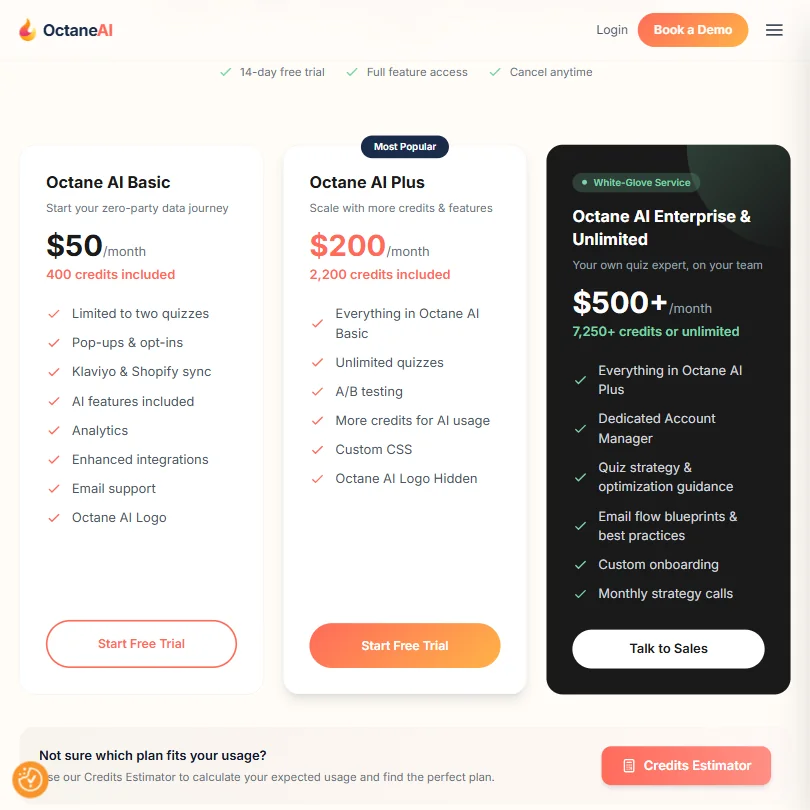
Three tiers. Basic at $50 a month with 400 credits included, Plus at $200 a month with 2,200 credits, and Enterprise starting above $500 with 7,250 or more credits. Both Basic and Plus offer a free trial. No permanent free plan exists.
The credit-based structure on Basic and Plus creates a ceiling that high-volume stores will hit, and hitting it means either upgrading or rationing AI features. On Enterprise the credit question becomes moot, but you're talking to sales before you know your number.
The jump from $50 to $200 is steep when you consider that A/B testing, unlimited quizzes, and custom CSS all sit behind that wall. We're skeptical of the value at Basic for any brand with a deep SKU catalog. You need the deeper capabilities to make the data useful, and those cost more.
Refund policy isn't published anywhere publicly. We looked. Not ideal.
Enterprise adds a dedicated account manager, quiz strategy calls, email flow blueprints, and custom onboarding. At that price floor it makes sense. Getting there requires a sales conversation first, which is its own friction.
Octane AI vs Digioh: Which E-Commerce AI Tool Is Better?
Digioh does quiz-based personalization and zero-party data collection too. The category overlap is real. The meaningful difference is flexibility versus depth.
Digioh runs across more platforms than Shopify. Octane runs deeper inside the Shopify ecosystem than Digioh does. Octane's native catalog sync is tighter than anything Digioh patches together for Shopify merchants, and that depth is what makes the recommendations behave like recommendations rather than filtered search results.
RevenueHunt sits in the same conversation, cheaper and less polished. Jebbit skews enterprise with a higher price floor. Typeform handles general survey logic but doesn't touch product recommendation logic or zero-party data capture in any meaningful way.
Octane is not the cheapest option and not the most flexible. For a Shopify-native brand that wants recommendation logic wired directly to catalog data, it's probably the tightest fit in that group.
Who Should Use Octane AI? (And Who Shouldn't)
Shopify brands in beauty, skincare, or supplements. The Image Analyzer and shade matching exist because those verticals were the design target. The templates confirm it.
Brands doing real volume, somewhere in the five-figure monthly revenue range or above, where improved email opt-in rates actually compound into something. Octane cites a 42% average email opt-in rate on their homepage. We can't verify that independently, but merchant posts suggest strong opt-in rates are achievable when the quiz is built properly.
Multi-platform sellers. They should go elsewhere, and there's no indication that changes anytime soon.
Stores expecting Basic at $50 to deliver full platform functionality will get frustrated quickly. The ceiling on that tier is low, and the features that make Octane interesting are mostly above it.
Octane AI Review Verdict
One thing, taken seriously. That's the fair summary.
Octane AI is a product quiz platform that captures zero-party data and feeds it into the tools Shopify brands already use, with AI that interprets quiz answers against a real product catalog rather than matching keywords to categories. The CORE-1 engine is the differentiator. The Shopify-only constraint is the ceiling.
The pricing jump from Basic to Plus is where the platform earns or loses its audience. A/B testing and unlimited quizzes behind a $150-per-month wall is a real ask for a brand still testing whether quiz-driven data capture moves the needle.
Octane AI has a Capterra listing, although its independent review footprint appears thinner than its Shopify App Store presence, and we could not confirm a dedicated G2 review profile. That leaves us working from a narrower evidence base than we'd prefer. Worth factoring in.
Developer connectivity exists through the REST API, webhooks, and Zapier. Custom integrations and custom builds are Enterprise features. The line between general API access and Enterprise API support is a little blurry in their documentation, but that's the clearest distinction we could draw.
For brands comparing angles, Kimonix is worth a look if collection merchandising and catalog personalization are the priority rather than quiz-driven data capture. Different tool, same native Shopify context.
Octane isn't for everyone. For the brands it fits, it fits well.
Frequently Asked Questions
Does Octane AI work with platforms other than Shopify?
No. Octane AI is built exclusively for Shopify. The catalog sync, product recommendations, and integration ecosystem all assume Shopify as the storefront. No WooCommerce or Amazon support exists, and nothing in their public documentation suggests that's changing.
What integrations does Octane AI support?
Klaviyo and Attentive are the headline integrations for email and SMS. Beyond those, the platform connects with tools like Recharge for subscriptions and Gorgias for support, and a few others. Developer connectivity is available through the REST API, webhooks, and Zapier. Custom integrations and expanded API support are Enterprise features, not general-tier ones.
Is there a free plan for Octane AI?
No permanent free plan. Basic and Plus both offer a 14-day free trial. After that, you're paying from $50 a month. The refund policy isn't posted publicly, so we'd treat the trial seriously rather than assuming there's a safety net on the other side of it.