Galileo is an AI coding assistant for teams building LLM applications, distilling expensive LLM-as-judge evaluation into small low-latency models.

The homepage is confident. LLM evaluation, production monitoring, agents that actually work in the real world. We cross-referenced the vendor docs, went through third-party coverage, and searched for candid user accounts from teams actually shipping AI products. What we kept seeing was more specific than the marketing implies. Galileo isn't a code assistant and isn't trying to be. It's an LLM observability platform built for the engineering teams who need to know, with some actual confidence, whether their agents are behaving in production.
Founded in 2021 and based in San Francisco. The niche is narrow on purpose. Not broad developer tooling. Evaluation engineering and production monitoring for teams building on top of large language models.
What is Galileo AI?
You're shipping an LLM-powered product. You need to know when it hallucinates, when a prompt injection slips through, when an agent goes sideways. Galileo sits in that gap.
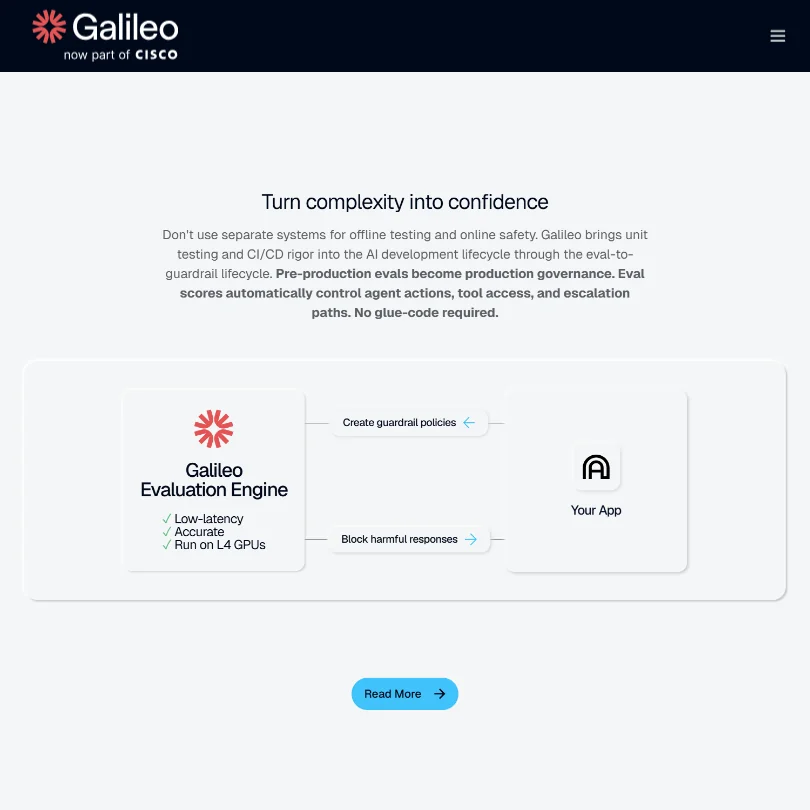
What makes it unusual is how it handles evaluation at scale. Their own documentation describes distilling expensive LLM-as-judge evaluations into compact proprietary models they call Luna models. The claim is 96% lower cost than running a full LLM evaluator on every request. We're cautiously interested in that number. Specific enough to be testable, which is more than most vendors bother to offer.
The platform covers building eval datasets and running evaluations during development, then pushing those same evaluators into production as real-time guardrails. That loop, from offline testing to live monitoring, is the whole workflow.
Honestly, most competitors treat those two phases as separate problems. Galileo's argument is that they shouldn't be. That tracks.
Galileo AI Features: Code Generation, Review & Developer Workflow
Galileo doesn't do code generation. No autocomplete, no refactoring suggestions. The heading above is our standard template and Galileo doesn't fit it. Not a knock. Just a different category entirely.
What it does instead is generate eval datasets automatically, from synthetic data and live production traces. You're not writing test cases by hand. The platform pulls from what's actually happening in your system and builds test sets from that material. For teams running any real volume of LLM requests, that matters considerably.
The insights engine is the debugging layer. It watches agent behavior, flags failure modes, and surfaces possible fixes. We haven't run it ourselves, so we're working from documentation here. The pattern we'd expect: agent goes off-rail, Galileo logs the trace, the insights engine points to the step where it broke. Whether the prescriptions are actually useful is the part our research can't verify.
Security evals live in the platform too. Prompt injection detection and adversarial input testing. Not comprehensive coverage of every attack surface, but present and documented.
CI/CD integration is supported. MCP server support as well. Teams can wire Galileo into their deployment pipeline and run eval checks before shipping, which is a reasonable workflow for anyone doing serious LLM development.
Galileo AI Code Quality: How Accurate and Reliable Is It?
This section maps oddly onto Galileo. It's not assessing your code. It's assessing your LLM outputs.
The real quality question is how good the Luna models are at catching actual problems. Their documentation points to the LLM-as-judge methodology as the foundation, with Luna as the compressed version of that. The 96% cost reduction implies significant compression. Compression usually costs something in accuracy. We're skeptical of that claim without independent benchmarks. Not dismissive. Just skeptical.
The vendor has obvious incentive to present the best-case comparison. Fair.
What we did find in third-party coverage is that hallucination detection is where Galileo gets mentioned most consistently. Teams building RAG applications in particular. That tracks. Retrieval-augmented generation is exactly the context where hallucinations are expensive and hard to catch manually, and it's the use case that surfaces most often in conversations around LLM monitoring tools generally.
Galileo AI IDE & Workflow Integration: Where Does It Work?
Web-based SaaS product. That's the primary surface. No VS Code extension in the research data, no JetBrains plugin. Tools like Cursor cover that ground instead.
What Galileo integrates with is more infrastructure-adjacent. NVIDIA NeMo and NIM show up in the docs. CrewAI is listed, and a few others. MCP server support is present for developers working in that ecosystem.
The CI/CD integration is the most practically relevant piece for engineering teams. That's where eval engineering connects to actual shipping. Git integration is confirmed. GitHub and GitLab specifics weren't detailed in the documentation we reviewed, but the general CI/CD story is there.
VPC and on-premises deployment are available at the Enterprise tier, per the pricing page. Not many LLM observability tools offer on-prem at all. For teams with data residency requirements, that deployment flexibility is meaningful, and it separates Galileo from most of the field.
Is Galileo AI Easy to Set Up and Use?
The docs site exists and appears functional. The API is documented. For a developer audience that's the baseline expectation, and Galileo meets it.
Actual onboarding experience is harder to assess from our research. The free tier gives you 5,000 traces per month, unlimited users, and unlimited custom evals. That's a reasonable runway to test the platform before committing anything. Not a trial. A standing free plan.
Support on the free tier is bot chat only. Human support starts at Pro. Enterprise gets a dedicated customer success manager, which is the tier where you'd actually expect hard questions to get answered.
We found no community forum mentioned anywhere in the docs or public materials. That's a gap. For a developer tool, a public community is where institutional knowledge accumulates. Without one, you're dependent on docs and whatever the bot can handle. Not great.
Galileo AI Pricing: Is It Worth It for Solo Devs and Teams?
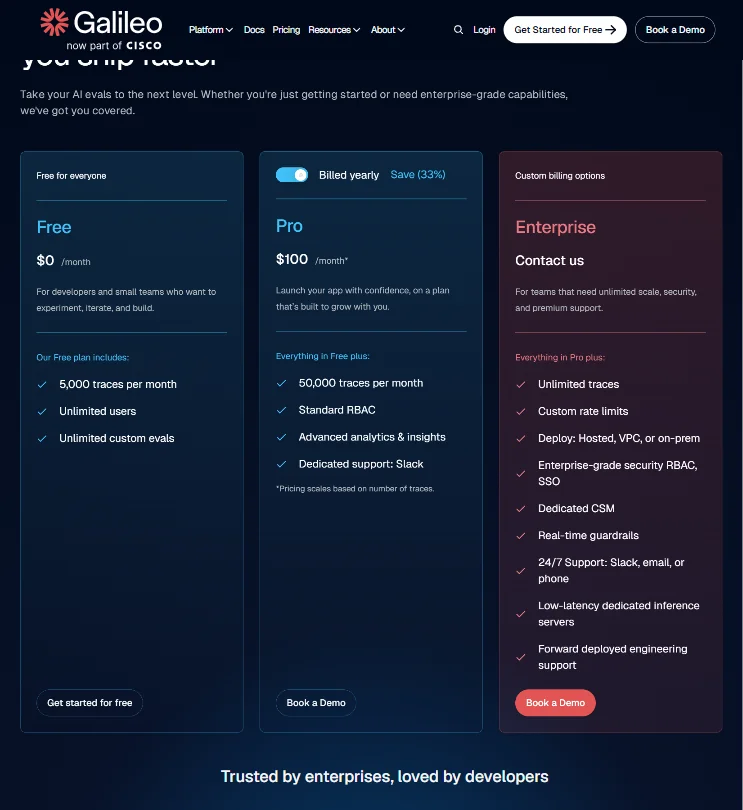
The free tier is $0 per month. Pro runs $150 per month billed monthly, per the pricing page. Enterprise is custom billing, contact them directly.
The free tier is genuinely usable. 5,000 traces per month is a real number, not a token gesture. Unlimited users on the free tier is unusual. Most tools in this space gate users or seats from day one. Braintrust does it. Helicone does it. Galileo doesn't.
At $150 per month, Pro unlocks 50,000 traces per month, Standard RBAC, and advanced analytics and insights. Dedicated Slack support is also included. The pricing page notes that pricing scales based on number of traces, so teams pushing past 50,000 should expect a conversation about volume.
The jump from $150 to "contact us" for Enterprise is steep in the abstract, but Arize AI does the same thing and so does Braintrust. Standard move in this category. Still annoying.
Refund policy isn't publicly stated. Worth flagging, though at this price point it's not unusual to handle refunds through support rather than a published page.
Solo developer poking at an LLM side project. The free tier is probably enough. Teams doing real eval engineering at volume, $150 per month is probably fine if it saves meaningful manual evaluation time.
Galileo AI vs Langsmith: Which AI Coding Tool Is Better?
Langsmith is the obvious comparison. Both platforms handle LLM tracing and evaluation. Both target teams building on top of language models. The overlap is real.
Where they differ: Langsmith integrates especially naturally with LangChain and LangGraph. If you're building in that ecosystem, that integration is frictionless. Galileo doesn't have that same ecosystem dependency. It also makes a specific claim around production guardrails via Luna models that Langsmith doesn't really mirror. The pitch from Galileo is that evaluation and production monitoring are the same pipeline. Langsmith treats them more separately in practice.
Arize AI is another honest comparison. More mature platform, more public case studies, stronger community presence. Galileo is arguably more focused on the eval-to-production pipeline specifically, while Arize covers broader ML observability.
We'd also point teams toward CodeRabbit if the actual problem is catching issues in code review rather than in LLM output quality. Different problem entirely.
Braintrust is worth a look if you want a more open evaluation framework with fewer proprietary black boxes. That tradeoff cuts both ways, and which side you land on depends entirely on how much you trust vendor-supplied eval models versus building your own.
Who Should Use Galileo AI? (And Who Shouldn't)
AI/ML engineering teams shipping LLM-powered products. That's the core fit. Specifically teams who've moved past the prototype phase and are dealing with real production traffic, real failure modes, real costs from running evaluations at volume.
RAG application developers. They come up repeatedly in the context where Galileo gets mentioned, and the hallucination detection use case fits that audience well.
Solo developers on simple LLM side projects. The free tier technically works, but the platform is built for teams managing real complexity. Using Galileo for a basic chatbot wrapper feels like overhead that won't pay off.
Teams without any CI/CD pipeline for AI evaluation. The platform assumes you're treating eval engineering as a real practice. If you're not there yet, Galileo is probably ahead of where you actually are.
Galileo AI Review Verdict
Galileo is a focused tool with a specific thesis. Build evals, run them in CI, push them to production as guardrails. That loop is coherent and the Luna model cost-reduction claim is interesting if it holds under independent scrutiny.
The support situation is the weakest spot. Bot chat on the free plan, no public community, docs that thin out past the basics. For a developer tool, that's a real friction point. Not great.
The free tier is the most underrated thing about this product. Unlimited users and unlimited custom evals with no time limit is genuinely generous for a platform in this space. Most competitors don't come close on those terms.
No substantial G2 or Capterra presence yet means we're working with less user feedback than we'd prefer. That's not a knock on the product. It's a data gap that makes strong conclusions harder to land with confidence.
Serious LLM product development teams who need production guardrails that connect back to the eval pipeline. Worth the time to test on the free tier. Building something smaller or earlier-stage. The overhead probably doesn't pay off yet.
Frequently Asked Questions
Does Galileo AI offer a free plan?
Yes. The free plan includes 5,000 traces per month, unlimited users, and unlimited custom evals. Standing free tier, not a time-limited trial, which puts it ahead of most competitors in this category. The main constraint is trace volume, and for early-stage LLM development that limit is workable for most teams.
How does Galileo AI compare to Langsmith for LLM monitoring?
Langsmith integrates especially naturally with LangChain and LangGraph, and that's a real advantage if that's your stack. Galileo's differentiator is the claim that Luna models can turn offline evaluations into live production guardrails at significantly lower cost. Adjacent problems, somewhat different approaches. The right choice depends on whether you're deep in the LangChain ecosystem or working across frameworks without a strong stack dependency.
Can Galileo AI be self-hosted?
Yes, but only at the Enterprise tier. The pricing page lists hosted, VPC, and on-premises deployment as options at that level. Free and Pro tiers are cloud-hosted SaaS only.