What is Copysmith?
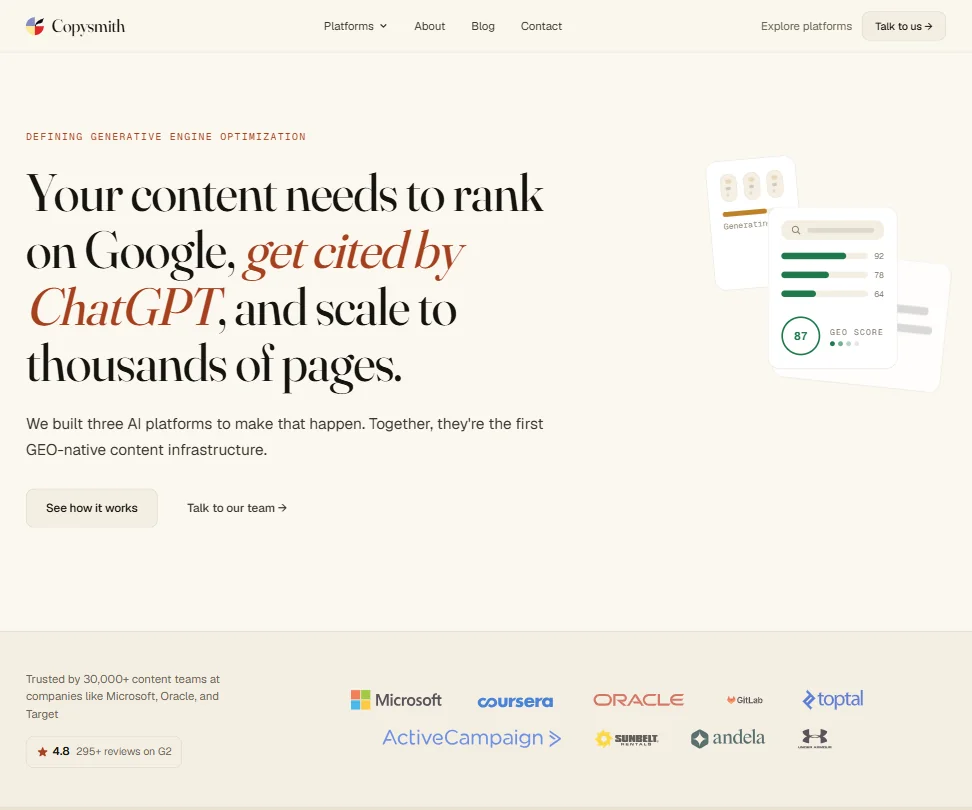
Founded in 2020 and based in San Francisco, Copysmith started as an AI copywriting tool aimed at eCommerce and marketing teams. That positioning still shows up on the homepage. What the homepage doesn't lead with is the structural change underneath: Copysmith now operates as a parent company for three separate platforms. Frase handles SEO and long-form content. Describely handles bulk product descriptions. Rytr handles short-form copy across channels. You are not buying a single product called Copysmith anymore. You're buying into an ecosystem it manages.
Honestly, that surprised us. The pivot is real and it's documented, but the homepage undersells how much the product model has changed since 2020.
The GEO-native positioning is the current pitch. The idea is that content has to rank on traditional search and get cited by AI engines like ChatGPT or Perplexity. Frase does the optimization work, including native GEO scoring and AI citation tracking. Describely pushes product content at volume. Rytr fills short-form gaps. Whether those three pieces feel like one coherent product is still an open question.
Copysmith Features: What You Actually Get
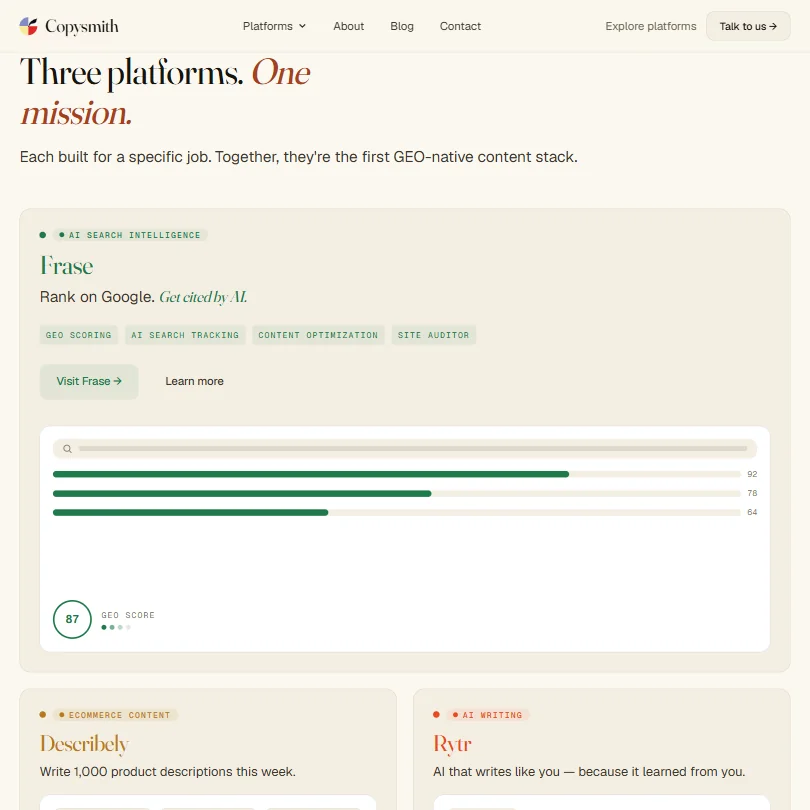
The feature set is broad. It's also distributed across three separate interfaces, which is not a small caveat.
Frase carries the SEO weight: GEO scoring, AI search citation tracking, a site auditor, and content optimization tooling. That's a real differentiator compared to tools that treat SEO as a checkbox. Frase also supports AI-search citation tracking specifically, tracking whether a brand gets cited in AI-generated results. Worth being precise about that: automatic source citation within generated copy is a separate capability and is not what Frase documents.
Describely handles bulk product description generation.
Rytr covers short-form copy with a brand voice feature called MyVoice, which is designed to learn from writing samples over time. We're cautiously optimistic. Brand voice tools are easy to promise and harder to deliver consistently. Rytr also includes a plagiarism checker with documented functionality for detecting duplicated text and supporting rewording of flagged copy. That's a Rytr-specific feature, not a Copysmith-wide one. The confusion in earlier coverage comes from treating the two as interchangeable.
On integrations: Rytr's Chrome extension works inside Google Docs and WordPress, plus Gmail, LinkedIn, Slack, and a few others. That's browser-extension functionality, not native API integration. Copysmith does not document these as direct native integrations. Fair distinction.
Copysmith AI Output Quality: Is It Good Enough?
Copysmith runs on GPT-4 with a proprietary layer.
For product descriptions, speed and volume are the standout qualities: getting a large catalog described at a fraction of the human time cost. That tracks with what Describely is built for.
Quality consistency is a different story. Outputs often need editing. Not heavy editing, but not publish-without-review copy either. That's true of Jasper, Writesonic, and essentially every AI writing tool in this category right now, so it's context rather than a specific knock. Frase brings content briefs, SERP analysis and GEO scoring for search visibility. We don't buy it as a complete feature yet.
Is Copysmith Easy to Use?
The three-platform model creates real friction here. You're not logging into one product. You're navigating between Frase, Describely, and Rytr depending on the task. For a user with one clear use case, that's manageable. An eCommerce manager who lives in Describely doesn't need to care what Frase does. A content marketer who wants SEO work, short-form copy, and brand voice in one place is going to feel the context-switching. That's our concern.
Rytr's Chrome extension helps. Writing directly in whatever tab you're in, without returning to a dashboard, is a genuine convenience point. For short-form tasks specifically, that workflow is more fluid than what most comparable tools offer. Jasper has something similar but it's heavier to configure.
Learning curve depends entirely on which platform you're in. Frase has depth and takes time. Describely is narrower and probably faster to get comfortable with. Rytr is accessible from the start.
Not great for teams that want one login, one UI, one mental model. The multi-platform structure asks for flexibility some teams won't have patience for.
Copysmith Pricing: Is It Worth the Cost?
Nothing. No tiers, no numbers, no starting point. Copysmith does not publish pricing for any standalone Copysmith product. Frase, Describely, and Rytr each have separate pricing pages through their own sites. The Copysmith parent company level offers only a 7-day free trial, with enterprise pricing requiring a sales conversation.
That's frustrating. Fifteen of the 28 AI writing tools we've reviewed offer a permanent free tier. Copysmith doesn't. You get a trial and then you need to talk to someone.
Enterprise-tier custom pricing is standard. The complete absence of any public starting price across the parent company is harder to justify. Jasper posts its base-tier pricing. Copy.ai posts its pricing. Copysmith gives you nothing to anchor on before committing time to a demo. That alone creates friction for buyers who want to self-serve to a decision.
Copysmith vs Jasper: Which Is Better?
Jasper is the most direct comparison at the brand and enterprise content team level. Both target content at scale, both have SEO-adjacent features, both land in custom pricing territory at the top end.
The structural difference is interface. Jasper has stayed relatively unified as a content platform. Copysmith is three tools. For eCommerce product descriptions specifically, Describely is more purpose-built than anything Jasper ships out of the box. That's a genuine edge for catalog-heavy teams.
For general marketing content, brand voice consistency, and long-form blog work, Jasper has a more mature single-surface experience. It's also more transparent about cost. Teams whose primary goal is SEO-driven article production at scale might also look at Koala AI, which is built around that specific workflow and doesn't require navigating a multi-platform structure.
The edge for Copysmith is narrow outside eCommerce. Inside it, the argument is real.
Who Should Use Copysmith? (And Who Shouldn't)
Large eCommerce teams managing big product catalogs. That's the core fit.
SEO-focused content teams who want GEO scoring and AI citation tracking built in, not added on as an afterthought, are a second solid fit through Frase.
Teams that need one login and one interface. Not the audience here.
Small businesses or solo operators looking for a straightforward writing assistant will hit the pricing opacity fast and find the multi-platform model overkill. Simpler options exist for less money, and some of them publish what they charge.
Copysmith Review Verdict
The GEO-native content infrastructure concept is a genuine product vision. A hub covering AI search citation tracking, traditional SEO, and bulk eCommerce copy at the same time is not a trivial thing to attempt. The question is how much of it has actually shipped, and the honest answer is: parts of it.
Frase does real work on SEO and GEO scoring. Describely solves a documented problem for eCommerce teams. Rytr adds short-form coverage with a plagiarism checker and a brand voice tool that has real documentation behind it. But the multi-platform architecture creates friction that a more unified tool wouldn't, and the complete absence of public pricing makes it hard to recommend to buyers who need to evaluate cost before committing to a demo.
The eCommerce catalog use case is where the product is strongest. Outside that lane, the evidence is thinner. Pricing transparency would change this calculus considerably. Right now it forces a sales conversation before you know whether the budget even makes sense.
Worth a serious look for the right team. Not a default pick for everyone else.
Frequently Asked Questions
Does Copysmith have a free plan?
No. There's no permanent free tier. A 7-day free trial is available, which gives you some runway to test the platforms before committing. After that, understanding what it actually costs requires a conversation with the sales team. No public tier pricing exists at the Copysmith parent level.
What is Copysmith best used for?
Product description generation at scale is where Copysmith earns its most consistent praise. The Describely platform is purpose-built for eCommerce teams managing large catalogs, and that workflow has real advantages over general-purpose AI writing tools. Frase is also solid for SEO content work, including GEO scoring and AI citation tracking for teams who care about visibility in AI-generated search results.
How does Copysmith compare to Copy.ai?
Copy.ai has stayed closer to a single-surface experience and publishes its pricing publicly. Copysmith's edge is in eCommerce bulk content and the GEO scoring layer that Copy.ai doesn't offer. For general marketing copy with a clearer pricing model, Copy.ai is faster to evaluate. For catalog-scale product content and AI search optimization, Copysmith has the deeper toolset.