Thirteen-plus years of e-commerce data. That's the number Clerk.io leads with, and it's not nothing. We pulled vendor documentation, Trustpilot patterns, G2 and Capterra gaps, and forum discussions across a few weeks before writing this, and the picture that came back is more textured than the homepage lets on. Founded in 2011 out of Copenhagen, this is not a company that appeared last year to chase an AI trend. What's harder to establish is whether the product earns that heritage for the mid-market merchants it's clearly built around.

What is Clerk.io?
Clerk.io occupies a specific position in e-commerce AI. Not a content tool, not a pure search layer, not just an email platform. The pitch is connective tissue across the whole customer journey, from the search bar to the inbox to on-site recommendations to chat, all of it trained on behavior data from the merchants who came before you.
Five core modules: AI-powered search, product recommendations, an AI chat agent, email personalization, and audience segmentation. Each sold modularly, which matters for pricing reasons we'll get to. The platform provides direct integrations for Shopify, WooCommerce, Magento, PrestaShop, and numerous other e-commerce platforms, though reported setup experiences vary more than the integration page implies.
That breadth is genuinely uncommon. Algolia is primarily search. Nosto leans hard into recommendations. Clerk.io's argument is that you don't need to stitch those tools together yourself. Whether that holds up in practice is a separate question, and one we couldn't fully answer without hands-on access.
Clerk.io Features: Product Listings, Bulk & Marketplace Tools

Not a product listing tool. No bulk upload, no marketplace submission, nothing writing your product descriptions and pushing them to Amazon. That's not a knock. It's just a completely different category, and worth knowing before you book the demo.
What Clerk.io actually does on the product side is use sales data and real-time availability signals to decide which products surface where, and in what order. Less about creating content, more about making sure the right items reach the right people at the right moment. The AI absorbs your catalog on connection, learns customer behavior patterns, and reportedly pulls in competitor data once you authorize it. We're a little skeptical of how much that competitor layer actually moves the needle for most merchants. But it's a differentiator they mention prominently, so it's worth flagging.
A/B testing is available. Merchants in review threads describe running tests between Clerk-automated recommendations and their own manual setups. That's a useful sanity check. Not many mid-market recommendation engines hand that over without friction.
Clerk.io AI Writing Quality: Are the Product Descriptions Good?
Short answer: Clerk.io doesn't write product descriptions. Not publicly, anyway. Their documentation doesn't surface a content generation feature, and nothing we found in customer reviews mentions it either. Hypotenuse AI is the more direct answer if bulk catalog content is your primary need.
What Clerk.io's AI does generate is intent mapping. It reads what a shopper types, typos and vague phrasing included, and connects it to the right products. The output isn't words on a page. It's a search result set. Honestly, that's harder to get right than most people assume, and the distinction matters when you're evaluating whether this tool belongs in your stack.
Trustpilot sits at 4.7 out of 5 across what the homepage claims are 500-plus reviews. We'd prefer a G2 or Capterra presence for easier cross-referencing, and the absence of either is a mild irritant. The Trustpilot signal is positive, but it's a single channel with limited segmentation by role or company size. Not useless. Not complete.
Clerk.io Marketplace Support: Shopify, Amazon & Beyond
Clerk.io provides direct integrations for Shopify, WooCommerce, Magento, PrestaShop, and numerous other e-commerce platforms. Experiences vary, though. Some reviewers describe setup as straightforward. Others report Shopify category-level issues or integrations that needed more work than expected out of the box. Fair warning.
Amazon doesn't appear anywhere in their documentation. Clerk.io operates on-site and in email, not on external marketplaces. That's a clear boundary, not a gap they're trying to close. If your business runs primarily through Amazon or Etsy, this tool has nothing to offer you.
The Meta and Google Ads connection via lookalike audiences is interesting. Build a high-value segment inside the Audience module, push it to paid channels. That's a workflow mid-market merchants would actually use. We found no detailed user reviews on how well it performs in practice. Frustrating, but that absence is itself a data point.
Is Clerk.io Easy to Use?
This is where the research gets murkier. The documentation is genuinely extensive: a help center, developer docs, a frontend UI kit, a video library, and webinars. Real investment in self-serve resources. But thorough docs and an easy setup are not the same thing.
The platform is modular. You're not flipping one switch. You're potentially configuring search, recommendations, email logic, and chat behavior as separate workstreams, each with its own setup logic. Merchants without a dedicated e-commerce manager or a developer on call may find the initial configuration slow going.
We didn't find a flood of "this was confusing" complaints in what we pulled. But we also didn't find many "up in an hour" stories. The Trustpilot praise tends to focus on the support team's responsiveness during onboarding, which suggests onboarding isn't fully self-service for most users. That tracks.
Clerk.io Pricing: Is It Worth It for E-Commerce Sellers?
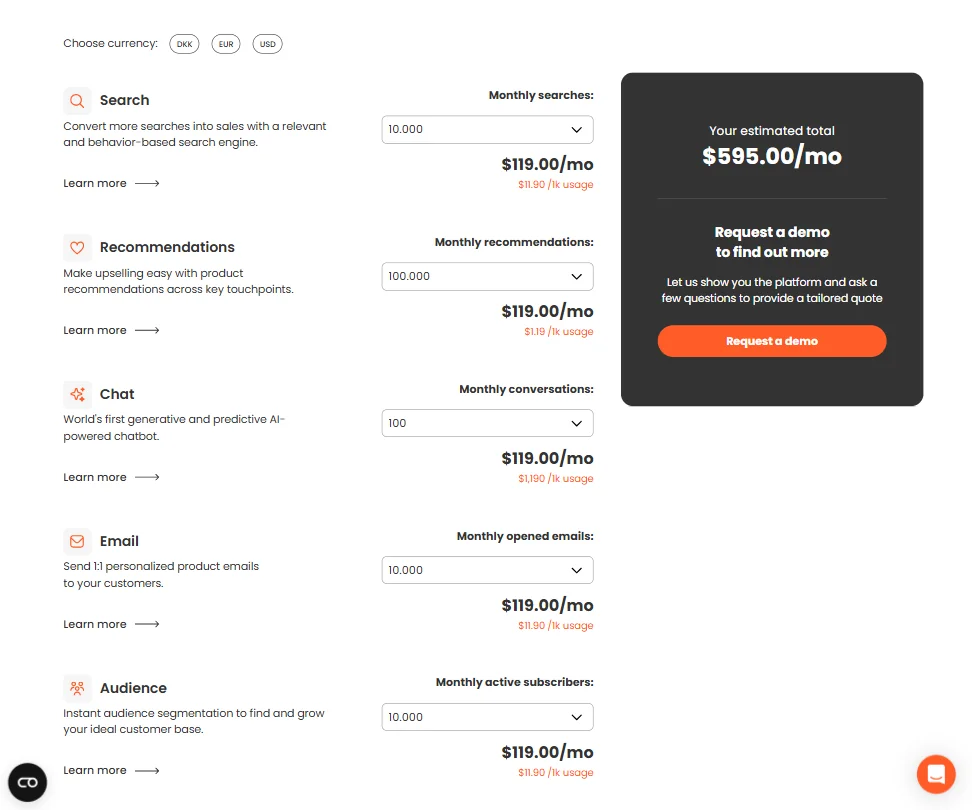
Usage-based. Modular. Custom quotes. No public pricing page with actual numbers on it.
We dug through their pricing page and found nothing you can act on without a sales conversation first. No starting figures, no plan tiers with module costs broken out. The enterprise package involves custom SLAs, which is standard. The refund policy isn't publicly stated anywhere we could locate.
The pricing opacity is the biggest practical problem for smaller merchants evaluating the tool, and we kept seeing this frustration surface in indirect ways across forums and discussion threads. You can't run a back-of-envelope comparison against Klevu or Doofinder without a sales call first. A free trial exists, but the duration isn't publicly stated either. Not a great sign.
For larger merchants who expect custom pricing as the norm, this is fine. For a WooCommerce store doing $500k a year trying to figure out if the math works before committing time to a demo, this is genuinely annoying.
Clerk.io vs Algolia: Which E-Commerce AI Tool Is Better?
Algolia is the most frequent direct comparison we saw. Worth taking seriously. Algolia is primarily a search infrastructure product, developer-friendly, fast, with a recommendation layer that exists but isn't the core product.
Clerk.io's pitch runs the other direction. Search is one module of five, and the other four are what justify the investment for most buyers. Pure search buyers will probably find Algolia more predictable on both capability and pricing. If you want search plus recommendations plus email plus audience sharing the same behavioral data layer, Clerk.io becomes more defensible.
Worth a look alongside this: Luigi's Box covers similar ground on search and product discovery, and is worth evaluating if Clerk.io's pricing process puts you off before a demo. Nosto is a real competitor on recommendations. Klevu shows up in the same search-focused conversations. None of them offer the same five-module combination in one platform. Whether that's Clerk.io's strongest argument or a sign that the individual modules are shallower than the specialists, we can't say without hands-on testing.
Who Should Use Clerk.io? (And Who Shouldn't)
Mid-market e-commerce brands on owned storefronts. That's the fit. Businesses running on Shopify or WooCommerce with enough monthly volume that usage-based pricing doesn't feel like a guessing game, and with a developer available for initial setup.
Marketplace sellers. Not the right call. Amazon-first businesses have nothing to plug in here, and that's not going to change based on where Clerk.io has invested its roadmap.
Solo merchants on tight budgets should also think twice. Not because the product is bad, but because the pricing process alone will consume real time before you know whether you can afford it.
Clerk.io Review Verdict
Fifteen years of e-commerce data is not marketing fluff. The five-module approach is genuinely differentiated, and the Trustpilot signal, while imperfect as a single channel, skews positive in a way that feels earned rather than manufactured.
But pricing opacity is the thing that will cost Clerk.io smaller customers, and the absence from G2 and Capterra makes it harder to build conviction for buyers who rely on those platforms for due diligence. The modular setup requires real attention and, realistically, some developer time. Not a plug-and-go situation.
Strong option for the right merchant profile. Not a default recommendation. Worth a demo if you're already spending on two or three separate tools to cover search, recommendations, and email, and you're frustrated with the stitching.
Frequently Asked Questions
Does Clerk.io have a free plan?
No permanent free tier exists. A free trial is available, though the duration isn't publicly stated anywhere we could find. You'll need to ask during signup. Minor friction, but real friction.
Which e-commerce platforms does Clerk.io integrate with?
Clerk.io provides direct integrations for Shopify, WooCommerce, Magento, PrestaShop, and numerous other e-commerce platforms. Setup experiences vary, with some reviewers reporting smooth installs and others describing issues that needed extra work. The full list is in their documentation. Amazon and Etsy don't appear in the integration set.
How does Clerk.io compare to Algolia for site search?
Algolia is developer-oriented search infrastructure. Fast, flexible, and pricing is more transparent. Clerk.io treats search as one part of a larger system, which makes sense if you want search and personalization sharing the same behavioral data. Pure search buyers will probably find Algolia the cleaner fit. Buyers who want search plus recommendations plus email in a single data layer will find Clerk.io's case more compelling, assuming the pricing conversation goes somewhere useful.