Founded in 2017 out of Vancouver as CoPilot AI and now called Yoke, the company has had plenty of time to figure out what it's doing. It's a tool with a genuinely interesting architecture sitting inside a pricing and support structure that asks buyers to take a lot on faith.
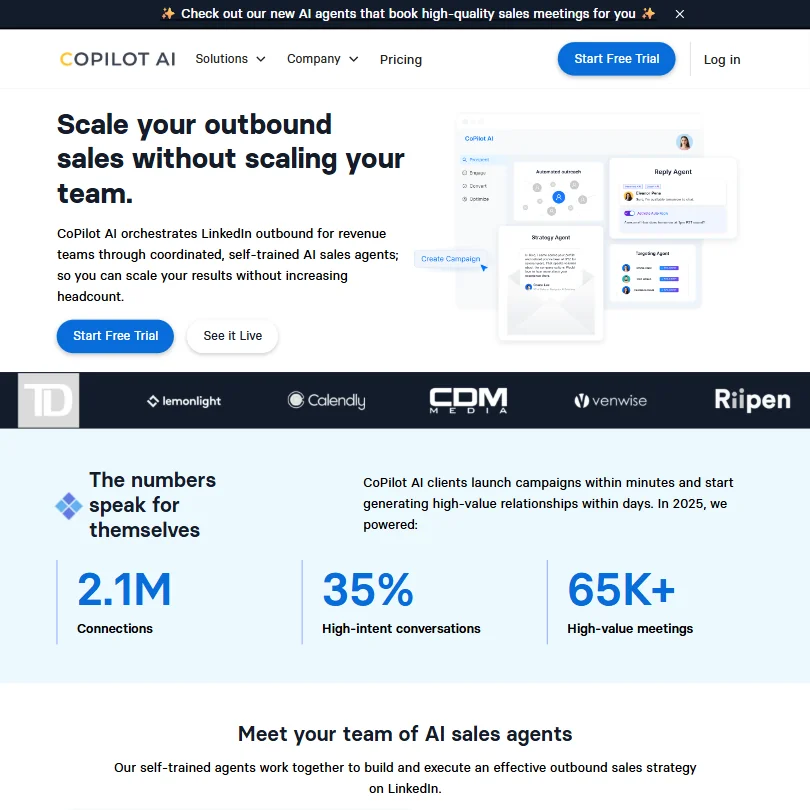
The core pitch is a three-agent system for LinkedIn outbound prospecting that runs without adding headcount. Ambitious. Worth examining closely.
What is Yoke?
Three agents. Distinct jobs. The Strategy Agent learns your business context and figures out who you should target. The Targeting Agent pulls audience segments from LinkedIn Sales Navigator. The Reply Agent handles inbound responses and books meetings directly to your calendar, closing the loop without a human in the middle.
Honestly, the architecture is cleaner than most competitors manage. One murky "AI assistant" doing everything badly is the norm in this category. Yoke at least separated the responsibilities.
Web-only. No mobile app, no browser extension we could confirm. English only. The audience is B2B sales teams, SDRs, and solo founders running structured outbound. That's the box. If your work lives outside it, this probably isn't your tool.
Yoke Features: Automation, AI Assistant & Workflow Capabilities
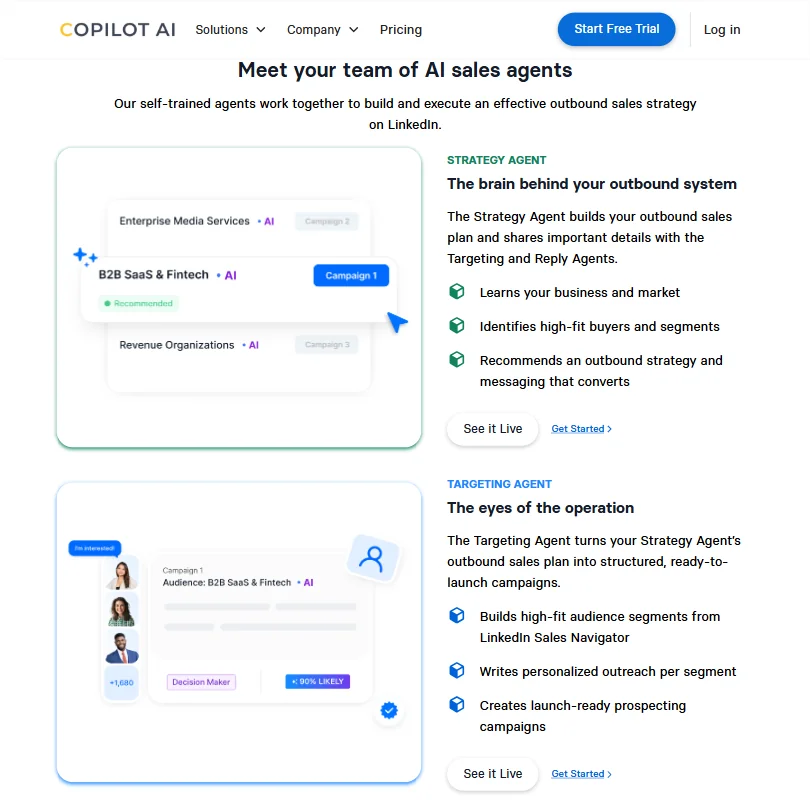
What separates this from simpler tools like Dux-Soup or LinkedHelper is that those products automate the clicks. Yoke claims to automate the thinking too. The AI sales agent layer handles strategy, targeting, and reply management as coordinated systems rather than a queue of scripted actions.
Campaign management includes A/B testing and AI-driven lead filtering. The Reply Agent adds sentiment analysis and intent detection, so it's not responding to everything uniformly. It's supposed to recognize who's worth pursuing. That's a real distinction from spray-and-pray tools.
CRM integration ships with the Guided and Teams plans. Unlimited AI-generated messages are available across all paid tiers. Calendar booking is baked into the Reply Agent itself.
The Teams plan adds a shared inbox and duplicate outreach prevention across seats. That last feature matters more than it sounds. Without it, multiple reps can contact the same prospect independently, which tends to kill deals quietly.
Be wary of the "fully automated" framing. G2 reviews describe a real setup curve before the agents perform at a useful level. The system learns from your inputs. That takes time. Not weeks of idle waiting, but active configuration work that sits with the user.
Yoke AI Quality: How Smart and Useful Is the Assistant?
Proprietary model. No GPT-4, no Claude. Yoke built their own, which makes the quality hard to audit. G2 feedback across 95 reviews skews positive, though not uniformly.
Where reviewers push back is reply quality on broad segments. When targeting is wide, the Reply Agent's messaging can sound generic, which is exactly the problem agentic tools are supposed to solve. The Strategy Agent is only as good as the business context you feed it. Garbage in, polished garbage out. That tracks.
Intent detection and sentiment analysis are harder to verify externally. Some reviewers mention them as functional. Others don't reference them at all, which either means they work quietly or they don't register as meaningful. We can't tell which from here.
Proprietary vertical models tend to perform reasonably within their narrow focus and hit ceilings faster than foundational models. That's consistent with what we're seeing described.
Yoke Integrations: What Does It Connect To?
LinkedIn Sales Navigator is mandatory. Not a recommended add-on. If you don't have an active Sales Navigator subscription, the Targeting Agent cannot function, and neither can the rest of the workflow. That cost starts around $99 per month per seat and isn't reflected in any headline pricing.
CRM integration is listed for Guided and Teams tiers. Which specific CRMs are supported isn't clearly documented publicly. API access isn't publicly stated. Zapier isn't mentioned.
For a product priced at $299 per month, the integration surface is genuinely thin. We've seen tools at half the price with more documented connectivity. If your stack runs through Salesforce or HubSpot and you need reliable two-way sync, ask that question directly before signing an annual contract.
Calendar booking works. That's confirmed across reviews. It's something. But it's not an integration story that justifies the price on its own.
Is Yoke Easy to Use?
The plan name is "Guided." That tells you something about the learning curve before you read a single review.
Live chat is a bot. Email support is available. The help center is described as basic. For a product that requires configuring three AI agents and connecting Sales Navigator before anything runs, that support level is on the lighter side.
G2 reviewers who report strong results consistently mention a ramp-up period of a few weeks before output quality stabilizes. The agents need business context from the user, and that work doesn't happen automatically. Not a dealbreaker. But not a tool you deploy Monday and run campaigns Wednesday.
Web-only. No mobile. For SDRs working from laptops, probably fine. For anyone else, it's a gap worth noting before committing.
Yoke Pricing: Is It Worth It vs Free Alternatives?
Core runs $199 per month on annual billing and Guided $299 per month on annual billing; monthly billing is quoted on request. Teams and White-Label are custom. There is no free plan, but there is a 7-day free trial.
Add Sales Navigator on top. One person using Yoke at the Core tier is realistically looking at about $300 per month minimum before their CRM costs anything. At the Guided tier, closer to $400 per month. Those are the real numbers.
Expandi starts around $99 per month. Waalaxy and Lemlist both run significantly cheaper for basic LinkedIn automation. What Yoke is charging for is the agentic coordination layer. Whether that layer justifies the gap depends entirely on whether the agents perform for your specific market and segment. Based on reviews, they do for some users. Not for all.
The refund policy isn't stated publicly. At $299 per month on annual billing, that's a problem. You're making a serious commitment without knowing the exit terms.
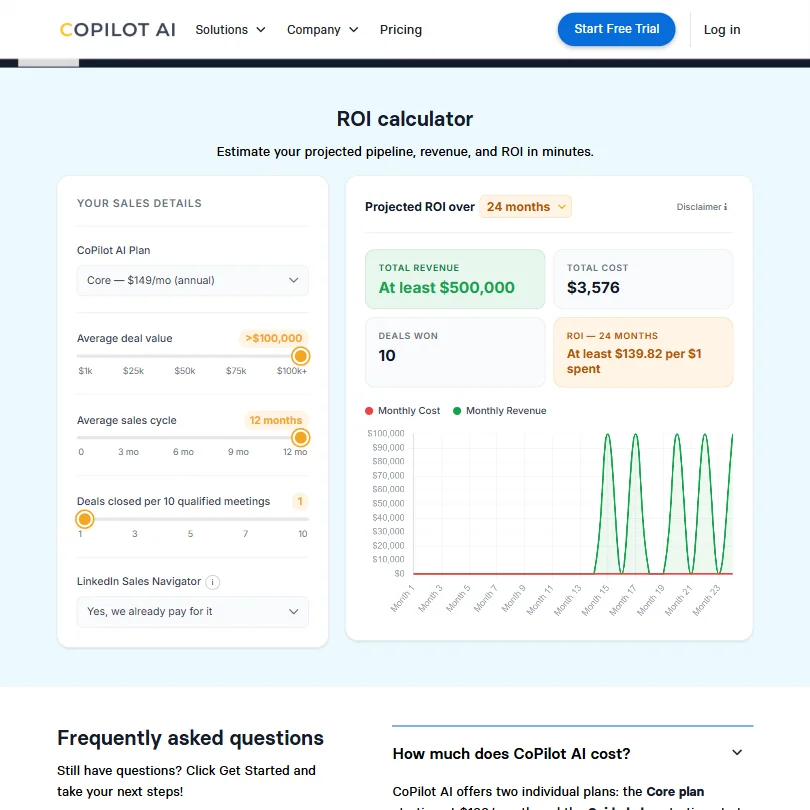
The ROI calculator shown in the tool's own interface projects "at least $500,000" in total revenue over 24 months against a $3,576 total cost, claiming $139.82 return per dollar spent. We don't buy that framing at face value. Those figures depend heavily on inputs the user controls, including deal size and close rate assumptions.
Yoke vs Expandi: Which Productivity Tool Wins?
Expandi automates LinkedIn actions. Connection requests, follow-up sequences, message scheduling. Solid at the mechanical layer. Far cheaper.
Yoke's argument is that the three-agent architecture handles what Expandi doesn't, including deciding who to target and managing replies with intent detection. For teams who want full-cycle automation without hiring an SDR, that difference is real and not trivial.
Expandi has more documented integrations and a longer presence in user communities. Reddit threads about Yoke surface occasional complaints about value at scale. Expandi threads focus more on LinkedIn account safety concerns. Different problems.
Meet Alfred and Waalaxy are also in this conversation. Both are cheaper. Neither has the agentic framing Yoke is pushing. If the agentic layer isn't a priority, those are worth a look first.
Who Should Use Yoke? (And Who Shouldn't)
B2B sales teams with Sales Navigator already in the stack who've hit the ceiling on simpler automation tools. That's the fit.
Solo founders or early-stage teams testing outbound. Probably not. The monthly commitment at either pricing tier is steep for one person validating a channel.
Anyone without Sales Navigator should stop before reaching the pricing page. The dependency changes the math considerably, and it's non-negotiable.
Yoke doesn't touch post-meeting workflows, note-taking, or internal knowledge management. Fathom AI Notetaker handles the post-meeting side of the sales cycle and runs well alongside a dedicated outbound tool if you need both ends covered.
Yoke Review Verdict
The three-agent model is a legitimate architectural bet. Not a gimmick. When it works, and reviewers who describe strong results are credible, it genuinely reduces the manual overhead of running outbound at scale.
What gives us pause is the commitment structure. Annual billing at $299 per month with no published refund policy and a support tier that leans heavily on bots and email asks for a lot of trust before you've seen results. The integration story needs more transparency. Sales Navigator as a hard dependency adds cost that's invisible in the headline number.
The G2 feedback is real. Not manufactured. But this isn't a tool you evaluate cheaply or quickly. Commit to the ramp-up period or don't start.
Frequently Asked Questions
Does Yoke work without LinkedIn Sales Navigator?
No. Sales Navigator is a hard requirement for the Targeting Agent to function at all. Factor that subscription cost into your real budget before anything else, because the tool doesn't work without it.
Is there a free trial for Yoke?
Yes. The pricing page offers 7 days free. There is no free plan, and the refund policy is not published, so ask about exit terms before committing to annual billing.
How does Yoke compare to other AI sdr tools in terms of setup time?
Expect a few weeks before output quality stabilizes. The agents need business context before the b2b sales automation performs at a useful level, and that configuration work sits with the user. G2 reviewers who report strong results mention this consistently. Not a fast setup, which matters if you're under short-term pipeline pressure.