Our research on Wizzy started with their docs and landed pretty quickly on a question that kept following us: who exactly is paying $399 a month for a Shopify search bar? That's not rhetorical. After working through this review, we have a clearer answer. But it took some digging. We pulled vendor documentation, cross-referenced what little public review data exists, and went looking in the places people actually complain, like Reddit product communities and e-commerce forums.
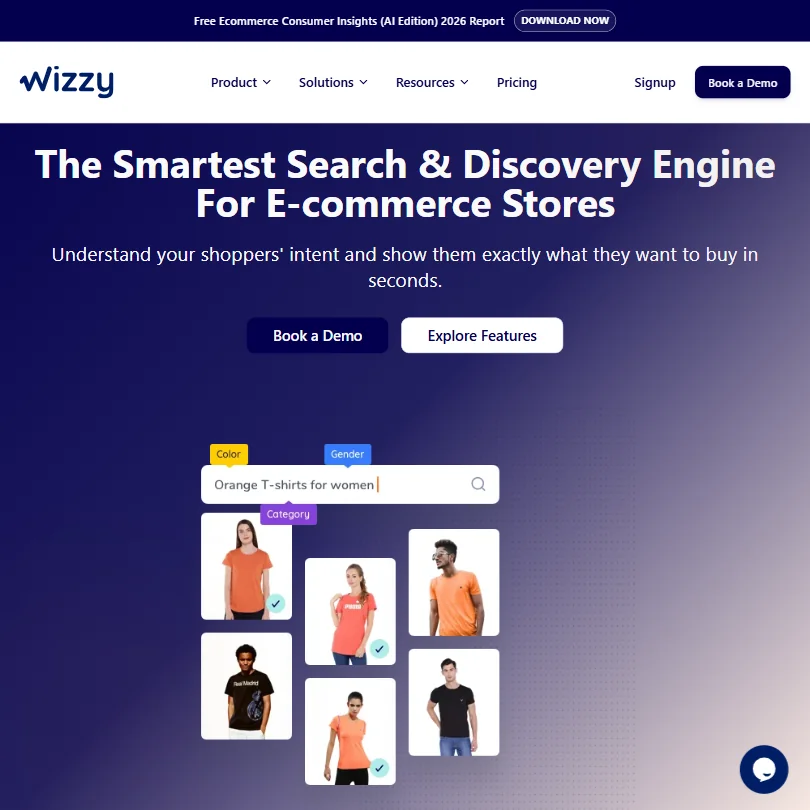
Wizzy is headquartered in Ahmedabad, India. Founded sometime before 2020 based on context clues in their docs, though the exact year isn't public. They serve over 1,000 stores, which is the one user-scale number they'll commit to on the homepage.
What is Wizzy?
A site search and product discovery platform built specifically for e-commerce. Not a general search tool someone bolted onto a Shopify plugin. Purpose-built, with a distinct focus on what happens between a customer typing something and them finding a product they'll actually buy.
The platform ships eight modules. AI Search handles intent-matching and typo tolerance. Advanced Filters builds dynamic filter options from your catalog. There's a Merchandising layer with product boosting and A/B testing. Visual Search lets customers upload an image to find similar products. And then there's Reels View Discovery, which is exactly what it sounds like: a short-video-style browsing experience for product discovery. That last one is unusual. We hadn't seen it positioned this way in a B2B search tool before.
Honestly, the module count is impressive on paper. Whether stores are using all eight in practice is a different question. The platform's core value proposition sits in what happens between a customer's query and their purchase decision, and every module is oriented around that single axis. Narrow scope. Real focus.
Wizzy Features: Product Listings, Bulk & Marketplace Tools
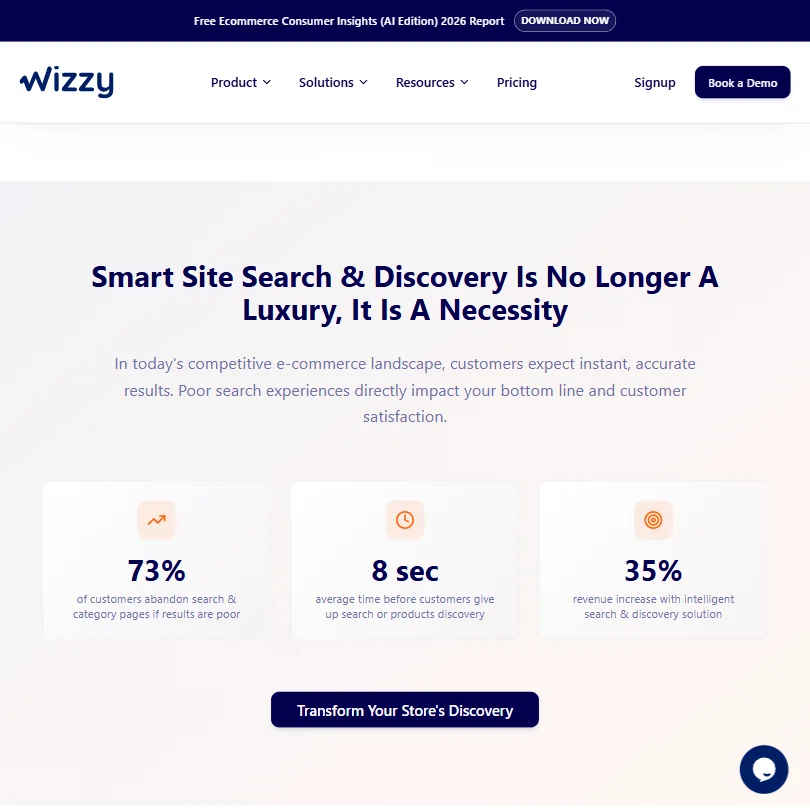
Wizzy doesn't generate product descriptions. No ad copy, no SEO title writing, no listing optimization in the traditional sense. That's not what it does.
What it does is control how your existing catalog surfaces when someone searches it. Bulk product sync works via API, which is functional if you have developer resources. The Catalog Enrichment feature is more interesting than we expected once you get past the vague marketing language. It can clean categories, assign gender attributes, generate search tags, create discovery-focused attributes using titles and images, process catalog changes in batches, and suggest canonical categories, aliases, synonyms, SEO keywords, and collection names. That's a real feature with real specifics. Not all tools at this price point can say the same.
Merchandising is where the editorial control lives. You can boost specific products, bury others, and run A/B tests on search result layouts. That's useful for anyone who's ever watched a generic search engine serve up the wrong SKU to a high-intent customer.
The analytics module covers search performance and revenue attribution. We'd want to see how granular that attribution actually gets before calling it a strength. Not great that it's hard to verify externally.
Wizzy AI Writing Quality: Are the Product Descriptions Good?
Not applicable. Full stop.
Wizzy doesn't write product descriptions. It doesn't generate content for listings, optimize titles, or produce copy of any kind. If that's what you're after, something like Hypotenuse AI is built for exactly that use case.
Wizzy's AI is entirely focused on the search and discovery layer. Natural language processing interprets what customers type. The model ranks results based on intent signals, not just keyword matching. That's the scope. Nothing more.
We're not penalizing them for it. A narrow focus done well beats a sprawling feature list done poorly. But buyers coming in expecting content generation will leave disappointed.
Wizzy Marketplace Support: Shopify, Amazon & Beyond
Shopify integration is native. Magento too. REST API access is documented at their site with webhooks and SDKs included. Amazon isn't supported, and WooCommerce isn't confirmed either, which is a gap worth flagging for anyone not on one of the two primary platforms.
No Etsy. No Zapier listed. The integration surface is narrow and focused.
That tracks for a tool at this price point. They're not trying to be everything. But if your stack lives outside Shopify or Magento, the REST API is your only real path in, and that requires someone who can build with it. Worth knowing before you start a trial.
Is Wizzy Easy to Use?
We couldn't find enough public reviews to draw a confident conclusion here. Wizzy isn't listed on G2 or Capterra. Not on Trustpilot either. That's unusual for a tool at $399 a month targeting 1,000+ stores.
What we do know: the documentation is thorough. User docs, developer API docs, template docs, event tracking docs. Four distinct layers. That tells us they expect users to do real configuration work. This probably isn't a point-and-click tool with sensible defaults, though Wizzy's own marketing claims quick deployment with minimal technical overhead and says catalog feeds can be connected with minimal setup. Those two things can both be true simultaneously: a quick initial connection and a steep configuration curve once you're in. We've seen it before.
Without review data to calibrate against, we're partially guessing at how steep the learning curve actually is. Not ideal.
Wizzy Pricing: Is It Worth It for E-Commerce Sellers?
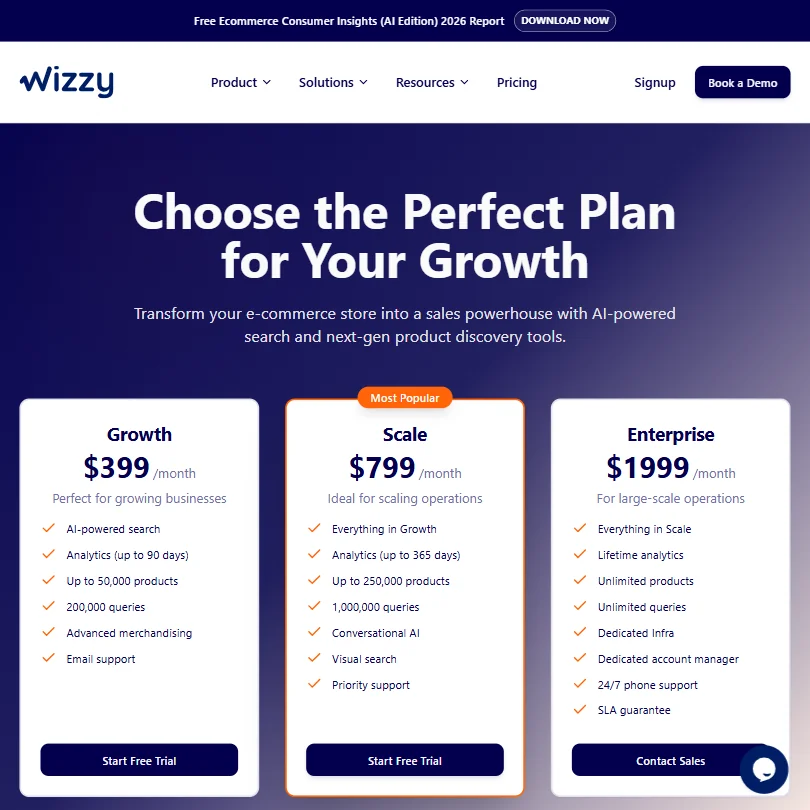
$399 a month is the floor. Growth plan. Scale runs $799 a month. Enterprise lands at $1,999 a month, with a "Contact Sales" button instead of a free trial option.
The Growth and Scale tiers both include a 14-day free trial, which Wizzy does state on their features page, even if it's not prominently advertised everywhere. Fair. That's a reasonable window to pressure-test a search tool against real catalog data.
No free plan exists. That's confirmed.
The Growth plan caps you at 50,000 products and 200,000 queries a month, with analytics going back 90 days. Scale pushes those to 250,000 products and 1,000,000 queries, with a full year of analytics history and adds Conversational AI plus Visual Search. Enterprise unlocks unlimited products, unlimited queries, lifetime analytics, dedicated infrastructure, a dedicated account manager, 24/7 phone support, and an SLA guarantee. The jump from $799 to $1,999 is steep. Dedicated infra and an SLA probably justify it for the right buyer, but that's a narrow group.
Searchanise starts considerably lower. Boost Commerce similarly. Klevu gets expensive fast too, but at least has documented mid-market case studies that justify the cost. Wizzy's pricing assumes the tool is producing measurable revenue lift, and without public review data to validate that, buyers are trusting the vendor on it.
We're skeptical. Not of the product's capability, but of the value justification at this price with this little third-party evidence.
Wizzy vs Searchanise: Which E-Commerce AI Tool Is Better?
Searchanise is cheaper. Meaningfully cheaper, especially at the entry level. It's been around longer, with more public reviews and a more established presence on both Shopify and WooCommerce.
Wizzy's case against Searchanise is the module depth. Visual search, reels-style discovery, and conversational filtering aren't things Searchanise ships. If those features matter to your specific store experience, Wizzy has a real argument. If you need solid keyword search with filters and autocomplete, Searchanise gets you there for less money.
Luigi's Box is the other name that comes up in this conversation. Better documented externally, with more verifiable customer data, though it skews toward mid-market European retailers.
For most small Shopify stores, the price gap makes Searchanise the default. Wizzy makes sense when you're doing real volume and want features the cheaper tools simply don't ship.
Who Should Use Wizzy? (And Who Shouldn't)
Stores doing serious volume on Shopify or Magento. That's the fit. Specifically ones where search is already a known revenue driver and the default platform search is visibly failing customers.
Early-stage stores. Not the right fit. $399 a month on search infrastructure before you've proven product-market fit is backwards. WooCommerce shops aren't a great fit either, unless someone on your team can build against the API.
The Visual Search and Reels View modules are genuinely interesting for fashion and home goods brands where how a product looks matters as much as how it's described. That's a specific niche, but it's a real one. The Scale plan is where both those features appear, which means $799 a month minimum if they're the reason you're here.
Wizzy Review Verdict
Wizzy is doing something real. The eight-module approach to e-commerce site search is more complete than most competitors at a similar tier, and the features that don't exist elsewhere, like the reels-style discovery interface and mobile visual search, are worth paying attention to. The Catalog Enrichment feature is more developed than the marketing copy suggests, with actual batch processing and synonym generation doing real catalog work.
The problems are practical. No public review presence on any major platform makes independent verification nearly impossible. Pricing starts high and climbs fast. The integration list is narrow enough that a significant chunk of the e-commerce market is excluded by default.
We'd feel better recommending this if we had a few dozen G2 reviews to triangulate against. Right now we're working with documentation and the vendor's own claims. That's not nothing. But it's not enough to say "buy this with confidence."
Worth the 14-day trial if you're on Shopify at real scale and your current search is losing you revenue. Everyone else should look harder at the alternatives first.
Frequently Asked Questions
Does Wizzy work with WooCommerce?
WooCommerce support isn't confirmed anywhere in their public documentation. Shopify and Magento are the two named integrations. If you're on WooCommerce, the REST API is your only realistic option, and that means development work on your end before you get anything running.
Is there a free plan for Wizzy?
No free plan exists. A 14-day free trial is available on the Growth and Scale tiers. Enterprise doesn't list a trial option, pointing to a sales contact instead. You'll still want to confirm trial terms directly with Wizzy before committing time to a full setup.
How does Wizzy compare to Klevu?
Both are AI-powered search tools for e-commerce with serious pricing. Klevu has more public review data and better-documented enterprise case studies. Wizzy counters with modules like Visual Search and the Reels View discovery interface that Klevu doesn't offer. For stores that need those specific capabilities, Wizzy has a differentiated case. For stores that just need reliable AI search with proven results, Klevu's track record is easier to verify externally, and that matters when you're spending this much per month.