What is Sellozo?
Founded in 2017 out of Kansas City, Sellozo has been in the Amazon advertising software space long enough to have earned a real opinion. Seven years is not nothing. Plenty of time to build something genuinely useful, or to calcify. Based on what we read across vendor documentation, Trustpilot threads, and Reddit seller communities, it's a bit of both.

Amazon PPC automation. That's the whole product. It doesn't touch Shopify, doesn't write product descriptions, doesn't do review analysis or image editing. What it does is put most of the manual work in Amazon advertising on autopilot through an AI layer handling bid management, keyword discovery, and budget allocation.
The pitch is built around flat-rate pricing. $250 a month, one marketplace, regardless of how much ad spend flows through the platform. For sellers running serious budgets, that math gets interesting fast. We'll get to that.
Sellozo Features: Product Listings, Bulk & Marketplace Tools
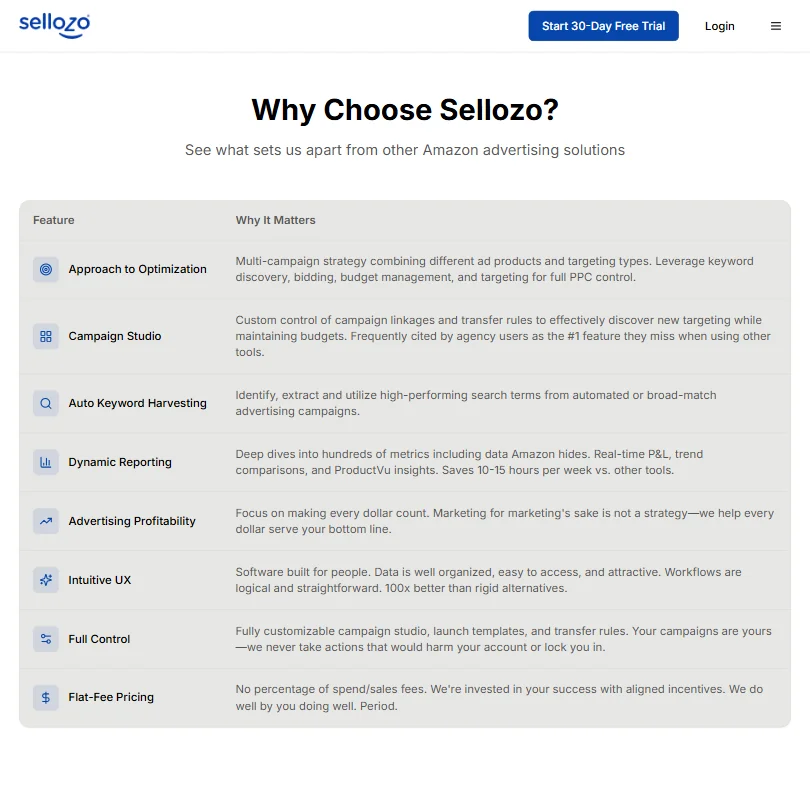
Narrow by design. Campaign Studio is the centerpiece of the entire product, a drag-and-drop interface for building and managing multi-campaign structures. Beyond that, there's automated keyword discovery, dayparting technology for time-based bid adjustments, and a built-in Repricer. Budget management and financial reporting round out the main suite.
Genuinely useful if your job is Amazon advertising. Not useful for much else.
What kept coming up in our research was the reporting depth. Sellozo claims to surface metrics that Amazon's own dashboard buries or withholds entirely. That tracks. Amazon's native reporting has frustrated sellers for years, and any tool that closes that gap is solving a real problem. Fair. That's worth something at $250 a month.
Sellozo AI Writing Quality: Are the Product Descriptions Good?
Nothing to review here. Sellozo generates no product descriptions, writes no ad copy, and produces no content of any kind. The AI referenced in their marketing refers to bidding logic and campaign optimization, full stop.
Wrong product entirely if you came here for an AI writing tool. Content generation does not exist anywhere in the platform, and the vendor makes no real pretense that it does. Sellers who need bulk product copy should look at Hypotenuse AI instead. Completely different category.
Honestly, the section heading doesn't apply to Sellozo at all. We're including this because enough people search that question to make it worth answering directly.
Sellozo Marketplace Support: Shopify, Amazon & Beyond
Amazon only.
No Shopify. No WooCommerce, no Etsy, no other channel. Sellozo integrates with the Amazon Advertising API and Amazon Seller Central, and that's the complete list. The tradeoff for that narrow scope is genuine depth on the Amazon side. Twenty international Amazon marketplaces are supported, which exceeds what most competitors in this space bother to cover.
North America, Europe, Japan, Australia. All manageable from one account. For sellers running global Amazon operations across multiple regions, that's a real operational advantage, not a marketing bullet point.
Is Sellozo Easy to Use?
Mixed. Campaign Studio's drag-and-drop setup draws consistent positive mentions in user feedback. Sellers find it more intuitive than working directly in Amazon Ads. That's a low bar, but clearing it matters more than it should in this category.
The harder part sits underneath. Automated keyword discovery and multi-campaign AI optimization sound clean on the homepage. In practice, understanding what the AI is actually doing, and knowing when to override it, takes real time. Reddit threads from working sellers confirm the onboarding period is genuine. Not insurmountable, but not a plug-and-play experience either.
We're skeptical of any PPC platform that implies you can set it and walk away. Sellozo doesn't quite make that claim outright, but some users clearly arrive expecting it, and the gap between expectation and reality shows up in the feedback.
Not great. But not uniquely bad either.
Sellozo Pricing: Is It Worth It for E-Commerce Sellers?

$250 a month covers one marketplace. Each additional marketplace adds cost, though the per-marketplace rate isn't published anywhere we could find. Agencies or sellers running multiple international storefronts need to contact sales for the full picture, which is a friction point.
There's a 30-day free trial. No explicit refund policy is stated, but the billing is month-to-month with no annual contract lock-in. That helps.
The flat-rate model is the most defensible part of the entire value argument. Perpetua and Pacvue both charge a percentage of ad spend, which compounds quickly at scale. A seller pushing $50,000 a month through ads will pay very differently on a percentage model versus a $250 flat fee. Do that math against your own budget before deciding $250 sounds steep.
Sellozo vs Perpetua: Which E-Commerce AI Tool Is Better?
Perpetua targets the same Amazon PPC market with a percentage-of-ad-spend pricing model. At lower spend volumes, Perpetua can come out cheaper. At higher volumes, Sellozo's flat rate wins on paper, sometimes significantly.
The product comparison is less clean. Perpetua has invested heavily in goal-based AI optimization and has a larger public review footprint. Sellozo counters with Campaign Studio's visual workflow and the flat-rate pitch. Scale Insights and Zon.Tools also compete here, generally at lower price points with fewer features on offer.
Pacvue is the enterprise option. More features, more complexity, more cost. Sellozo sits comfortably in the mid-market gap between budget tools and full enterprise stacks. That's a reasonable position to hold, and the flat-rate pricing actually reinforces it.
We don't think there's one clear winner across the board. Spend volume determines the financial answer. Feature needs determine the rest.
Who Should Use Sellozo? (And Who Shouldn't)
Amazon sellers spending at least $10,000 to $20,000 a month on ads. Below that threshold, the flat-rate math doesn't pay off as clearly, and a percentage-based competitor likely comes out ahead on cost. Above it, paying a percentage to Perpetua or Pacvue starts to sting.
Amazon advertising agencies. Managing multiple client accounts across international marketplaces is exactly where Sellozo's multi-marketplace coverage earns its keep. The Campaign Studio structure also maps reasonably well to agency workflows handling several accounts simultaneously.
Who shouldn't bother? Sellers who need content generation tools. Anyone whose primary channel is Shopify or another non-Amazon platform. Anyone looking for full catalog management. The scope is deliberately narrow, and if that scope doesn't match your actual problem, Sellozo won't fix it.
Sellozo Review Verdict
Focused tool that knows what it is. That's genuinely rarer than it sounds in a space full of platforms that keep bolting on features until nothing works well.
Sellozo has listings on Capterra and G2, although its visible review volume appears limited compared with larger competitors. Trustpilot shows a 4.0 out of 5 across 73 reviews. Respectable. Not a ringing consensus. We'd want more data points before calling it definitively settled.
The flat-rate pricing model and the 20-marketplace Amazon coverage are the two things Sellozo can point to with confidence. Campaign Studio's usability holds up reasonably well in the feedback we aggregated. The opaque multi-marketplace pricing, thin public review trail, and real onboarding curve are the genuine limitations worth weighing.
For Amazon-native sellers with real ad budgets, this tool deserves a serious look. The 30-day trial is long enough to find out whether it works for your specific account structure. Take it.
Frequently Asked Questions
Does Sellozo work for Amazon sellers outside the United States?
Yes. Sellozo supports 20 Amazon international marketplaces, covering major regions across Europe, Asia-Pacific, and the Americas. The $250 starting price covers one marketplace only, so sellers operating in multiple regions should expect additional costs and contact Sellozo directly for pricing before assuming the flat-rate model extends automatically across all regions.
Does Sellozo replace Amazon's native advertising tools?
It works alongside Amazon, not instead of it. Sellozo connects through the Amazon Advertising API and Seller Central, pulling data and pushing campaign changes through that connection. An active Amazon Ads account is still required. What Sellozo adds is the automation layer sitting on top of what Amazon already provides, not a replacement for the underlying account structure.
Is Sellozo worth it for a seller with a small ad budget?
Probably not. At $250 a month flat, the tool makes financial sense as ad spend climbs into the five-figure monthly range. A seller running a few hundred dollars a month in ads would likely pay a comparable or lower effective fee to a percentage-based competitor like Perpetua. The flat-rate model was built for volume. Run your own numbers against your actual monthly spend before committing, and use the 30-day trial to test the platform mechanics before that decision.