OpenAI Codex is OpenAI's coding agent, available as an open-source command line tool, editor extensions, a desktop app and cloud tasks. It is not sold on its own: it comes with a ChatGPT plan, from Free up to Enterprise. What decides whether it suits you is how much coding you do each week, because the usage you get depends on the plan.
What is OpenAI Codex?
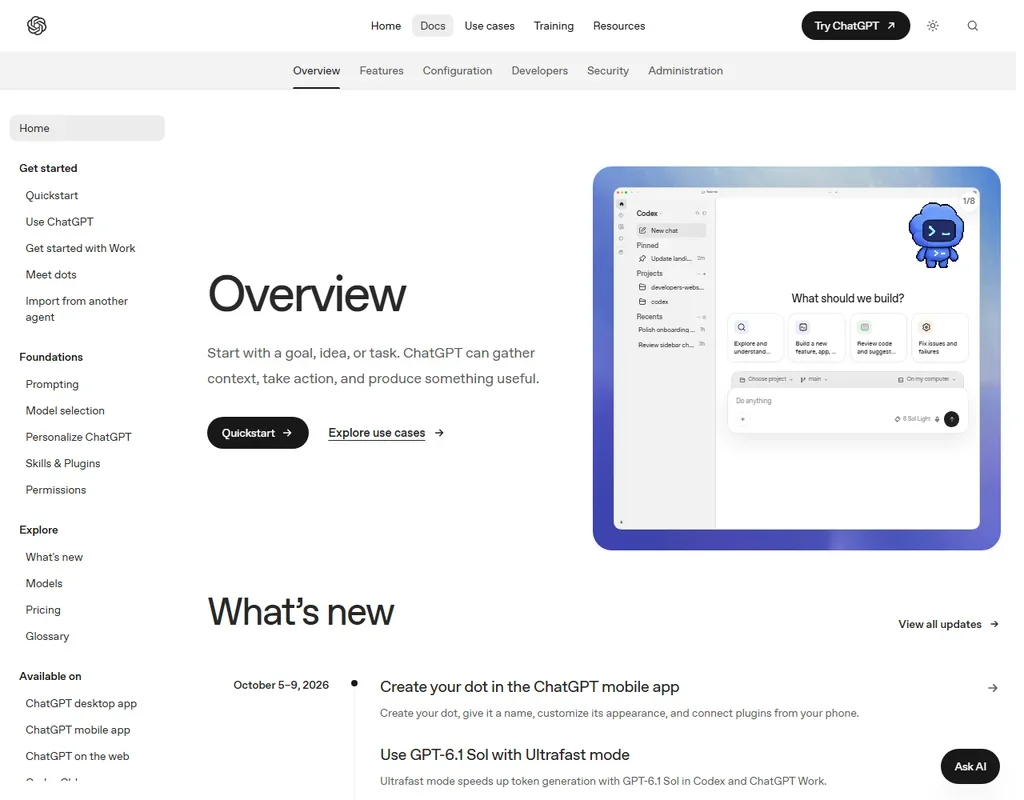
Codex is made by OpenAI, headquartered in San Francisco, United States. The command line tool runs on macOS, Windows and Linux. Editor extensions cover VS Code, Cursor, Windsurf, JetBrains and Xcode, and Codex also runs in a ChatGPT desktop app, on the web, in the ChatGPT iOS app, and through GitHub, GitLab and Slack.
The Codex CLI is open source under the Apache-2.0 licence. The IDE extension, the cloud service and the desktop app are not open source. Codex is not an editor of its own.
What Codex does in your code
Codex works as an agent. It edits files and runs commands in a sandbox, and an approval policy sets what needs your confirmation. The IDE extension opens a Codex chat sidebar with your open files as context, and it does not offer as-you-type completion.
Cloud tasks run in OpenAI-hosted environments and end in a commit or a pull request. They are on Plus and above. For review, you can write @codex review on a pull request, and automatic reviews are available too. The agent itself has no option to run on your own infrastructure.
Codex runs OpenAI's own GPT-6 Sol and Luna models. You can use your own API key, and custom model providers can point Codex at any endpoint compatible with the Responses API. Built-in Ollama and LM Studio providers let you run local models. Codex supports MCP, and the Codex SDK and the non-interactive codex exec command let you script it.
Beyond VS Code there are Xcode and JetBrains integrations, and the terminal CLI gives you the agent without an editor. Codex also has GitHub, GitLab and Slack integrations.
Working with other people
Business and Enterprise workspaces come with admin controls, analytics and audit exports. SAML single sign-on is on the Business plan and above, and Business is priced for 2 or more seats.
OpenAI Codex pricing: what each plan gives
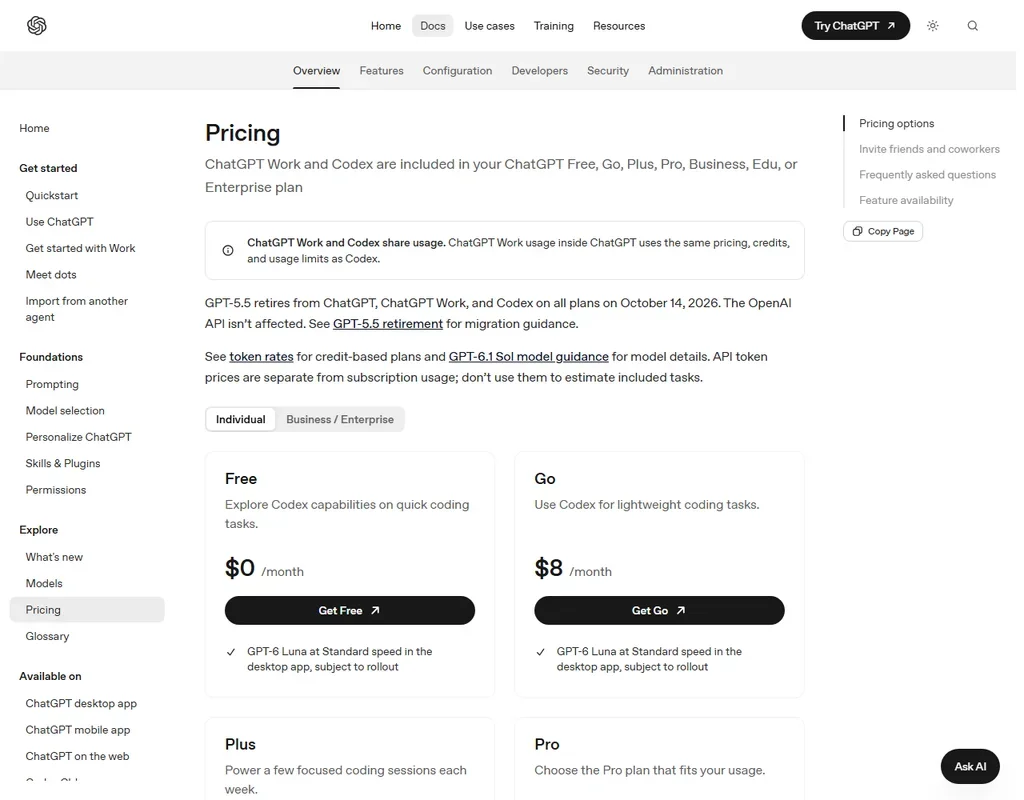
Codex is included in ChatGPT plans, so the price is the price of the plan. Usage limits vary by plan, model and task size, and ChatGPT credits extend them. If you use an API key instead, you pay API token prices.
The Free plan lets you explore Codex on quick coding tasks with GPT-6 Luna at standard speed in the desktop app, subject to rollout, and it has no image generation. Go costs $8 a month and is meant for lightweight coding tasks. Plus costs $20 a month, gives a few focused coding sessions each week, and is the first plan with Codex on the web, in the CLI, in the IDE extension and on iOS.
Pro starts at $100 a month with higher usage limits, and a $200 tier also exists. Business costs $25 per user a month, or $20 per user a month billed annually, for 2 or more seats. Enterprise is priced by custom quote from sales.
Privacy and security
On individual plans, you decide whether your data is used for training and model improvement. Data from Business, Enterprise and the API is not used for training by default.
OpenAI has a SOC 2 Type 2 examination covering its API and ChatGPT business products, and it maintains ISO/IEC 27001:2022 and ISO/IEC 27701:2019 certifications. For GDPR, OpenAI can execute a Data Processing Addendum for ChatGPT Business, ChatGPT Enterprise and the API. A Business Associate Agreement is offered for qualifying business products, and the Codex docs include a HIPAA configuration for Work.
Codex support runs through GitHub issues and discussions, with a Help Center at help.openai.com.
Who OpenAI Codex suits
Codex suits developers who already pay for ChatGPT and want a coding agent in the terminal, the editor or the cloud without a separate subscription. Pro is there for heavier use, with higher usage limits. It also suits people who want an open-source CLI, a choice of local models through Ollama and LM Studio, or cloud tasks that finish as pull requests.
It suits less well heavy daily coders on the lower plans, since Plus gives a few focused sessions each week and Go is for lightweight tasks. It also suits less well anyone who wants Claude or other vendors' models, because Codex runs OpenAI's GPT-6 models, and anyone who wants as-you-type completion in the editor.
Frequently Asked Questions
How much does OpenAI Codex cost?
Codex is included in ChatGPT plans. Free costs nothing, Go is $8 a month, Plus is $20 a month, Pro starts at $100 a month, and Business is $25 per user a month or $20 billed annually. Enterprise is a custom quote.
Is there a free plan?
Yes. Codex is included in ChatGPT Free for quick coding tasks with GPT-6 Luna at standard speed in the desktop app, subject to rollout, with no image generation.
Which models does Codex run?
Codex runs OpenAI's GPT-6 Sol and Luna models. You can also use your own API key, point a custom provider at a Responses API compatible endpoint, or use the built-in Ollama and LM Studio providers.
Does OpenAI train on my code?
On individual plans there is a training setting, so you decide whether your data is used for training and model improvement. Business, Enterprise and API data is not used for training by default.