Albert is unusual. Not in a good way, exactly, but in a way that takes some explaining.
Albert has been around since 2010. That's older than most AI marketing tools by a decade. And yet it operates almost invisibly from a public trust perspective. No G2 profile. No Capterra listing. Nothing on Trustpilot. For a platform that positions itself as the world's only fully autonomous paid media AI, the absence of third-party validation is something we kept coming back to.
What is Albert?
Albert is an autonomous AI platform built to run paid media campaigns across channels without needing constant human input. It connects to existing ad accounts on Google Ads, Meta, and a few others, then manages bidding, audience targeting, and creative performance on its own, around the clock.
The pitch is focused. This isn't an AI SEO tool in any traditional sense. It doesn't generate blog posts or write content briefs. It's closer to a media buying brain that runs while your team sleeps. Albert claims to cover 90% of the biddable universe, which sounds ambitious and probably is.
Honestly, the positioning is cleaner than most tools in this category. The question is whether the product actually delivers on it.
Albert Features: SEO & Content Tools Breakdown
Most tools in this category try to do everything. Albert does not. Deliberate choice.
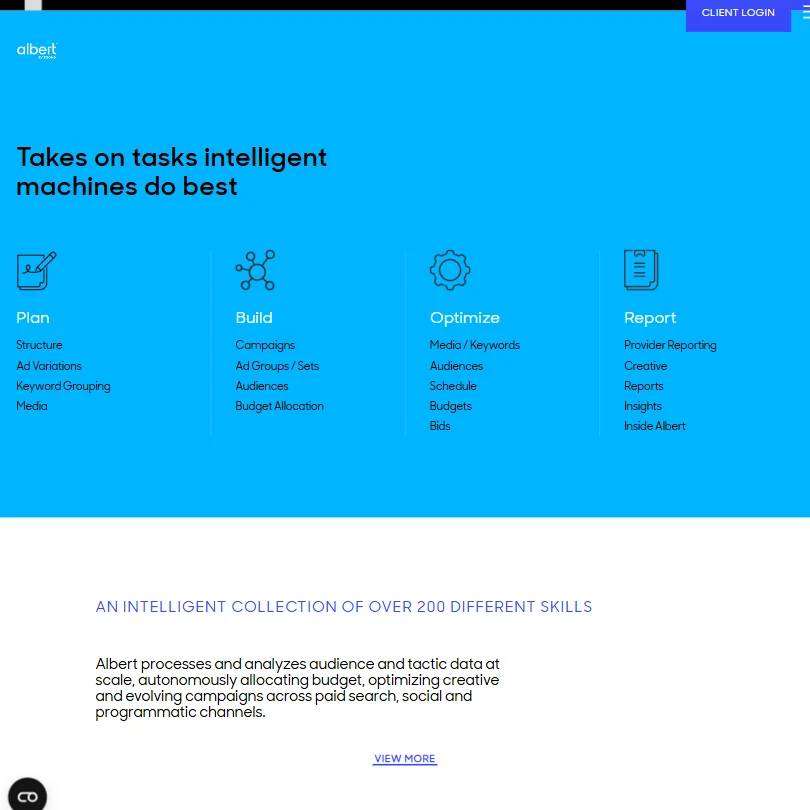
The core feature is autonomous campaign management. Albert designs, executes, and adjusts campaigns without a human in the loop for every decision. It handles audience segmentation, bid optimization, and creative rotation. The "Personalization at Scale" framing on the site refers to this: matching ad creative to micro-audience segments automatically.
What Albert doesn't do is just as relevant. No content briefs. No on-page SEO. No rank tracking. Anyone hunting for a traditional AI content optimization workflow will be looking at the wrong tool entirely.
There's also a critical limitation buried in Albert's own FAQ: it does not generate ad copy. Full stop. It relies entirely on advertiser-provided, pre-approved creative materials. Don't think of it as an AI writing tool. It isn't one. It manages and rotates the assets you hand it, which is a meaningful distinction that the site's framing tends to soften.
Albert Keyword Research: How Deep Does It Go?
Efficient Long Tail Search is what Albert specifically calls out in its results documentation. That's the keyword angle. It's about finding lower-competition search terms that convert, not building topical authority or mapping content clusters.
This is keyword optimization in service of paid search, not organic SEO. There's no evidence of SERP analysis capability. No keyword clustering in the editorial sense. Paid search targeting. That's it.
For an AI keyword research workflow that feeds into content strategy, Albert isn't structured for that. Ahrefs or a more traditional SEO platform fits that need far better.
Albert Content Creation: AI Writing Quality Tested
Content generation isn't the point here, and the FAQ confirms Albert generates none of its own ad copy at all. It rotates and tests creative variations you supply. It learns what performs.
Not articles. Not landing page copy in bulk. Creative rotation from a pre-approved asset library. If you're expecting a general-purpose AI writing layer, you'll be disappointed, and the FAQ makes that explicit in a way the marketing copy doesn't quite match.
We've seen worse implementations of ad creative management AI. We've also seen better. The problem is there's almost no public review data to triangulate against, so we're working with thin material.
Is Albert Easy to Use?
Albert's site says implementation takes weeks, not months. It operates inside existing ad accounts rather than requiring a full platform migration. On paper, sensible.
But ease of use for an autonomous system is a strange thing to measure. The whole point is that it operates without constant human input. So the onboarding experience is really about trust, specifically whether you trust the AI to make real-time spending decisions. That's a different kind of friction than learning a new interface.
Albert Pricing: Is It Worth It vs Free Alternatives?
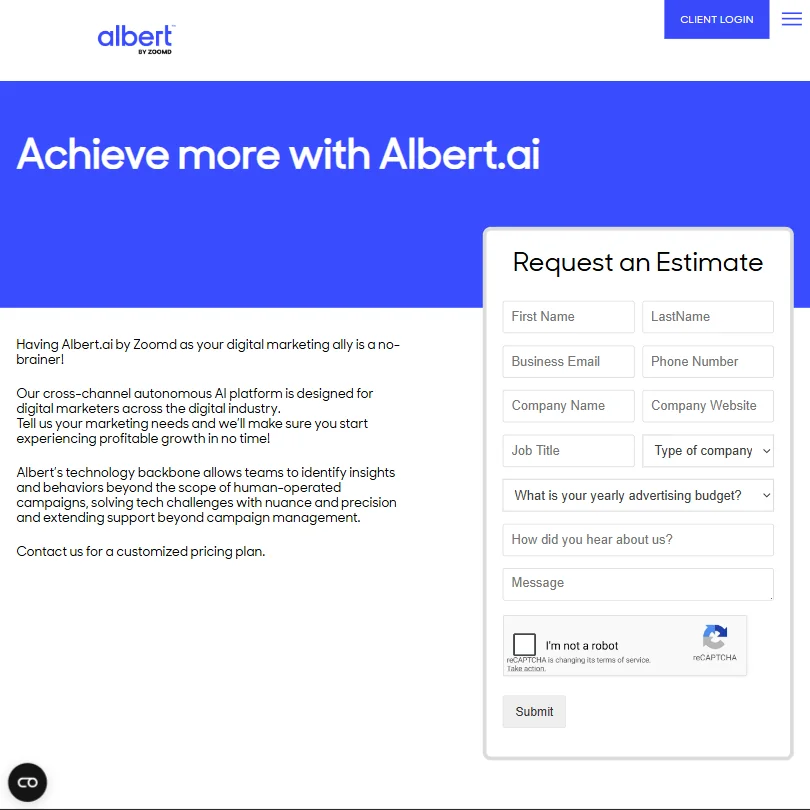
No public pricing. The site has a pricing page. It asks you to request an estimate, with a form collecting your company name, job title, yearly advertising budget range, and company type. Enterprise pricing behavior, which means the number is almost certainly large.
No free plan. No free trial. Albert has no publicly available path to evaluate the product before committing to a sales conversation, and in our database of reviewed tools in this category, roughly a quarter offer a free plan. Albert isn't one of them.
For teams with serious paid media budgets, that might be acceptable. For anyone who wants to evaluate the tool before signing a contract, Albert doesn't publicly offer a pilot, so ask for one.
Albert vs Smartly.io: Head-to-Head Comparison
Smartly.io is the more obvious comparison. It also targets enterprise advertisers running multi-channel paid campaigns. It also operates on a managed, high-touch sales model.
The difference Albert pushes is full autonomy. Smartly.io requires more human direction on creative strategy. Albert claims to handle that layer too, though given that it relies on advertiser-supplied creative assets rather than generating its own, that claim deserves some scrutiny.
Skai and Quantcast both show up in the same competitive space. Each has more public review presence than Albert. That doesn't make them better products, but it does mean you can evaluate them more easily before committing budget. Fair.
Who Should Use Albert? (And Who Shouldn't)
Enterprise brands running large paid media budgets across multiple channels. That's the target. Specifically companies with enough ad spend to justify a custom contract and enough internal confidence in AI to let it make real-time budget calls.
Small and mid-market teams. Look elsewhere. The pricing structure alone signals this isn't built for them. Anyone wanting SEO content tooling should also look elsewhere, with something like Clearscope mapping to that workflow far better.
Albert Review Verdict
Albert is a narrow tool for a specific buyer. It does one thing: runs paid media autonomously. It doesn't pretend to be an AI SEO tool or a content platform.
The problems are structural. No public pricing, no free trial, and no meaningful third-party review presence make it nearly impossible to evaluate before you buy. Compound that with the FAQ confirmation that Albert generates no ad copy of its own, and the gap between the marketing framing and actual product scope becomes hard to ignore. That's concerning for a platform asking for enterprise-level trust and budget.
The positioning is confident. The evidence base for that confidence is thin from where we're sitting.
Frequently Asked Questions
Is Albert an AI SEO tool?
Not in any conventional sense. It focuses on paid media, not organic search. There's no rank tracking, no content brief generation, and no backlink analysis. The keyword work it does is in service of paid search campaigns, not content strategy.
Does Albert have a free trial?
No. There's no free plan and no publicly available trial option. Pricing is custom, gated behind a request-an-estimate form that asks for your budget range and company type before any number appears. Real barrier for teams trying to evaluate independently.
How does Albert compare to Smartly.io?
Both target enterprise advertisers and both require custom contracts. Albert's stated differentiator is full autonomy, meaning the AI makes more campaign decisions without human approval. Smartly.io has a larger public footprint in terms of reviews and case studies, which makes it easier to pressure-test before committing. Albert doesn't offer that same visibility.