Our research on Qodo started with the homepage and got more interesting pretty fast. We read through Qodo's documentation and pricing pages. What we kept seeing was a tool that's genuinely trying to solve a harder problem than most qodo ai code review tools bother with. Not just "catch bugs." More like: enforce how your whole team writes code, across every repo, at scale. Whether it actually does that is a longer answer.

What is Qodo?
Founded in 2023 and based in Tel Aviv, Qodo pitches itself as an AI-powered code review platform built around what they call a "living rules system." The idea is that it learns your team's standards over time and enforces them automatically, across pull requests, IDE sessions, and CLI workflows. They raised a $40M Series A in September 2024. For a two-year-old company, that's a meaningful vote of confidence.
The platform runs on a proprietary multi-agent context engine. That's vendor language, but the practical claim is real: Qodo indexes your full codebase, not just the file you're looking at. Dependencies, PR history, and even business requirements from ticket systems get pulled in. That's the part that separates it from tools that just read the diff.
They report 886,000+ users. Hard to verify, but it's the kind of number that at least tells you there's traction.
Qodo Features: Code Generation, Review & Developer Workflow
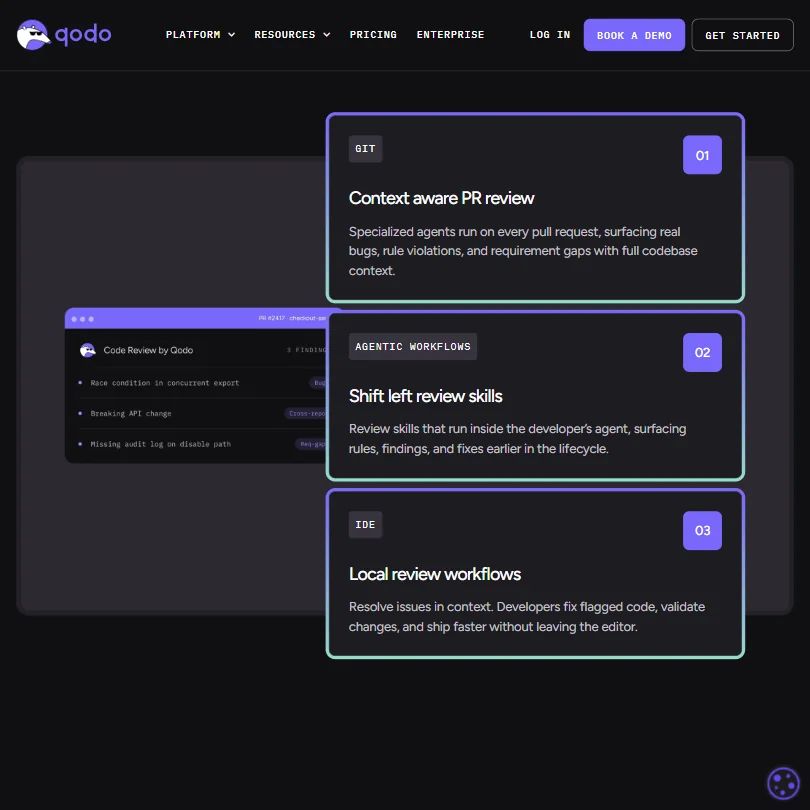
The core product covers a lot of ground. Automated pull request review is the flagship, running multi-agent analysis across the full codebase to catch bugs, flag logic gaps, and surface requirement mismatches. It doesn't just mark a line red. It generates a fix inline.
On the IDE side, you get real-time review with guided changes as you write. VS Code and JetBrains are supported. The suggestions aren't autocomplete in the traditional sense. They're more like a reviewer watching over your shoulder and pointing things out before you commit.
Test generation is included, tied to the review workflow rather than sitting separately. Security scanning is in there too, with audit trails and compliance flagging. In June 2025, they shipped the Qodo Command CLI, which opens up the review workflow outside of an IDE or Git platform entirely. Useful for teams running automated pipelines.
The governance layer is what sets this apart from most competitors. A dashboard for tracking risk, mapping repo relationships, and enforcing rules across teams. That's not a feature you see in tools aimed at solo developers. That's an enterprise pitch. Honestly, it surprised us how far they'd pushed that side of the product for a company this young.
Qodo Code Quality: How Accurate and Reliable Is It?
G2 shows 4.7 out of 5 across 63 reviews. That's a small sample, but the pattern is consistent enough to be meaningful. Reviewers in engineering roles describe the context-awareness as genuinely useful, specifically the ability to catch issues that simpler tools miss because they lack the full codebase picture.
What we kept seeing in the reviews: the multi-repo codebase indexing gets called out as the thing that makes the review feel less like a linter and more like a senior developer. That tracks with the multi-agent architecture they describe in their docs.
The flip side, and it does come up, is occasional noise. Some reviewers mention review comments that are technically correct but contextually irrelevant. That's a known failure mode for any context-heavy system. It doesn't dominate the feedback, but it's there.
We're skeptical of any claim that an AI review system has zero false positives. Nobody's solved that.
Qodo IDE & Workflow Integration: Where Does It Work?
VS Code and JetBrains cover the majority of professional developers. GitLab and GitHub are the primary Git integrations. Gerrit is listed as Enterprise-only, which makes sense given the install base.
Jira integration is mentioned in the context of pulling in business requirements as review context. That's a clever move. Most tools treat the PR in isolation. Pulling in the ticket gives the review engine something to compare the implementation against.
The CLI, launched June 2025, is new enough that we don't have deep user reports on it yet. Worth watching.
The integration story is solid, though nothing exotic is supported beyond what engineering teams already run. If your stack is GitHub plus VS Code, you're covered from day one. Gerrit users will need to be on Enterprise, which adds a conversation with sales before you can even try it.
Is Qodo Easy to Set Up and Use?
The 14-day free trial requires no credit card. That's always a good sign. Vendor docs are reasonably detailed. There's in-product help alongside the documentation, which matters when you're configuring custom rules for the first time.
Where it gets complicated is the governance setup. Defining team-wide rules, mapping repo relationships, configuring the audit trail: none of that is trivial. We didn't find complaints about it being broken. We found reviews that suggest it takes real configuration time to get value out of the enterprise features.
Fair. That's true of any governance tooling. You don't get deterministic standards enforcement without investing in the standards definition work first.
Support is ticket-based for paid plans. No live chat mentioned anywhere in what we could find. For a team in the middle of a complex rollout, that gap is worth knowing about before you buy.
Qodo Pricing: Is It Worth It for Solo Devs and Teams?

No free plan. That's a meaningful decision to flag. Open source projects can apply for free access, which is a reasonable carve-out, but individual developers who want to try this on a personal project are looking at a 14-day window before they start spending.
The Pro Team plan starts at $0.012 per credit, with packs from 2,500 credits. A 5,000-credit pack roughly covers 36 PR reviews per month. Do the math on a busy team and it adds up. The per-credit model makes costs hard to predict until you understand your team's review volume, which most teams don't know without a few weeks of data.
Enterprise is custom pricing with a demo call required. No public benchmark. That's standard for this tier, but it does mean smaller teams can't easily self-qualify.
The refund policy isn't stated publicly. That's a gap. Not a dealbreaker, but not great either.
Qodo vs CodeRabbit: Which AI Coding Tool Is Better?
CodeRabbit is the most direct comparison. Both do automated PR review on GitHub and GitLab. Both claim context-awareness. The differences show up in two places.
First, governance. CodeRabbit focuses on the review workflow. Qodo builds a governance layer on top of that, with audit trails, risk scoring, and cross-repo rule enforcement. For a single-team repo, that distinction barely matters. For a mid-size engineering org trying to enforce standards across 30 repositories, it matters a lot.
Second, pricing model. CodeRabbit runs per-seat. Qodo runs per-credit. Which is cheaper depends entirely on your usage pattern.
We wouldn't call one better in the abstract. Teams that want governance at scale have a clearer reason to look at Qodo. Teams that just want cleaner PRs without the overhead should think carefully about whether the full Qodo stack is more than they need.
Who Should Use Qodo? (And Who Shouldn't)
Engineering teams managing multiple repositories with real standards-enforcement problems. That's the fit. The governance portal and rules engine aren't decorative features. They're built for organizations that have felt the pain of inconsistent code quality across teams.
Solo developers. Probably not. No free plan, a per-credit pricing model with a learning curve, and a governance layer you'll never use. The value-to-friction ratio doesn't land for individuals. Something like Cursor, which is built around the solo and small-team agentic coding workflow, makes more sense for that use case.
Teams on Gerrit who aren't on Enterprise are also blocked. Worth checking before you invest time in evaluation.
Qodo Review Verdict
Qodo is doing something legitimately harder than most tools in this space. Full-codebase context, multi-agent review, a governance layer that enforces rules without manual intervention. The architecture is serious. The 4.7 on G2 is not inflated by volume; 63 reviews from engineering professionals pointing in the same direction means something.
The gaps are real too. No free plan and opaque enterprise pricing create friction at both ends of the buyer journey. The per-credit model is workable once you understand your usage, but it's not transparent upfront. Ticket-only support is fine until it isn't. And for teams that just need "review my PR and catch the obvious bugs," there's a real question of whether the full Qodo platform is the right weight class.
We'd recommend this for growing engineering organizations that have already felt the pain of inconsistent standards. Not the starting point for a three-person team. The right tool at the wrong stage is still the wrong tool.
Frequently Asked Questions
Does Qodo have a free plan?
No. Qodo doesn't offer a permanent free tier for individual developers. There's a 14-day free trial with no credit card required, and open source projects can apply separately for ongoing free access. If you need to evaluate it before committing, the trial window is your only path.
What languages does Qodo support?
Qodo's docs reference 25-plus programming languages. The vendor doesn't publish an exhaustive list on the pricing page, so if your stack includes something niche, it's worth confirming before you start the trial. Support for the mainstream languages used in most professional codebases appears to be solid based on what we found in user reports.
How is Qodo different from a standard linter or static analysis tool?
A linter reads the file. Qodo reads the file, the repo structure, the PR history, and the related business requirements from your ticket system. The multi-agent context engine is what makes the review feel like a code review rather than a style check. Whether that additional context produces better outcomes for your team is the real evaluation question, and that's exactly what the 14-day trial is for.