Our research into Snyk started, as it often does, with the vendor's own framing. Then we cross-referenced that against Snyk's own documentation and pricing pages. The tool is real. The security problem it solves is real. Whether the price makes sense for your team is a different question.

Snyk was founded in 2015, headquartered in Boston, and has grown to a user base the company pegs at over 2 million developers. That's a big number. It also covers a lot of free-tier users, so keep it in context.
What is Snyk?
Not an AI coding assistant. Not a code generator. Snyk scans what you write, or what your AI assistant writes for you, and tells you what's dangerous about it.
The company describes itself as an "AI Security Fabric," which is marketing. What it actually does is run multiple scanning engines across your codebase. Snyk Code handles static analysis, covering SAST. Snyk Open Source covers dependency vulnerabilities via SCA. Snyk Container scans Docker images and Kubernetes configs, and Snyk IaC checks Terraform and similar infrastructure files for misconfigurations.
The AI piece comes from DeepCode AI, their proprietary model. It powers the SAST engine and the fix suggestions. It's not ChatGPT bolted on. DeepCode was an actual acquisition, and the model has been trained specifically on security patterns. That distinction matters more than the marketing copy around it.
Snyk has recently pushed hard into AI-generated code security. The pitch is that tools like Cursor, Claude Code, and Codex produce vulnerable code at scale, and Snyk sits in the middle as the validator. That's a real problem. Whether Snyk is the best answer to it is what we kept trying to figure out.
Snyk Features: Code Generation, Review & Developer Workflow
Snyk doesn't generate code. Doesn't complete it either. What it does instead is review the code you already have, or that your AI assistant just produced, and flag the security problems inside it.
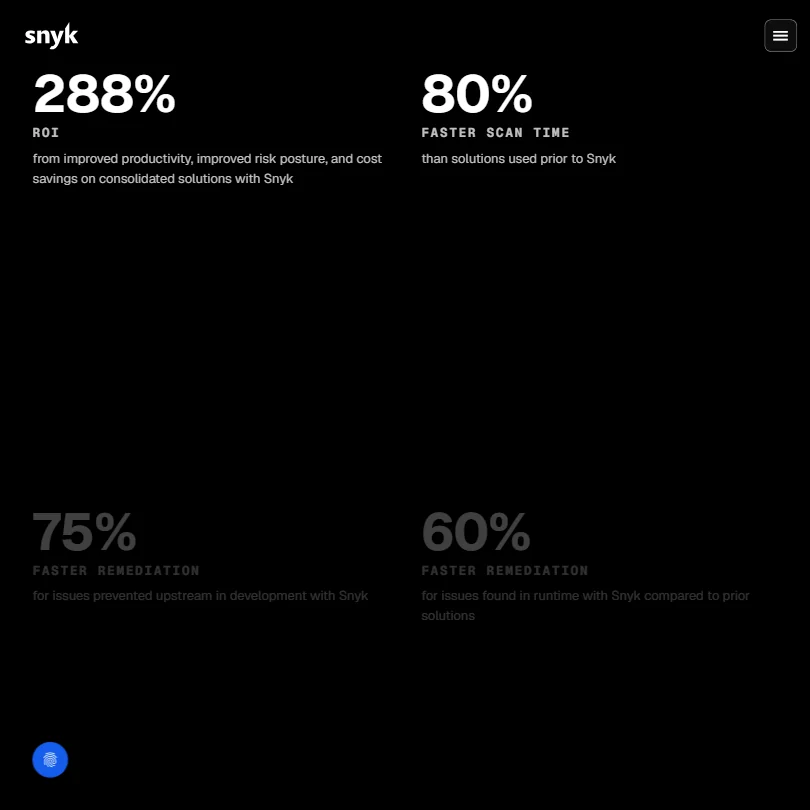
The SAST engine runs automatically when you push to a repo or trigger it from the CLI. It looks for injection flaws, hardcoded secrets, and insecure configurations. What's less usual is the reachability analysis. Snyk can tell you whether a vulnerable dependency is actually called by your code, which cuts down significantly on false positives. Reachability analysis like this is the kind of feature that makes a tool feel trustworthy rather than noisy.
Fix suggestions come alongside the findings. These aren't just "update to version X." The engine proposes actual code changes. Automated fix PRs are available too, so for clear-cut dependency issues, Snyk can open the pull request itself. That's genuinely useful. It doesn't always work perfectly on complex fixes, but for straightforward upgrades, reviewers said it mostly holds up.
The Snyk Broker option deserves a mention for enterprise buyers. It lets teams run Snyk against self-hosted source code management systems without sending code outside the firewall. That's a real architectural choice, not a marketing add-on.
For AI-generated code specifically, Snyk has built integrations with Cursor and Claude Code. The idea is that Snyk sits alongside the coding assistant and validates output in real time. We haven't tested this flow ourselves, but the vendor documentation describes it clearly enough.
Snyk Code Quality: How Accurate and Reliable Is It?
Accuracy is the right question to ask of any SAST tool. They all produce false positives. The question is how many, and how well the tool helps you ignore the ones that don't matter.
G2 currently shows a 4.5 out of 5 from 132 reviews. Capterra sits slightly higher at 4.6, but that number comes from only 21 reviews, so we'd weight the G2 figure more. Neither is bad. Neither is exceptional.
The false positive question comes up in reviews, but less frequently than you'd expect for a SAST tool. The reachability analysis is doing real work there. Reviewers who had come from Checkmarx or Veracode specifically mentioned fewer irrelevant alerts in Snyk. That tracks with what the docs claim, and it's one of the few cases where vendor claims and user reports actually aligned.
What reviewers flag more than accuracy is coverage gaps. C and C++ support exists, but several reviewers said it felt less mature than the JavaScript and Python scanning. We're skeptical that's fully fixed yet. Mobile coverage for Swift and Kotlin is there on paper, but the volume of real-world feedback on those languages is thin.
The remediation suggestions are generally well-regarded. Not perfect. One pattern we saw in G2 reviews from security engineers was appreciation for the fix suggestions, followed by frustration when a suggested fix introduced a different issue. That happens. It's a known limitation of automated remediation and not unique to Snyk.
Snyk IDE & Workflow Integration: Where Does It Work?
This is where Snyk has clearly invested. The IDE plugin list covers VS Code and JetBrains IDEs, among others. Git integrations cover GitHub and GitLab, plus Bitbucket and Azure Repos. CI/CD support includes Jenkins and CircleCI, and a few others worth confirming against your own stack.
Honestly, the breadth here is better than most competitors at this price point. The depth is a more interesting question.
The VS Code extension in particular gets consistently positive mentions. It surfaces findings inline without being disruptive. The JetBrains plugin works, but a few reviewers flagged it as slower, especially on larger projects. That's a recurring enough complaint that we'd take it seriously if your team lives in IntelliJ.
The Jira integration matters for security engineering teams that need to push findings into a ticket workflow rather than just a scan report. Snyk has it. It works. Reviews confirm it without much drama, which usually means it does what it's supposed to. Worth noting that Jira integration appears on the Team plan and above, not the free tier.
CLI support is full-featured. That matters for teams that want to run scans in scripts or local environments before anything touches a pipeline. The CLI is well-documented and the Snyk User Docs are genuinely good. We cross-referenced their documentation against user complaints and the docs held up.
Is Snyk Easy to Set Up and Use?
The free plan requires no credit card. You connect a repo, install the CLI or browser extension, and get results. That flow is fast. Most reviewers who talked about setup described it as one of the easier security tools they'd onboarded.
For teams, it gets more involved. SSO configuration, custom security rules, Snyk Broker for self-hosted environments. These aren't trivial. Enterprise onboarding takes real time, and pretending otherwise doesn't help anyone.
The learning curve for interpreting results is real too. A developer unfamiliar with security concepts can get overwhelmed by findings on a first scan, especially on a mature codebase with accumulated debt. Snyk Learn exists partly to address this, with educational content tied to the vulnerability types it finds. That's a smart product decision. Whether developers actually use it is a different matter.
Support is a gap. There's no live human chat on the lower paid plans from what we could find, just a bot on the site. For a tool that security teams sometimes need help with urgently, a bot is a rough answer. Next business day support appears on the Team plan, which at $25 per contributing developer per month is at least something.
Snyk Pricing: Is It Worth It for Solo Devs and Teams?
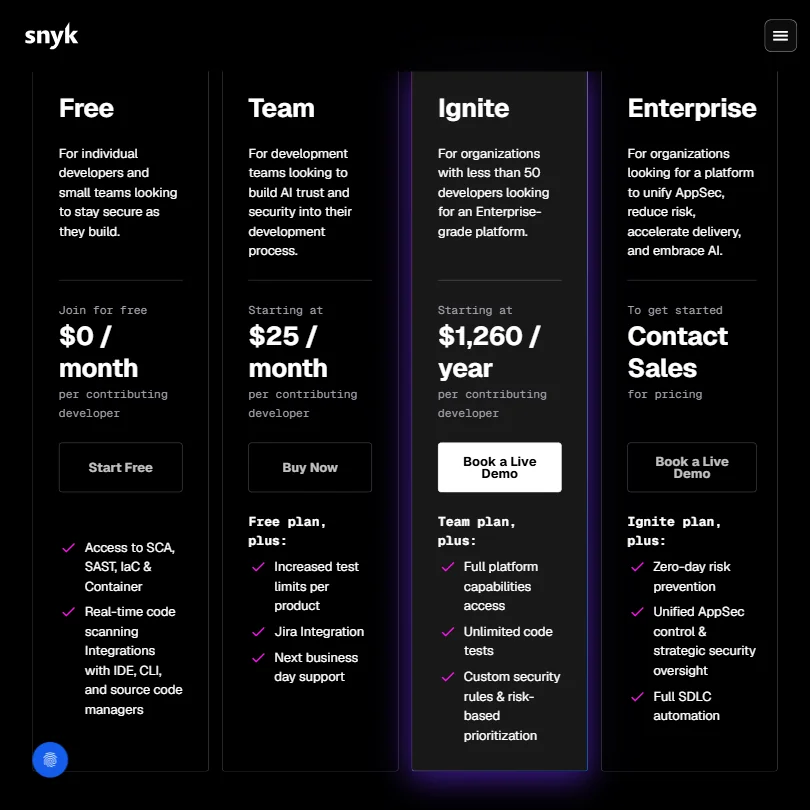
The free plan is real and genuinely usable. It covers limited tests per month across open source scanning, code scanning, and container scanning. Good enough to evaluate the tool. Not good enough for production use at any real volume.
The Team plan starts at $25 per contributing developer per month. The Ignite plan sits at $1,260 per year per contributing developer, aimed at organizations with fewer than 50 developers who want full platform capabilities access, unlimited code tests, and custom security rules. Enterprise is contact sales, which means whatever your negotiator is worth.
We dug through the pricing page and found the usual problem: what exactly counts as a "contributing developer" and how quickly you'll hit plan limits isn't immediately obvious. That's a common gripe in the reviews. G2 reviewers in smaller teams mentioned hitting free tier limits faster than expected and feeling pushed toward a paid plan before they'd fully evaluated the tool.
At $25 per month for Team, Snyk is reasonably priced against Veracode or Checkmarx, which run significantly higher for enterprise contracts. Against GitHub Advanced Security, which is bundled into GitHub Enterprise, it's harder to compare directly. That comparison deserves its own section.
The $1,260 per year Ignite plan adds full platform capabilities and priority support. We don't have visibility into the exact project limits at each tier. That's a transparency issue. Not a dealbreaker, but annoying when you're trying to forecast costs across a growing team.
Snyk vs GitHub Advanced Security: Which AI Coding Tool Is Better?
These two tools keep showing up in the same decision-making conversations, which makes the comparison worth working through carefully.
GitHub Advanced Security is bundled into GitHub Enterprise. If your team is already paying for GitHub Enterprise, GHAS is effectively included. That's a meaningful cost argument. Snyk isn't free at any meaningful volume.
What Snyk has that GHAS doesn't is independence. Snyk works across GitHub, GitLab, Bitbucket, and Azure Repos. If your team spans multiple SCM tools, or might in the future, Snyk's flexibility is real. GHAS is a GitHub-only story. Full stop.
GHAS has improved significantly since Microsoft pushed CodeQL into the mainstream, but Snyk's SCA coverage and the reachability analysis are generally considered stronger by the developer security community. That tracks with how the two tools are generally compared. We don't buy the idea that the gap has closed entirely.
For teams that want security embedded directly into an AI coding workflow, Snyk's integrations with Cursor and Claude Code give it an angle GHAS doesn't have yet. If you're building on top of agentic coding tools, that gap matters. And if you want a pure code review layer without the security angle, CodeRabbit is worth a look as a complementary tool rather than a replacement.
Veracode and Checkmarx compete at the enterprise end. Both cost more and both carry more institutional weight in regulated industries. Snyk is catching up on compliance features but it's not there yet for every regulatory context.
Who Should Use Snyk? (And Who Shouldn't)
Development teams shipping code fast and using AI coding assistants. That's the fit right now. The problem Snyk is solving, AI-generated code introducing security debt at velocity, is a real one and growing.
Security engineers at mid-size companies. The platform gives them visibility across the SDLC without requiring a Veracode-size budget or a six-month implementation.
Solo developers on the free plan. It's a reasonable way to build security habits without paying anything. Just know the limits are real and you'll feel them.
Who shouldn't bother? Teams already deep in the GitHub Enterprise ecosystem who don't have a pressing reason to pay for a separate tool. GHAS will cover most of what they need. Also, teams in heavily regulated industries where Checkmarx or Veracode are already approved vendors. Switching costs are high and the compliance headaches aren't worth it.
For teams primarily focused on enterprise-scale agentic development workflows, Augment Code handles the generation side of that equation while Snyk handles the security validation side. The two aren't competitors.
Snyk Review Verdict
Snyk works. The core scanning is solid. The reachability analysis genuinely reduces noise, and the integrations are broad and mostly well-executed. The free plan is honest about what it offers.
The frustrations are real too. Pricing transparency around plan limits could be significantly better, particularly around what counts as a contributing developer and how fast test counts accumulate. Support without live human access at lower tiers is a gap for a security tool, where problems can feel urgent. The C and C++ coverage is thinner than the marketing suggests.
The AI-generated code security angle is the most interesting piece of the product right now. Whether it's fully baked is hard to say without testing it ourselves, and we haven't. What we can say is that the vendor documentation is coherent, the integrations with Cursor and Claude Code are clearly described, and the problem being solved is legitimate.
For 2025, Snyk is one of the stronger independent application security tools in the mid-market range. Not the cheapest. Not the most enterprise-hardened. But well-integrated, developer-friendly by design, and increasingly relevant as AI-generated code becomes the norm rather than the exception. Fair.
Frequently Asked Questions
Does Snyk work with AI coding assistants like Cursor or Claude Code?
Yes, and this is one of the more interesting things Snyk has built recently. The integrations are documented by the vendor, though we haven't independently verified performance overhead on larger codebases. The idea is that Snyk validates code as it's generated, rather than waiting for a separate scan later. Whether that's a workflow improvement or an annoyance depends on how your team likes to work.
Is the Snyk free plan actually useful?
For evaluation purposes, yes. For ongoing production use, probably not. You'll hit test limits faster than expected, and several reviewers flagged that the free tier constraints aren't clearly telegraphed upfront. Good enough to spend a week learning the tool. Not good enough to rely on for a team shipping daily.
How does Snyk compare to Veracode for enterprise security?
Snyk is cheaper and faster to onboard. Veracode carries more weight in regulated industries where approved vendor lists matter and compliance requirements are strict. If your security team needs to satisfy a specific audit trail or regulatory framework, Veracode's institutional credibility still leads. If you need capable application security scanning at a fraction of the cost and timeline, Snyk is a serious option. The gap is narrowing, but it hasn't closed yet.