Claude Code is Anthropic's agentic coding tool, built to work across a whole repository from the terminal, an editor, a desktop app or the web. It comes with the paid Claude plans or is billed per token through the API. What decides whether it suits you is whether you want an agent that plans, edits files and runs tests for you, since it does not offer as-you-type autocomplete.
What is Claude Code?
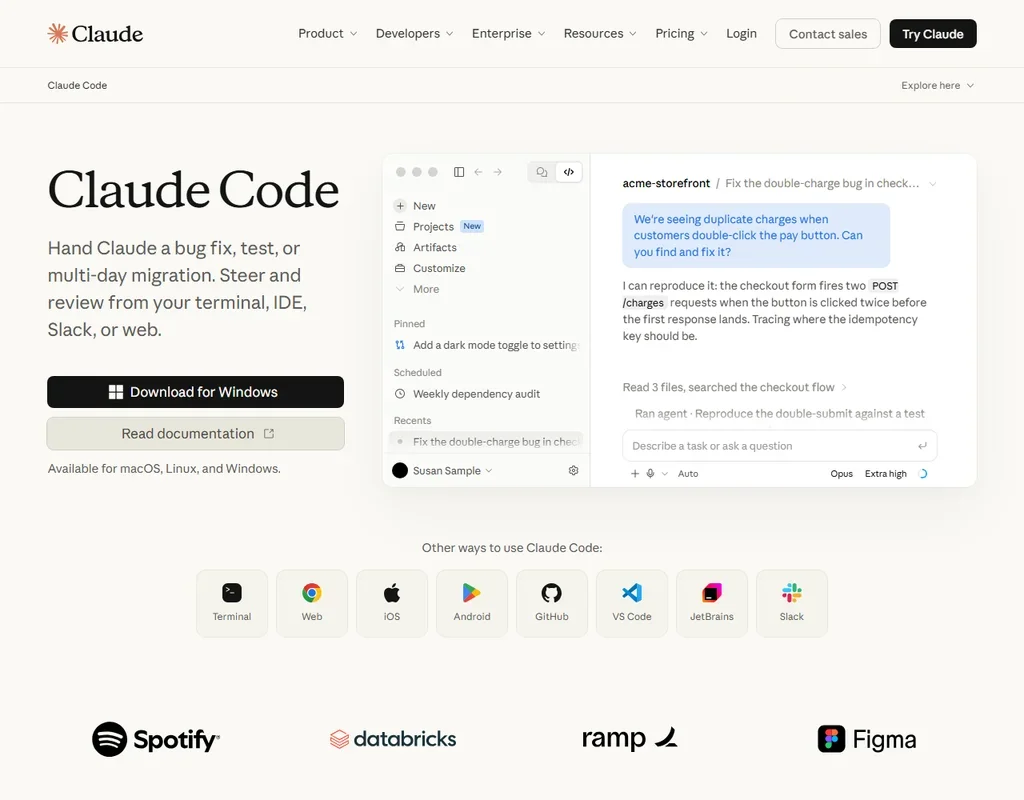
Claude Code is made by Anthropic, headquartered in San Francisco, United States. It runs in the terminal on macOS 13 and later, Windows 10 1809 and later, and Linux (Ubuntu 20.04 and later, Debian 10 and later, Alpine 3.19 and later). It also comes as a VS Code extension, a JetBrains plugin, a Code tab in the Claude desktop app, a web app, the Claude iOS and Android apps, and integrations for Slack, GitHub Actions and GitLab CI/CD.
It is a terminal-first agent with IDE extensions that show inline diffs. It is not an IDE fork and has no editor of its own.
What Claude Code does in your code
Claude Code is an agent: it edits files, runs commands and tests, and iterates on the result. Permission modes set what needs your approval, and auto mode is the default on Pro, Max and Team. It does not offer as-you-type autocomplete suggestions. In VS Code you get inline diffs, @-mentions, plan review and conversation history inside the editor, and the JetBrains plugin and the terminal give you the same kind of chat.
To understand a codebase, Claude Code searches the whole repository on demand with file-pattern and regex tools instead of keeping a pre-built index. Automated pull request review catches logic errors, security vulnerabilities and regressions using multi-agent analysis of your full codebase, and review also runs through GitHub Actions and GitLab CI/CD.
Cloud sessions run Claude Code from your browser, phone, desktop app or terminal. They are on Pro, Max, Team and Enterprise premium seats, and a session can auto-fix pull requests. Cloud sessions can run on compute your organization operates through self-hosted environments, while model inference runs on Anthropic or on Amazon Bedrock, Google Cloud or Microsoft Foundry.
The models are Anthropic's own Claude models, chosen through aliases for Sonnet, Opus, Haiku and Fable. You can sign in with an Anthropic Console account or use Bedrock, Google Cloud or Foundry credentials, and an LLM gateway that your organization already runs can sit in between. Keys for other vendors' models are not an option, and Claude Code does not run local models.
Claude Code connects to hundreds of external tools and data sources through the Model Context Protocol. It can also run headless with claude -p and through the Agent SDK, so you can script it.
Working with other people
The Team plan has admin tools, billing management, spend controls and a usage dashboard, and Team and Enterprise add single sign-on. Usage metrics and contribution metrics are available to Team and Enterprise admins in Claude Code analytics. Anthropic's commercial terms, which cover Team, Enterprise and the API, include protection against third-party intellectual property claims over your paid use of the services and outputs.
Claude Code pricing: what each plan gives
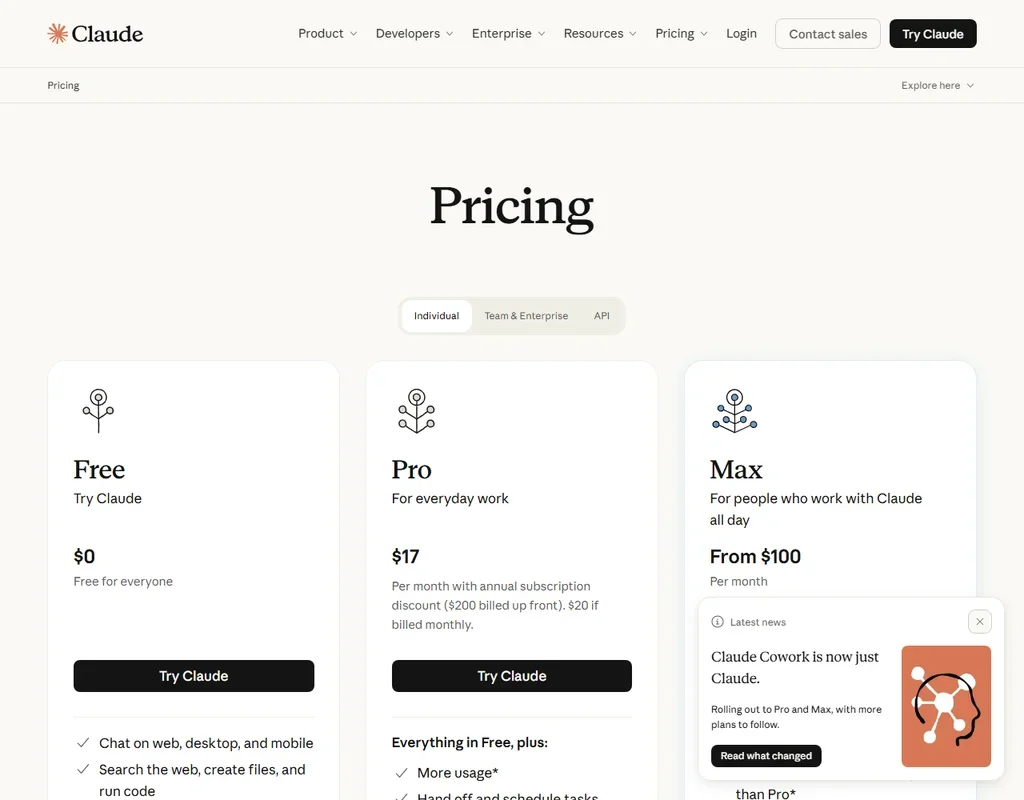
There is no free plan and no free trial. The free Claude chat plan does not include Claude Code. You can also use it pay-as-you-go with an Anthropic Console account at API prices.
Pro costs $20 a month, or $17 a month billed annually ($200 up front), and gives more usage than the free Claude plan with usage limits that apply. Max 5x costs $100 a month with 5 times the usage of Pro, and Max 20x costs $200 a month with 20 times the usage of Pro.
Team is priced per seat for 2 to 150 users. A standard seat costs $25 a month, or $20 a month billed annually. A premium seat costs $125 a month, or $100 a month billed annually, and gives 5 times more usage than a standard seat. Enterprise costs $20 per seat a month billed annually plus usage billed at API rates, and there is a sales-assisted option as well as a self-serve one.
Privacy and security
On Free, Pro and Max accounts you choose whether your data is used to improve future Claude models, through a model-improvement setting. On Team, Enterprise, the API and third-party platforms, Anthropic does not train on your code or prompts under commercial terms.
Anthropic holds a SOC 2 Type 2 report and an ISO 27001 certificate. HIPAA support is on Enterprise plans with a BAA and the HIPAA configuration enabled, and it applies to Claude Code in local mode through the CLI or the desktop Code tab. Standard commercial data retention is 30 days, and qualified Enterprise accounts can get Zero Data Retention.
Support is through a support messenger and email, the Claude Discord server and the community, and bugs go to the claude-code GitHub issues. There is no phone or live chat support.
Who Claude Code suits
Claude Code suits developers who want an agent to take a task across a whole repository: plan it, edit the files, run the tests and open the pull request. It also suits teams that want one tool in the terminal, the editor and the cloud, with MCP for external tools and review on every pull request. Organizations that need HIPAA, SSO or zero data retention can get them on Enterprise.
It suits less well anyone who wants as-you-type autocomplete, since Claude Code does not offer it. It also suits less well developers who want to bring keys for other vendors' models or run local models, because it runs Claude models, and anyone who wants to try it free first, since there is no free plan or trial.
Frequently Asked Questions
How much does Claude Code cost?
Claude Code is included in Claude Pro at $20 a month ($17 a month billed annually), Max 5x at $100 a month and Max 20x at $200 a month. Team seats are $25 a month for a standard seat and $125 for a premium seat, or $20 and $100 billed annually. You can also pay per token through an Anthropic Console account at API prices.
Does Claude Code have a free plan?
No. Claude Code is not part of the free Claude plan, and there is no free trial of Pro, Max or Team.
Which models can Claude Code use?
Claude Code uses Anthropic's Claude models, with aliases for Sonnet, Opus, Haiku and Fable. The same Claude models are available through Amazon Bedrock, Google Cloud and Microsoft Foundry, but keys for other vendors' models are not an option.
Does Claude Code train on my code?
On Free, Pro and Max accounts you can choose whether your data is used to improve future Claude models. On Team, Enterprise and the API, Anthropic does not train on your code or prompts under commercial terms.