A few weeks of pulling apart vendor documentation, G2 reviews, Capterra writeups, and whatever Reddit threads surfaced when we went looking. That's the basis of this one. Bito is harder to categorize than most tools in this space, and the positioning has shifted enough since 2021 that earlier takes are mostly obsolete now.
What is Bito?
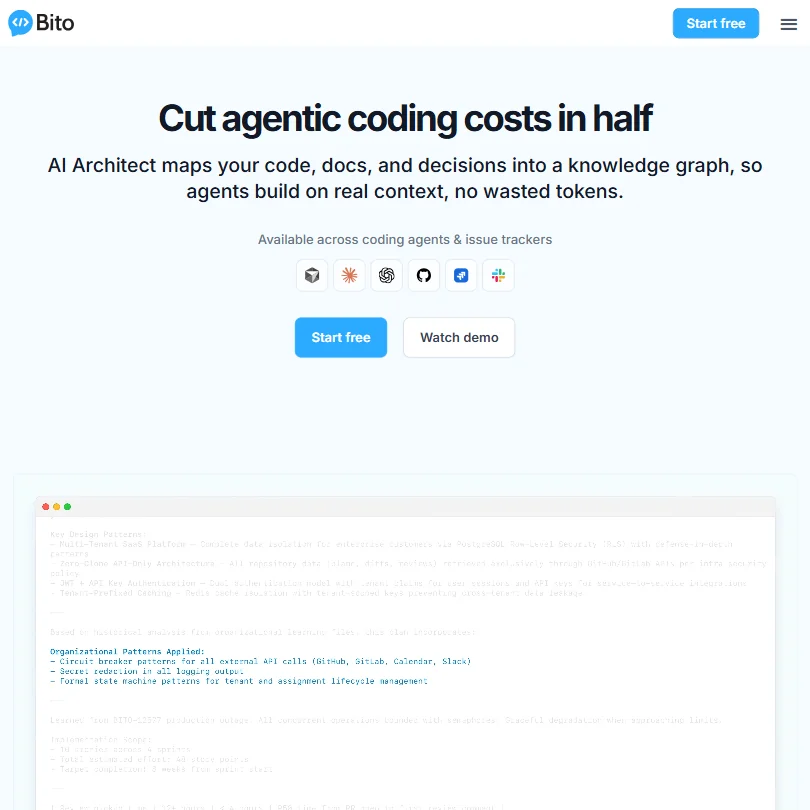
Started as a coding assistant. Now something else. The current product is built around what Bito calls the AI Architect, a system that indexes your repositories, commits, open issues, and documentation, then builds a connected knowledge graph across all of it. Every feature the platform offers, code generation, review, impact mapping, draws from that graph rather than operating context-blind.
Multiple AI models are in play. Claude Opus 4 is the listed primary. Others are available, and that matters because model selection affects output quality in ways that aren't always obvious from the outside.
The integration surface is wider than we expected. GitHub for PR reviews and commit indexing. Jira and Linear for project tracking. Slack for notifications. MCP support connects it to Cursor, Claude Code, and Codex. Honestly, for a company this size, that's a lot of surface area to maintain well.
Bito Features: Code Generation, Review & Developer Workflow

The thing Bito is pushing hardest is AI code review grounded in codebase context, and it's not just syntax checking. The system pulls in downstream context before a PR merges, which means it can surface risks touching other services or APIs, not just the lines in front of it. Reviewers get line-level suggestions, a PR summary, and a chat interface inside PR comments. That last part kept showing up positively in the reviews we read.
Their own documentation claims a 47% reduction in token costs and a 35% improvement on SWE-Bench Pro task success. We're skeptical of benchmark claims in general. The underlying logic is sound though. Context-grounded generation beating raw generation matches what practitioners report across other tools too.
Impact assessment is a real feature. Flag a change, and the system maps which other parts of the codebase might be affected. Genuinely useful for large systems. Overkill for small ones.
The MCP integration connects coding agents like those running inside Cursor to the knowledge graph directly, so agents aren't rediscovering context from scratch on every task. That's a meaningful efficiency if you're already running agent-heavy workflows.
Bito Code Quality: How Accurate and Reliable Is It?
G2 sits at 4.3 across 16-plus reviews. Capterra at 4.4. Neither sample is large enough for strong conclusions, but neither is trending the wrong direction either. What we kept seeing was specific praise for how grounded the suggestions felt. Reviewers called it out by name. That tracks with the core premise.
The codebase indexing accuracy is where the product's quality argument either holds or falls apart. If the knowledge graph is current and complete, outputs should be meaningfully better than a context-free assistant. If indexing lags or misses repositories, you're back to the same hallucination-prone outputs you'd get anywhere else.
We didn't find specific complaints about indexing failures. Decent sign. Not a guarantee.
Trustpilot sits at 3.2. Based on exactly one review. Discard it entirely as a signal.
Bito IDE & Workflow Integration: Where Does It Work?
VS Code and JetBrains are both confirmed. Bito's own documentation covers the JetBrains plugin marketplace installation, and the IDE documentation lists both environments explicitly. Those are the two dominant IDE families, so that's the right coverage to have.
On the Git platform side, GitHub, GitLab, and Bitbucket are all documented for AI code reviews. Bito's documentation describes connecting these providers through Bito Cloud, and the changelog confirms simplified native setup for GitLab and Bitbucket specifically. Not great that this wasn't clearer in earlier public-facing copy, but the support is there.
MCP is the mechanism for agent environments. Cursor, Claude Code, and Codex are the named ones. For teams already living in Cursor, this is a direct path to context-aware generation without rebuilding anything.
The Jira and Linear connections pull issue context into the knowledge graph, which means a spec written in Jira theoretically informs the code written against it. Useful loop in theory. We'd want to see it in practice before calling it reliable.
Is Bito Easy to Set Up and Use?
Documentation exists at bito.ai/docs. Changelog is maintained. YouTube and LinkedIn channels are there for community content. That's a baseline, not a selling point.
The knowledge graph setup takes real time. Indexing repositories, connecting commits, pulling in Confluence or Google Docs, that's not a five-minute install. Fair, given what the system is trying to do. Engineers shouldn't go in expecting zero-config.
Enterprise customers get a dedicated customer success manager. Everyone else has email support and the help center. We didn't find strong signals in either direction about support responsiveness. That's a gap worth knowing about before you're dependent on a fast answer.
Bito Pricing: Is It Worth It for Solo Devs and Teams?
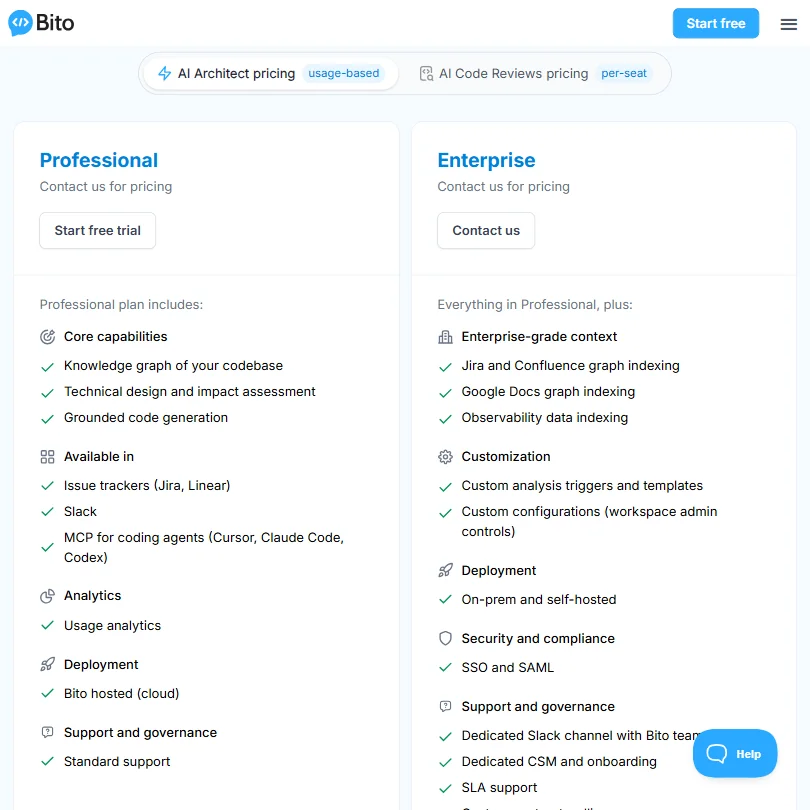
No public pricing. Not on the Professional plan. Not on Enterprise. Both require contacting Bito directly. There's a free trial for AI Architect and AI Code Reviews, no credit card needed. Fine as far as it goes.
The absence of any public price anchor is going to frustrate engineers trying to make a quick budget call. We have no baseline to compare against GitHub Copilot at $10 per user per month, or Tabnine's published tiers. Flying without instruments.
The refund policy also isn't publicly stated. Two pricing-related unknowns in one product is a pattern. It pushes all the friction into the sales process, which benefits Bito more than it benefits the buyer. We don't love it.
Bito vs GitHub Copilot: Which AI Coding Tool Is Better?
GitHub Copilot is the known quantity here. Transparent pricing, a massive user base, deep IDE integration, and steady improvement over time. It earns its default status for most teams.
Bito is making a different bet entirely. Copilot doesn't build a persistent, indexed model of your full system context the way Bito claims to. For large codebases carrying years of technical debt and tribal knowledge scattered across docs and issues, that difference could matter considerably.
For smaller teams or solo developers, Copilot's simplicity wins. Lower setup overhead, predictable pricing, excellent editor integration. Not a close call at that scale.
Engineering teams managing multiple repositories with complex dependencies are the audience where Bito's architecture-level context becomes the more compelling offer. Assuming, and this is still an assumption, the implementation actually delivers what the documentation describes. That's what the free trial is for.
Who Should Use Bito? (And Who Shouldn't)
Engineering teams managing large, multi-repo systems. That's the fit. The knowledge graph scales with complexity, and complexity is exactly where the generic tools start producing generic, unhelpful output.
Solo developers and small startups. Not the intended audience. Setup investment won't pay off fast enough, and pricing opacity makes it hard to justify the spend before you know the product works for your situation.
Teams running primarily GitLab or Bitbucket workflows are in a better position than the homepage once suggested. Documentation confirms code review support for both, so verify the specific depth you need, but the foundation is there.
If PR review is the core need and codebase context is secondary, CodeRabbit is worth evaluating alongside Bito. More established review trail, clearer pricing, purpose-built for that workflow.
Bito Review Verdict
Bito is doing something genuinely different from most tools in this category. The knowledge graph premise is sound. The integration surface is real and wider than it looks at first glance. Early user signals are positive enough that dismissing it would be lazy.
The concerns are equally real. No public pricing compounds friction over time. The free trial helps, but at some point a team needs a number to put in a budget. Bito doesn't give them one, and that's a choice they're making deliberately.
The knowledge graph differentiator is what makes this worth serious evaluation for the right team. That team has a complex codebase, tolerance for setup investment, and time to run a proper trial. Not everyone. But for those teams, this is one of the more interesting things we've looked at in this category this cycle.
Frequently Asked Questions
Does Bito work with GitLab and Bitbucket?
Yes, and this is better documented than the homepage once implied. Bito's documentation confirms AI code reviews for GitHub, GitLab, and Bitbucket, with connection handled through Bito Cloud. The changelog specifically notes simplified native setup for GitLab and Bitbucket. Teams should still verify the specific depth of commit indexing and PR review features for their workflow, but the integration is real and documented.
Is Bito's AI Architect the same as a code review tool?
Not exactly. The AI Architect is the knowledge graph layer underneath everything. The code review feature runs on top of it. Think of the Architect as the memory and context foundation, with code review being one feature that draws from it. Code generation and impact assessment draw from the same foundation. The Architect is the infrastructure. The reviews, generation, and assessments are what you actually interact with.
How does Bito compare to Tabnine for enterprise teams?
Tabnine's main pitch is privacy and security, including on-prem deployment and models that keep code off external servers. Bito also offers on-premise options at the Enterprise tier, so that's not a clean differentiator anymore. The real difference is focus. Tabnine is primarily a code completion and generation tool. Bito is more focused on architectural context and review workflows across repositories. Teams that care most about completion speed and strict data controls should look hard at Tabnine. Teams that care most about cross-repo context and PR-level review intelligence should lean toward Bito.