AI agents are going transactional, and big money is following
Stripe's reported $7 billion acquisition of OpenRouter, Amazon's new agent payment layer, and tripling enterprise agent deployment all point to the same shift: AI agents are no longer just answering questions, they are spending money.

Something changed quietly in 2026. AI agents stopped being glorified chatbots and started becoming economic actors. The evidence is arriving from several directions at once: a payments giant reportedly paying over $7 billion for an AI routing startup, Amazon shipping native payment capabilities for autonomous agents, and enterprise data showing the average organisation now runs 13 agents in production, up from five just fourteen months ago. These are not isolated datapoints. They are symptoms of the same structural shift.
The common thread is that agents are now taking actions with real-world consequences, including financial ones. As they do more, the infrastructure around them has to grow up fast. The companies positioning themselves at that infrastructure layer are attracting some of the largest cheques in recent tech history.
Stripe reportedly acquires OpenRouter for over $7 billion
The headline figure is Bloomberg's report that Stripe finalised a deal to acquire OpenRouter at a price exceeding $7 billion; Stripe itself has declined to comment. OpenRouter had raised a $113 million Series B in May 2026 at a $1.3 billion valuation, backed by Sequoia, Andreessen Horowitz, Menlo Ventures, and Alphabet's CapitalG. The startup, led by CEO Alex Atallah, built a single access point to more than 400 AI models, letting customers route tasks to different models based on cost and capability without locking into one provider. Atallah himself had described OpenRouter as "Stripe for AI." The irony of OpenRouter potentially being bought by Stripe is pointed. Stripe's entire business was built on abstracting away payment complexity so developers never had to think about it. Applying that same logic to AI model selection, at a moment when agents are making autonomous decisions across dozens of services, makes the strategic fit obvious. If completed, the deal would give Stripe a routing and abstraction layer rather than a model provider, which is exactly the kind of infrastructure a payments company understands.

Amazon Bedrock AgentCore adds native agent payment handling
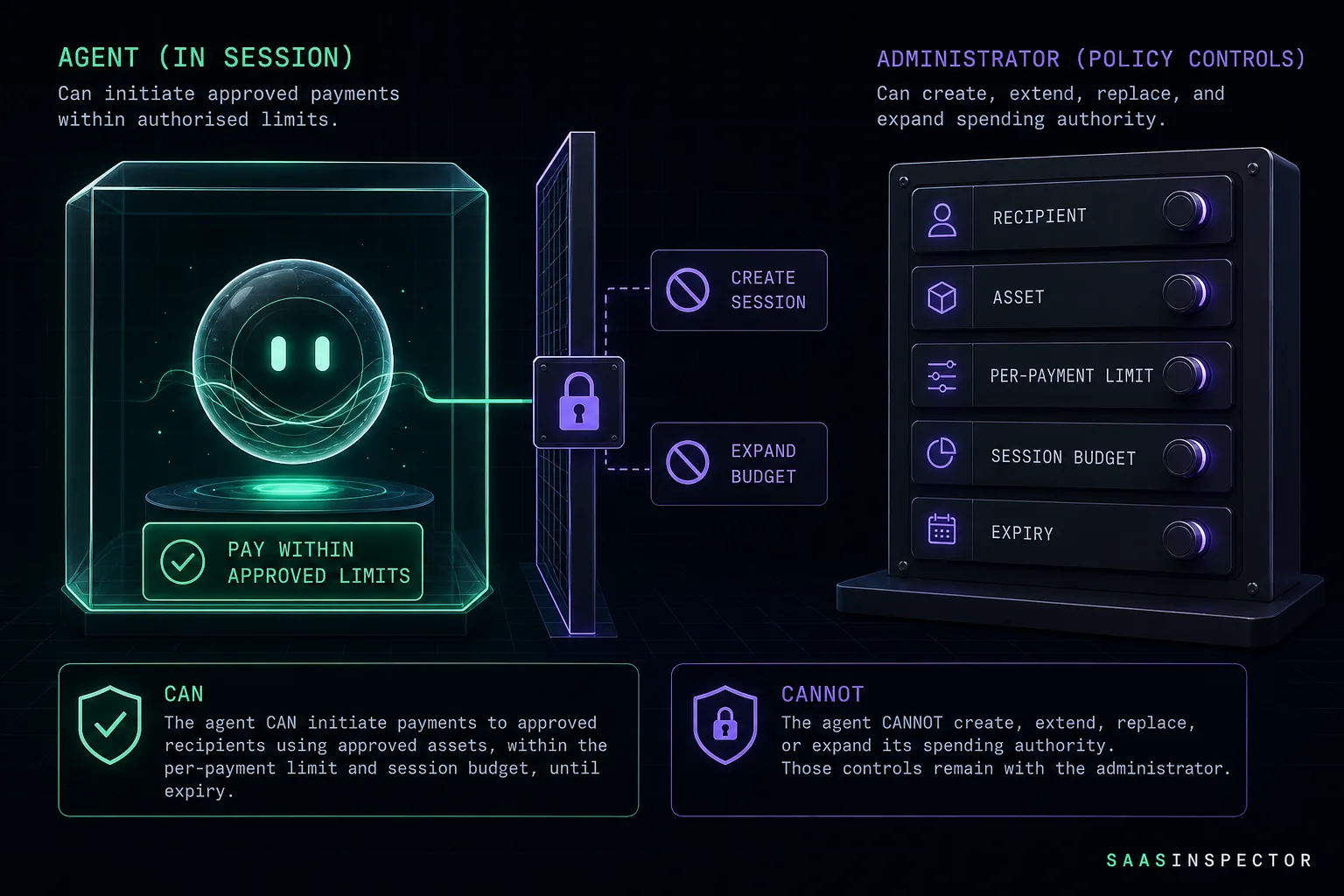
Separately, AWS published a technical walkthrough showing how developers can build agents using OpenClaw that settle HTTP 402 Payment Required responses autonomously via Amazon Bedrock AgentCore payments. The system supports both Coinbase wallets and Stripe Privy wallets, using stablecoin payments for small, sub-dollar transactions where card processing fees would otherwise make the economics unworkable. Crucially, the design keeps spending authority outside the model runtime entirely. A human administrator sets limits on recipients, assets, per-payment amounts, and session budgets in advance, and the agent operates within those bounds without requiring human approval at each step. This is meaningful architecture, not a demo. It addresses the real problem of prompt injection by assuming the model can be manipulated, then bounding what it can actually do with money regardless. The inclusion of Stripe's wallet product alongside Coinbase in the AgentCore payment layer looks different now that Stripe is reportedly buying OpenRouter. Stripe may be building toward owning both the routing layer and the payment rail for agentic workloads simultaneously.
Enterprise agent deployment tripled, with measurable ROI to show for it
The commercial urgency behind all of this becomes clearer when you look at Salesforce's 2026 Agentic Enterprise Index, which analysed five quarters of production data from 400 businesses using the Agentforce platform, alongside a survey of nearly 5,000 respondents. The average number of AI agents per organisation grew from 5 in February 2025 to 13 by April 2026. The time required to deploy a new agent dropped by 53 percent, from four days to under two. More telling still, the average number of unique actions per agent doubled from 2 to 4, and in retail the figure hit 9. Agents are not just running more often, they are doing more complex, cross-functional work each time they run. With 734 million agent work units consumed in April 2026 alone, and 15 percent month-over-month growth in the ratio of actions to output tokens, the volume of autonomous decisions being made on behalf of businesses is growing very quickly. Some of those decisions involve accessing paid APIs, content services, and compute resources. That is precisely the problem AgentCore payments and OpenRouter's routing layer are designed to solve.

What this means for teams evaluating AI agent platforms
If you are choosing an AI agent stack now, the transactional dimension matters more than it did six months ago. Payment-aware agents require infrastructure that handles credentials securely, enforces spending limits deterministically, and provides observability when things go wrong. AWS is building that into Bedrock AgentCore today. Salesforce is maturing it inside Agentforce. Stripe, if the OpenRouter deal closes, will control a large share of how agents select models and how they pay for services in a single combined layer. Vendor lock-in risk is real in this space, and it is worth noting that OpenRouter's original selling point was preventing exactly that. Buyers should ask potential vendors how spending limits are set and audited, which wallet and payment protocols are supported, and whether model routing decisions are observable and adjustable. The agents are getting autonomous. The money questions need human answers first.
- Stripe will reportedly acquire AI gateway startup OpenRouter for $7B+, TechCrunch AI ↗
- Stripe is reportedly acquiring AI startup OpenRouter for more than $7 billion, The Decoder ↗
- Business adoption of AI agents tripled this year - as measurable ROI emerges, ZDNET AI ↗
- Build OpenClaw agents that transact with Amazon Bedrock AgentCore payments, AWS Machine Learning ↗