The AI Cost Wars: Cheap Models Are Squeezing the Giants
Qwen3.8 Max, Kimi K3, and Meta's Muse Spark 1.2 are rewriting the price-performance equation — and the benchmarks reveal who's really winning.
Something uncomfortable is happening at the top of the AI market. Models from Alibaba, Moonshot AI, and Meta are now matching — and in some cases beating — frontier offerings from Anthropic and OpenAI on meaningful benchmarks, while costing a fraction of the price. That pressure isn't theoretical; it's showing up in real numbers across capability indices, coding leaderboards, and agent framework cost comparisons published this week.
The pattern is consistent: the gap between "good enough" and "best in class" is narrowing fast, and the cheapest option is rarely the worst performer. For anyone choosing AI tools right now, the calculus has genuinely shifted.
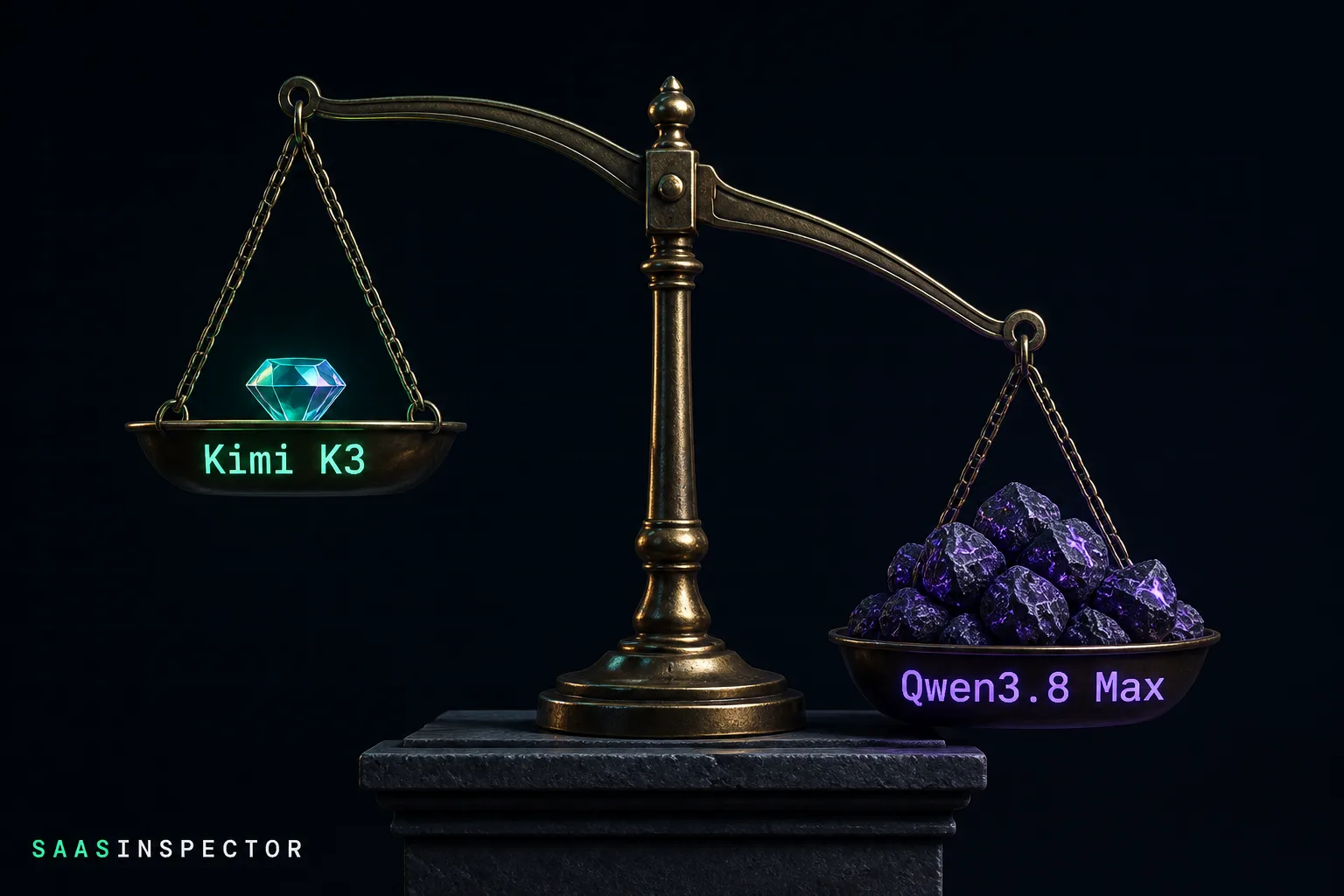
Kimi K3 outscores Qwen3.8 Max and undercuts it by 25%
Alibaba's Qwen3.8 Max made a striking leap on the Artificial Analysis Intelligence Index, jumping 10 points over its predecessor to score 56 — drawing level with Claude Opus 4.8. But Moonshot AI's Kimi K3 scores 57 on the same index and costs 25% less per task: $0.86 versus $1.14. That cost gap exists partly because Qwen3.8 Max now requires 64 reasoning steps per task compared to 14 previously, and its input token usage grew 15-fold as the model resends the full conversation history at each step. Alibaba did cut its headline token prices — input dropped from $2.50 to $2.00 per million, output from $7.50 to $6.00 — but those savings are swamped by the higher compute demands. The result is that Qwen3.8 Max costs more than double its predecessor per completed task, while a cheaper rival still beats it on the headline score.
Qwen3.8 Max's hallucination rate jumped from 23% to 40%
Raw benchmark scores only tell part of the story. Qwen3.8 Max shows regressions on two important measures compared to Qwen3.7 Max: AA-LCR, which tests long-context retrieval, fell 2 points, while AA-Omniscience, which measures whether a model correctly admits when it doesn't know something, fell 10 points. The hallucination rate climbed from 23% to 40% — the model now guesses far more frequently rather than acknowledging uncertainty. On the work-task benchmark GDPval-AA, Qwen3.8 Max does rank second overall with an Elo of 1,739, behind only Claude Opus 5 at 1,852, which is a genuine achievement. But buyers paying a premium over Kimi K3 need to weigh that against a model that is simultaneously less honest about what it doesn't know.
Meta's Muse Spark 1.2 competes on price, not benchmark dominance
Meta released Muse Spark 1.2 alongside Muse Code, its terminal-based coding agent, this week. The model is a coding-focused upgrade to Muse Spark 1.1, trained heavily on long-running programming tasks such as generating full repositories. Standard pricing holds at $1.25 per million input tokens and $4.25 per million output — competitive but not shocking. The more aggressive move is a new tier at just $0.20 per million output tokens, funded by users sharing their data for model training. The benchmarks Meta published show Spark 1.2 improving clearly over Spark 1.1 but not consistently closing the gap on Claude Opus 5 or GPT-5.6 Terra. Notably, Kimi K3 appears in Meta's methodology documents but was omitted from the published benchmark tables — an absence worth scrutinising, given K3 trails Claude Opus 5 by only a slim margin on Terminal-Bench 2.1 and sits well ahead of Spark 1.2.

The agent framework you choose costs as much as the model you pick
A Composio study published this week adds another layer: even when you've chosen your model, the framework wrapping it dramatically changes what you pay. Testing DeepSeek V4 Flash across Claude Code, Codex, OpenCode, and Oh My Pi on 30 real-world tasks, the researchers found nearly a 3x cost difference between the cheapest and most expensive frameworks. OpenCode cost $0.073 per successful task; Claude Code cost $0.195 — despite Claude Code being the fastest at 122 seconds per task and using fewer tool calls. Oh My Pi had the highest success rate at 17 out of 30 tasks but was the slowest at 272 seconds. Success rates were otherwise close across frameworks, meaning the real competitive variable for most use cases is cost and latency, not accuracy. For teams running agents at scale, framework choice is now a budget decision as significant as model selection itself.
- Qwen3.8 Max catches Claude Opus 4.8 but Kimi K3 still scores higher for 25 percent less, The Decoder ↗
- The company that made open weights mainstream now competes on discounts, The Decoder ↗
- Claude Code is the fastest agent framework but costs nearly three times more than the cheapest rival, The Decoder ↗